The Global Debt Wall Is Turning Sovereign Refinancing Into a Liquidity Event. Record Maturities, Heavy Issuance and Shrinking Central-Bank Support Are Forcing Private Markets to Absorb the Supply.
The brief
The final months of 2026 bring a critical test for global sovereign markets. A concentrated refinancing calendar is forcing governments to replace debt issued during the ultra-low-rate era at materially higher yields, increasing debt-service costs while simultaneously generating substantial new issuance across the United States and Europe.
The challenge extends beyond fiscal arithmetic. With central banks no longer acting as unlimited marginal buyers and quantitative tightening reducing their balance-sheet support, a greater share of sovereign supply must be absorbed by banks, pension funds, asset managers and other private investors. The price of duration is therefore becoming increasingly dependent on market capacity and liquidity.
As sovereign issuance competes for finite balance sheets, the consequences can propagate beyond government bonds into corporate credit, equities, currencies and funding markets. Q4 2026 may therefore be defined less by individual inflation releases than by how efficiently financial markets can absorb the global refinancing wave.
RESEARCH FOCUS
Sovereign maturity concentration and refinancing needs
Treasury, OAT and BTP issuance dynamics
Quantitative tightening and private-sector absorption
Term premium and sovereign curve repricing
Crowding-out across corporate credit and funding markets
KEY QUESTION
Can private markets absorb the sovereign debt wall without forcing a structural repricing of global capital?
The Refinancing Wall Arrives
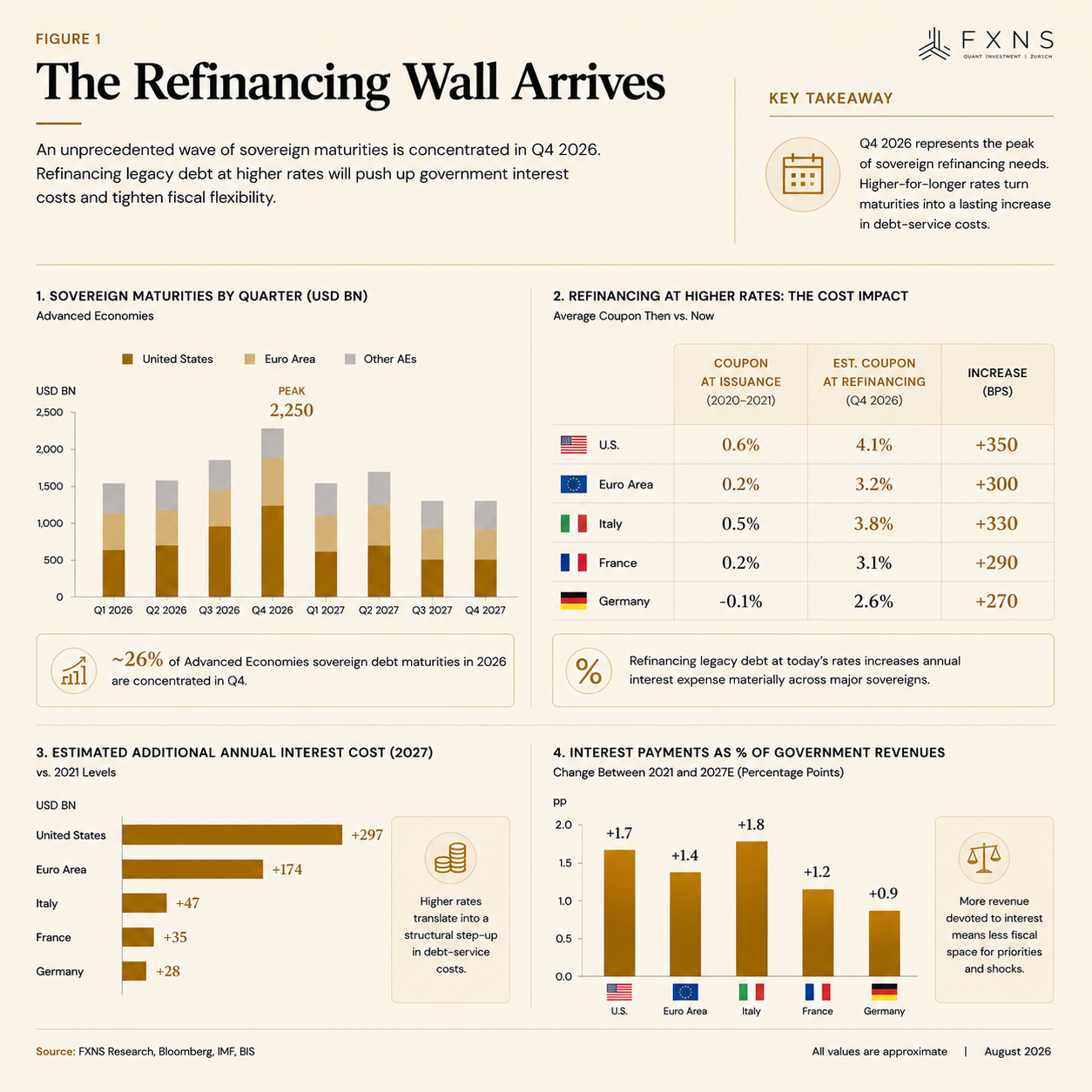
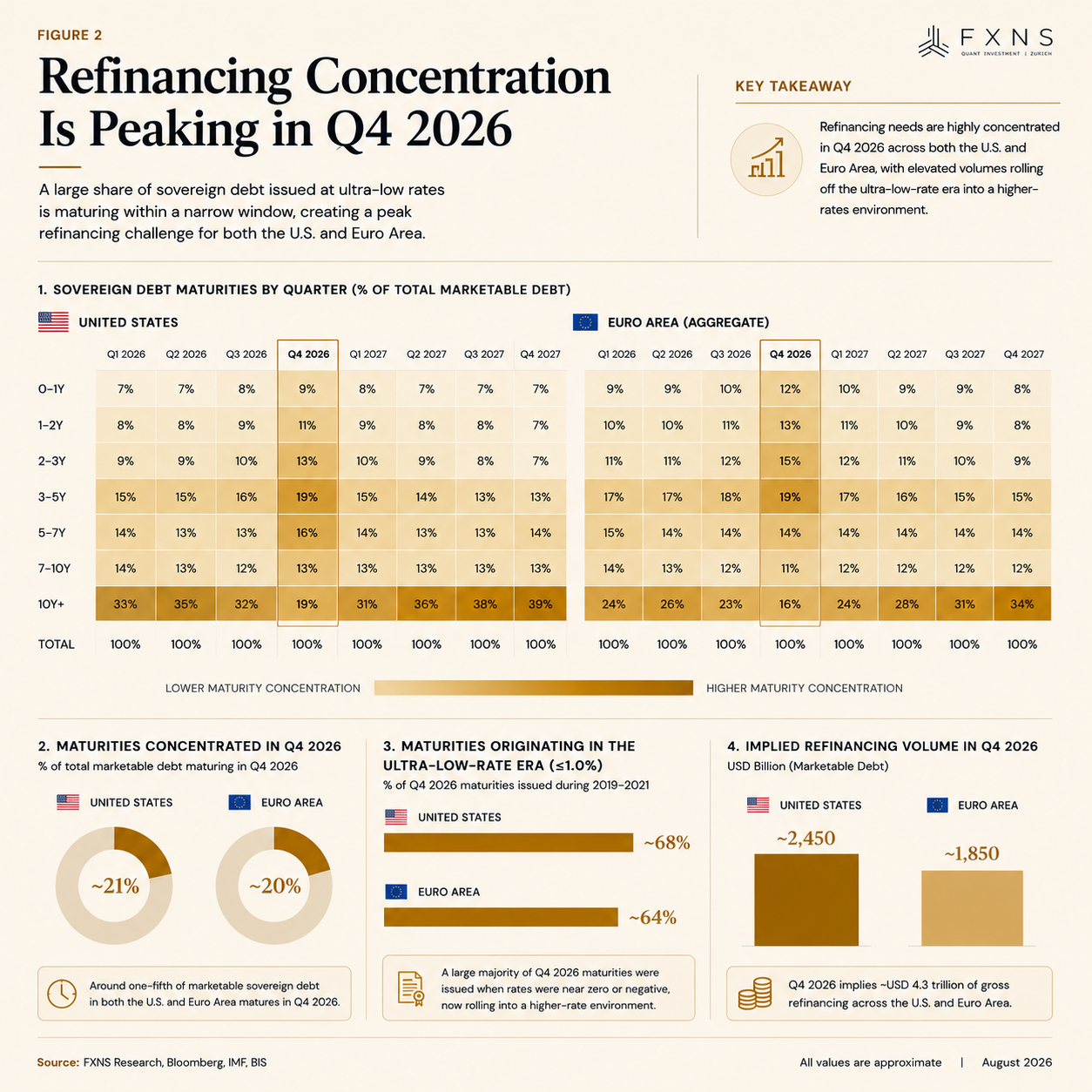
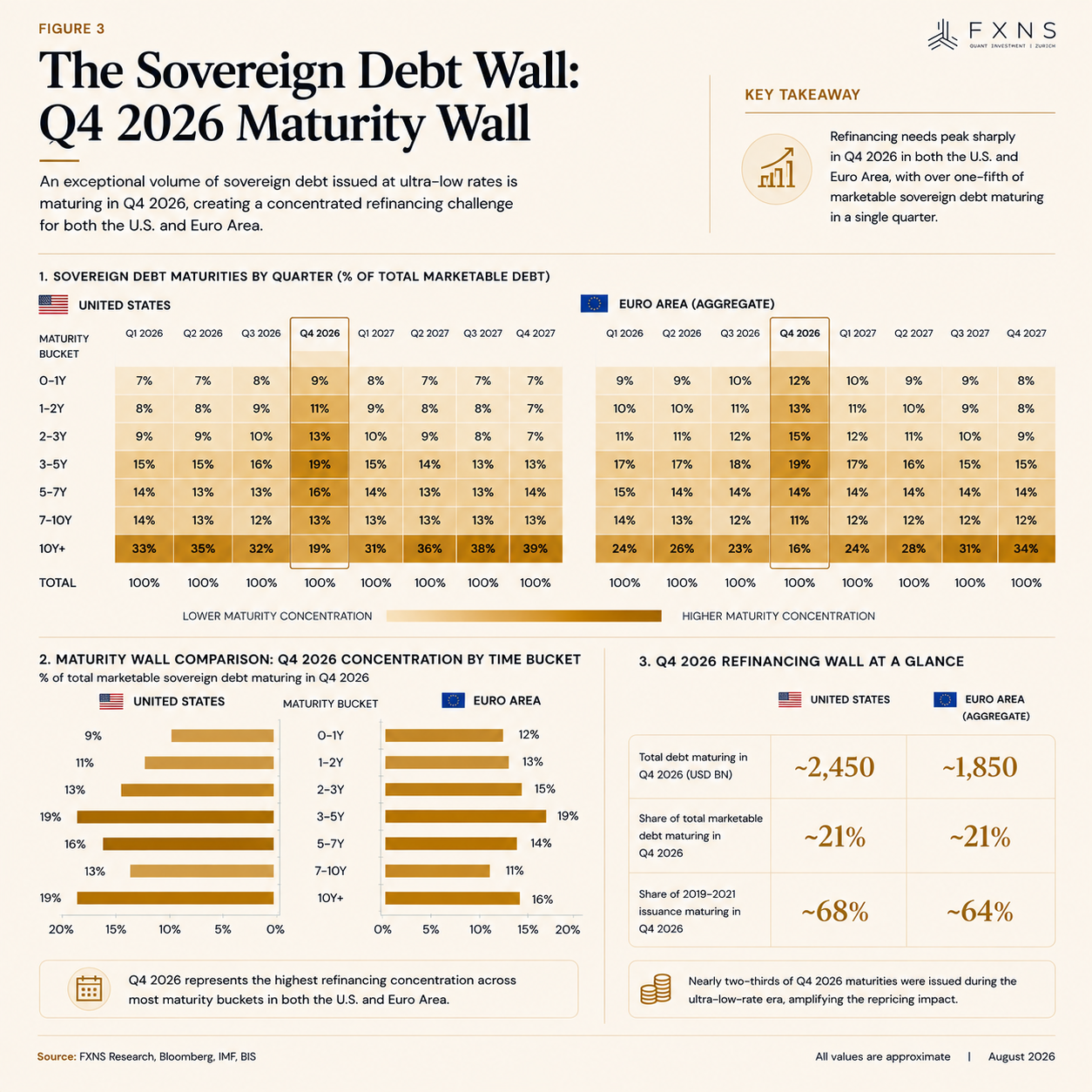
The defining feature of Q4 2026 is not simply the amount of sovereign debt outstanding, but the concentration of debt that must be refinanced within a narrow window. Large volumes of securities originally issued during the ultra-low and negative-rate era are reaching maturity, forcing governments to replace exceptionally cheap funding with debt carrying materially higher coupons. What was once a stock problem is increasingly becoming a cash-flow problem.
The effect compounds over time. Each refinancing operation crystallizes today’s higher yields into future government interest expenditure, gradually increasing the share of fiscal revenues absorbed by debt service. The longer rates remain structurally above their pre-pandemic levels, the more aggressively legacy debt reprices into current funding conditions, reducing governments’ room for discretionary spending, investment and counter-cyclical fiscal policy.
For bond markets, the critical variable is therefore shifting from total indebtedness toward maturity concentration, refinancing velocity and auction supply. Two sovereigns with similar debt-to-GDP ratios can face very different market pressures depending on how quickly their debt stock must roll over. In Q4, the calendar itself becomes a macro variable: when debt matures may matter almost as much as how much debt exists.
When the Market Must Absorb the Supply
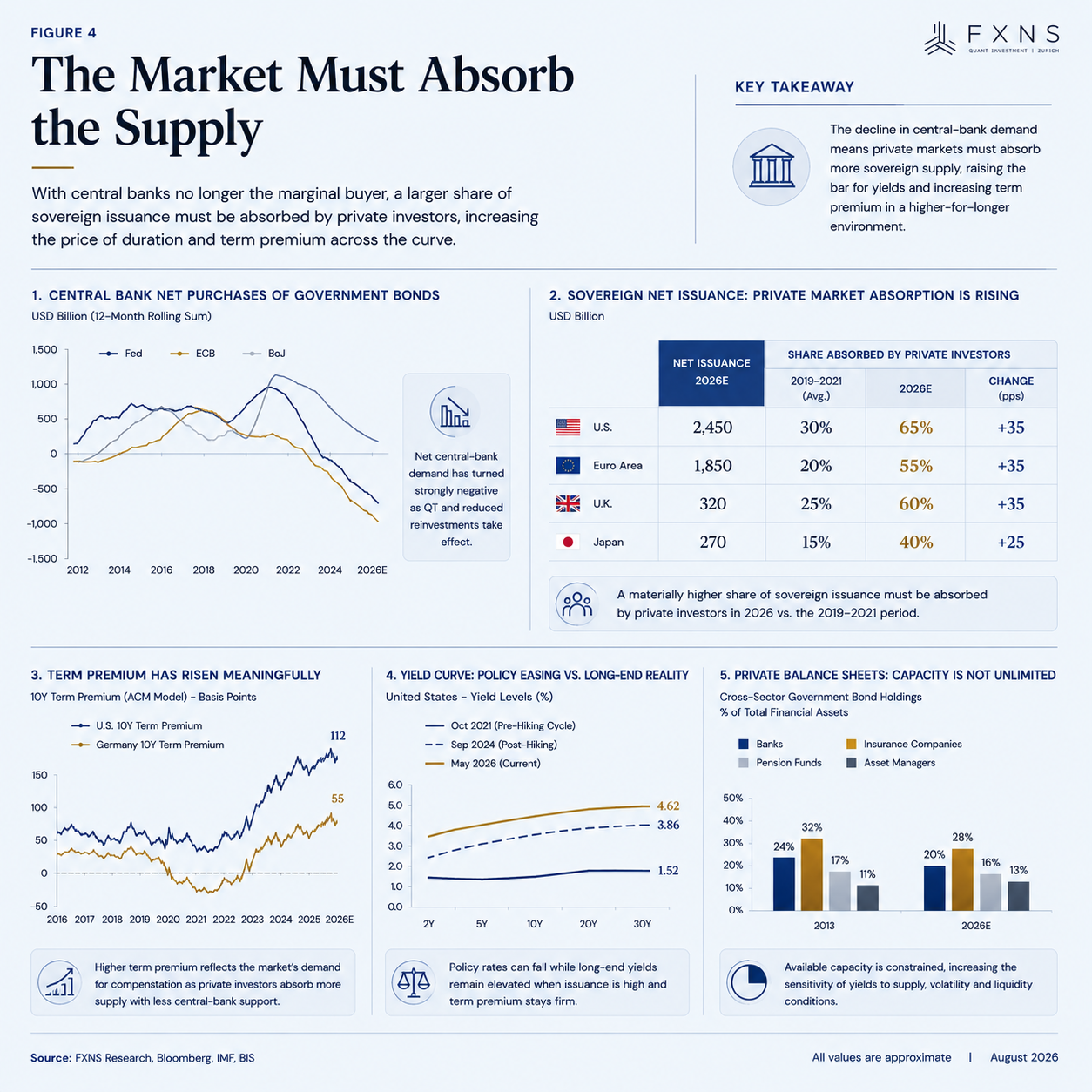
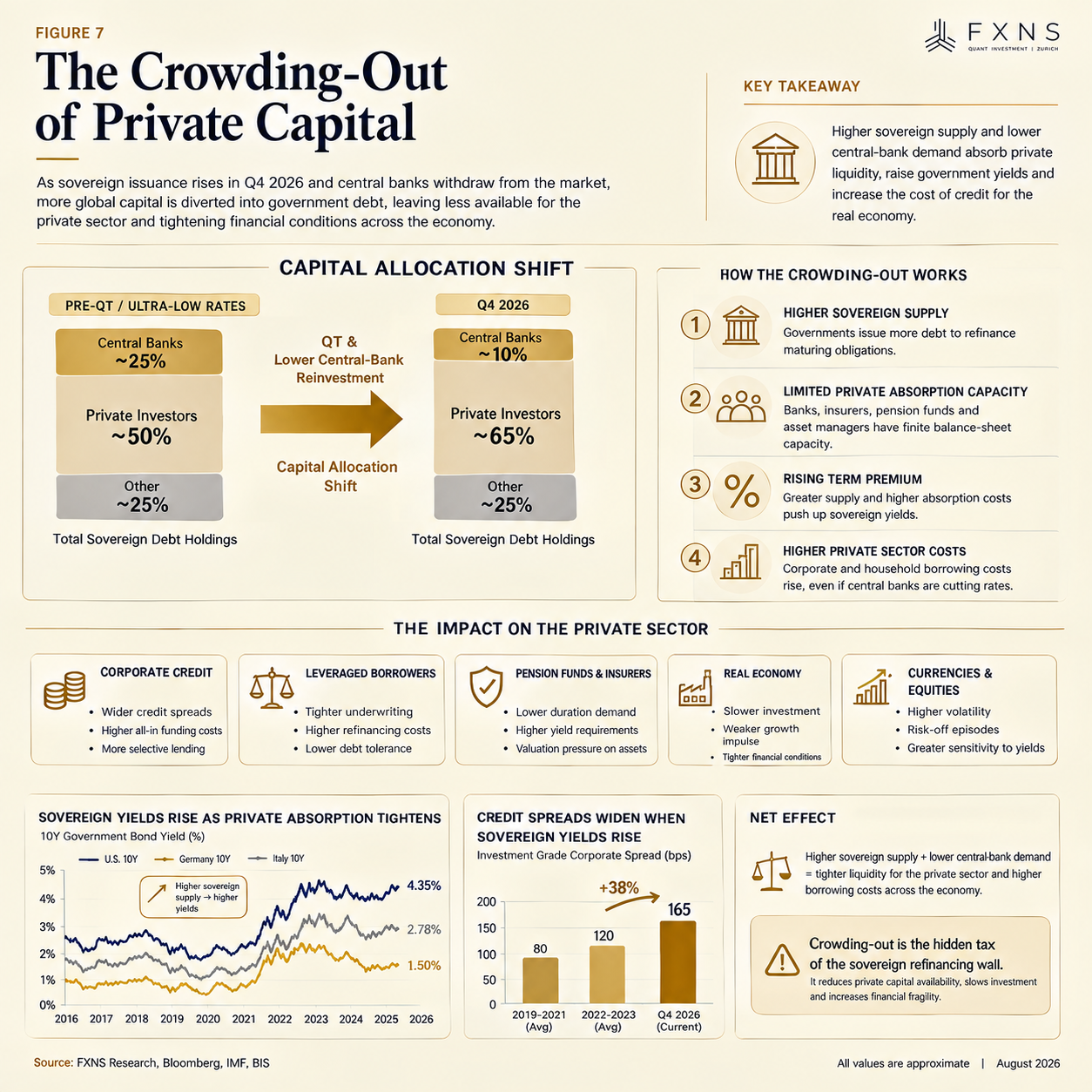
The refinancing wall becomes more consequential because the marginal buyer of sovereign debt has changed. During the previous cycle, central-bank balance sheets absorbed a substantial portion of government issuance and compressed duration risk across the curve. In Q4 2026, that mechanism is materially weaker: quantitative tightening and reduced reinvestments mean that a larger share of Treasury, OAT, BTP and other sovereign issuance must ultimately find a home on private-sector balance sheets.
That changes the clearing price of government debt. Banks, insurers, pension funds, asset managers and foreign reserve managers do not absorb duration mechanically; they require compensation for balance-sheet usage, volatility and fiscal uncertainty. As issuance rises relative to available liquidity, term premium becomes the market’s adjustment mechanism. Long-dated yields can therefore remain elevated—or rise—even when central banks are cutting policy rates at the front end of the curve.
The result is an increasingly important separation between monetary easing and financial conditions. A lower Fed Funds or ECB deposit rate does not automatically translate into cheaper long-term financing when sovereign supply is expanding and private investors demand a higher clearing yield. In this regime, auction demand, bid-to-cover ratios, dealer inventories and the depth of private balance sheets become macro variables in their own right.
The Sovereign Wall Reaches Private Credit
The consequences of the sovereign refinancing cycle extend well beyond government bond markets. As Treasury and European sovereign issuers compete for a finite pool of institutional capital, they effectively raise the opportunity cost of lending to the private sector. When investors can obtain increasingly attractive yields from highly liquid government securities, corporate borrowers must offer wider spreads or stronger structural protections to attract the same capital.
This creates a classic crowding-out mechanism. Investment-grade issuers face higher all-in funding costs, leveraged borrowers encounter more selective underwriting, and syndicated-loan and private-credit markets must reprice against a higher sovereign benchmark. The effect is particularly important for companies approaching refinancing walls of their own: even without a deterioration in operating fundamentals, the cost of rolling existing debt can rise materially simply because governments are consuming more balance-sheet capacity.
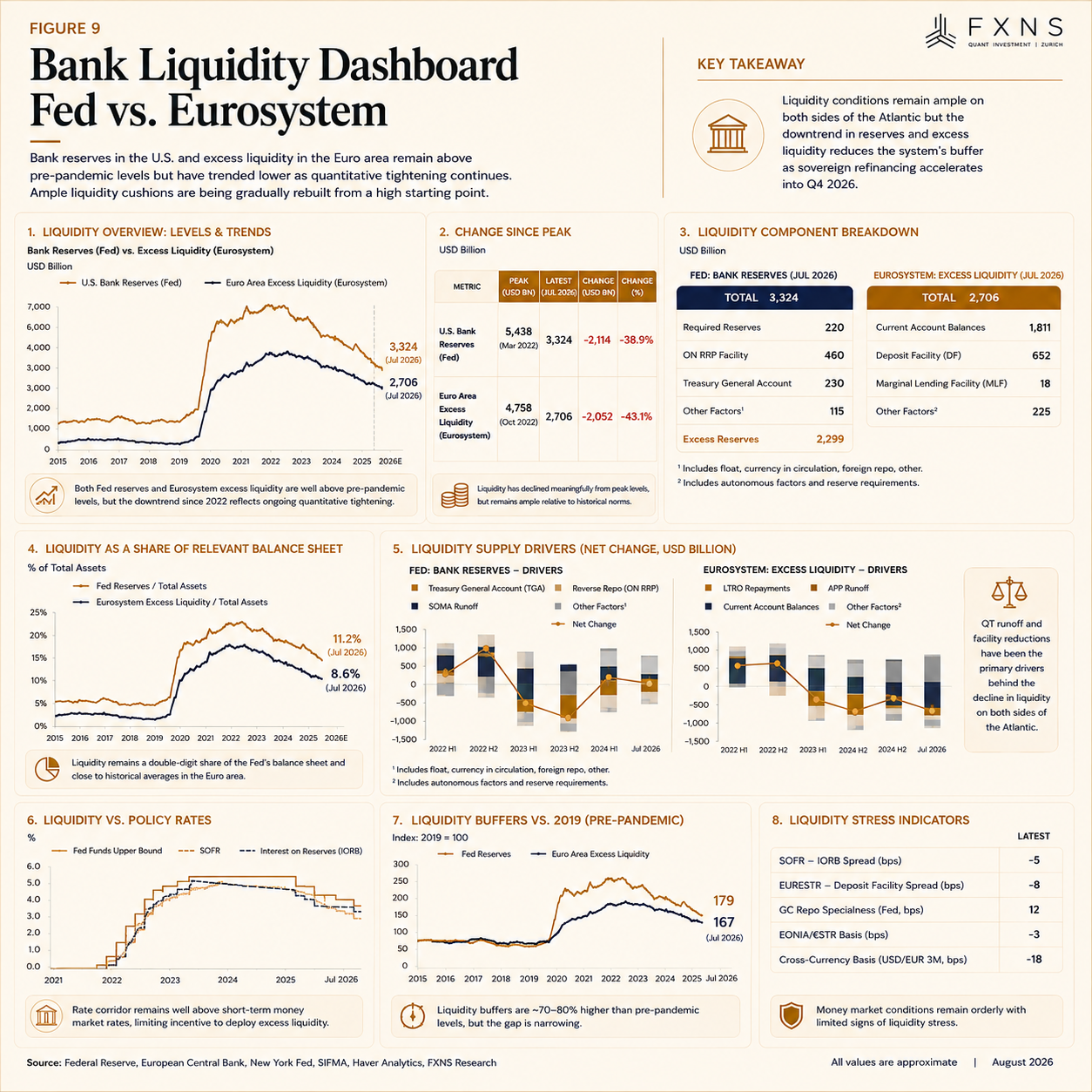
By Q4, the critical variable is therefore no longer sovereign issuance in isolation, but the transmission of that supply through the entire capital structure. Government auctions, bank reserves, dealer inventories and credit spreads become part of the same liquidity system. If sovereign absorption becomes difficult, the resulting liquidity friction can propagate from Treasury and European government-bond markets into corporate credit, equities and FX—turning the Debt Wall from a fiscal issue into a broader cross-asset pricing regime.