Legacy semiconductors are becoming one of the least understood strategic assets in the global industrial economy. What appears to be an obsolete component market is increasingly functioning as a hidden layer of supply-chain resilience, where availability—not technological performance—determines economic value.
THE FRAMEWORK
The research examines how mature semiconductor inventories evolve after manufacturing capacity migrates toward more advanced process technologies. Instead of focusing on technological innovation, the analysis concentrates on the economics of declining production, secondary-market liquidity, inventory concentration and industrial replacement risk.
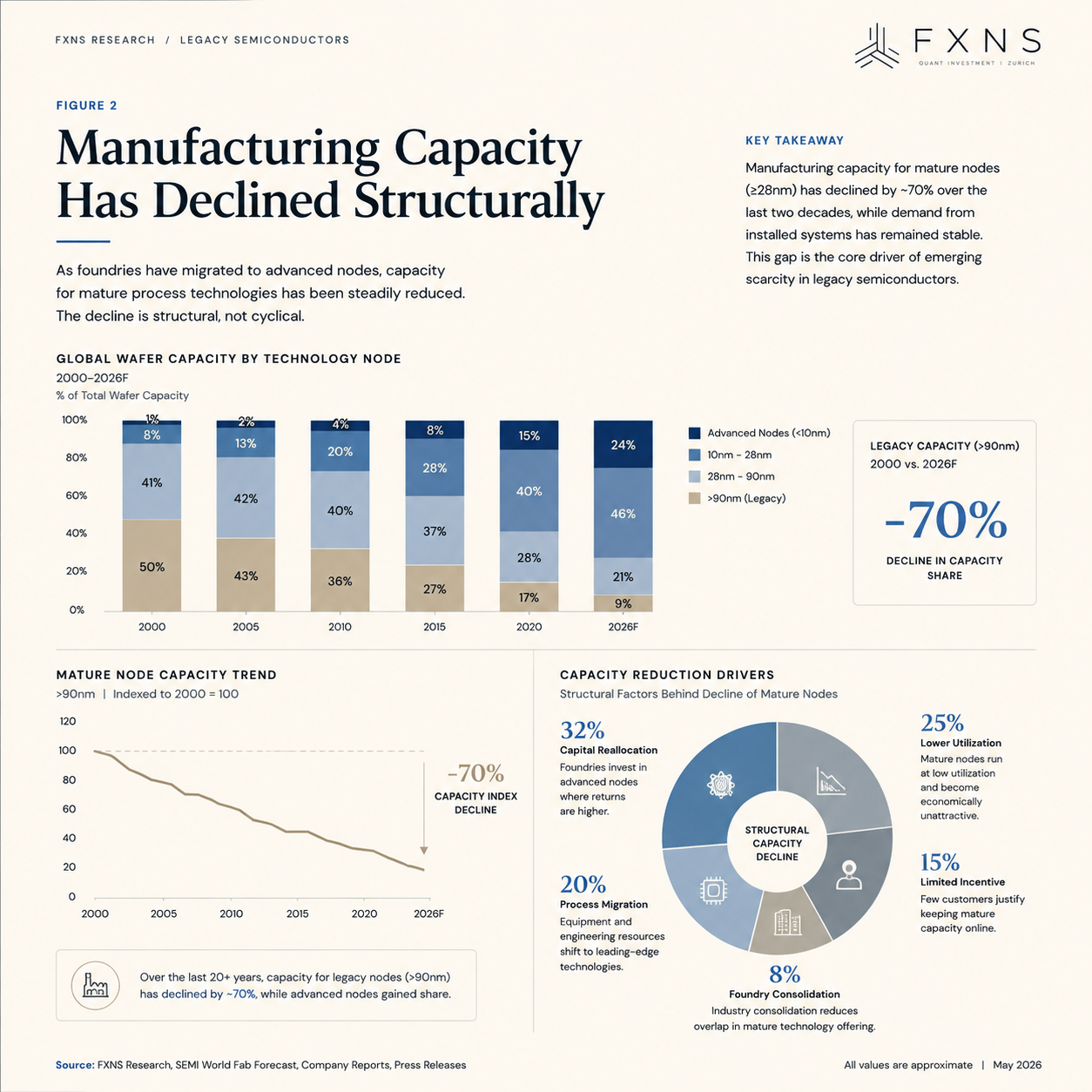
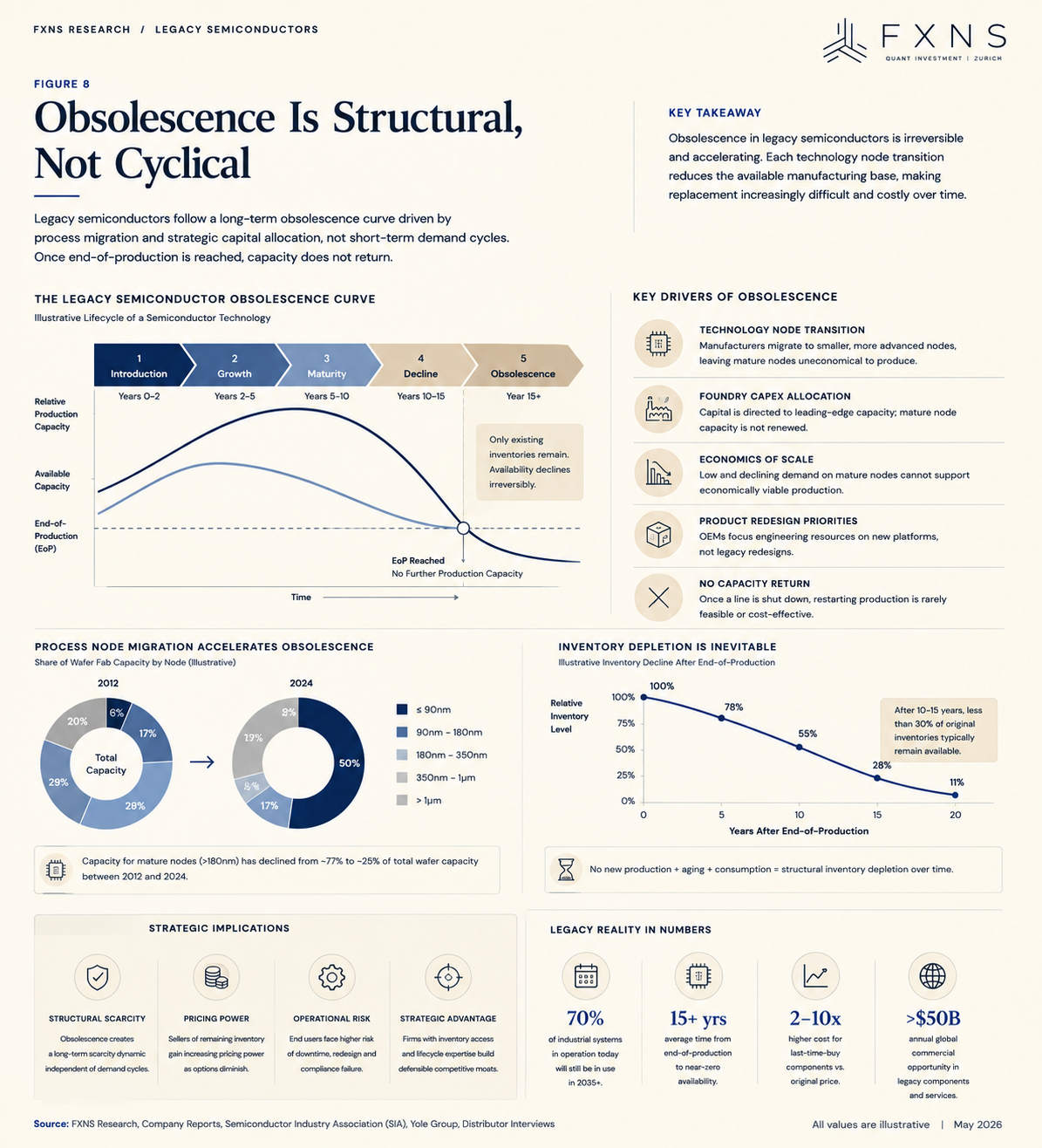
Rather than disappearing, legacy integrated circuits often become structurally scarce as foundries discontinue mature nodes while millions of industrial systems continue depending on the same architectures. This disconnect creates markets where availability progressively outweighs production cost as the dominant pricing mechanism.
The framework combines semiconductor production data, distributor inventories, industrial maintenance cycles, secondary-market transactions and product life-cycle analysis to distinguish temporary shortages from structural scarcity.
INVESTMENT RELEVANCE
Understanding where inventories become strategic assets provides a different perspective on industrial supply chains. Scarcity is increasingly created by manufacturing exits rather than demand growth, generating opportunities across specialised distributors, inventory holders, industrial maintenance providers and companies controlling irreplaceable component ecosystems.
Instead of treating obsolete semiconductors as depreciating inventories, the research evaluates when they begin behaving like financial optionality embedded within the physical supply chain.
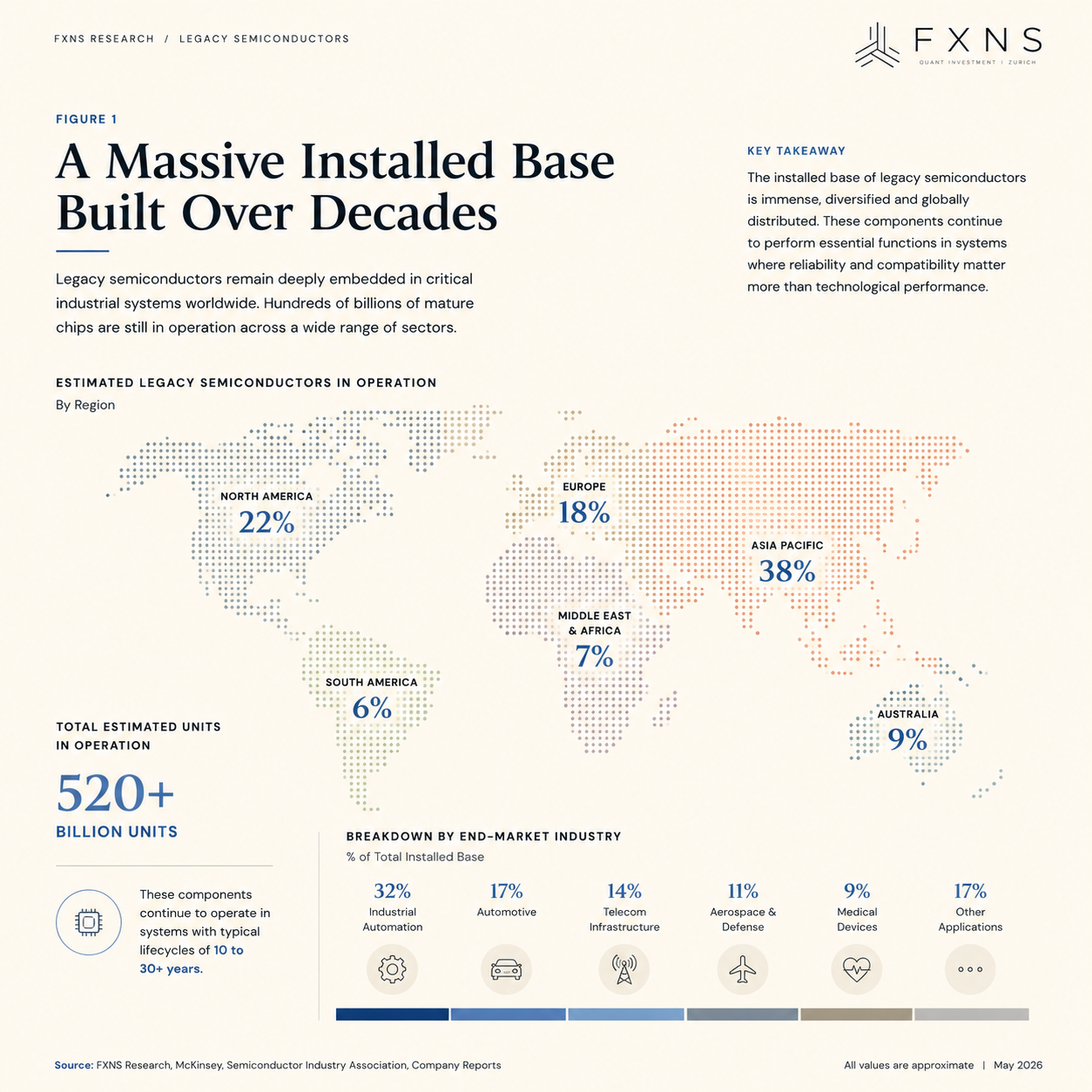
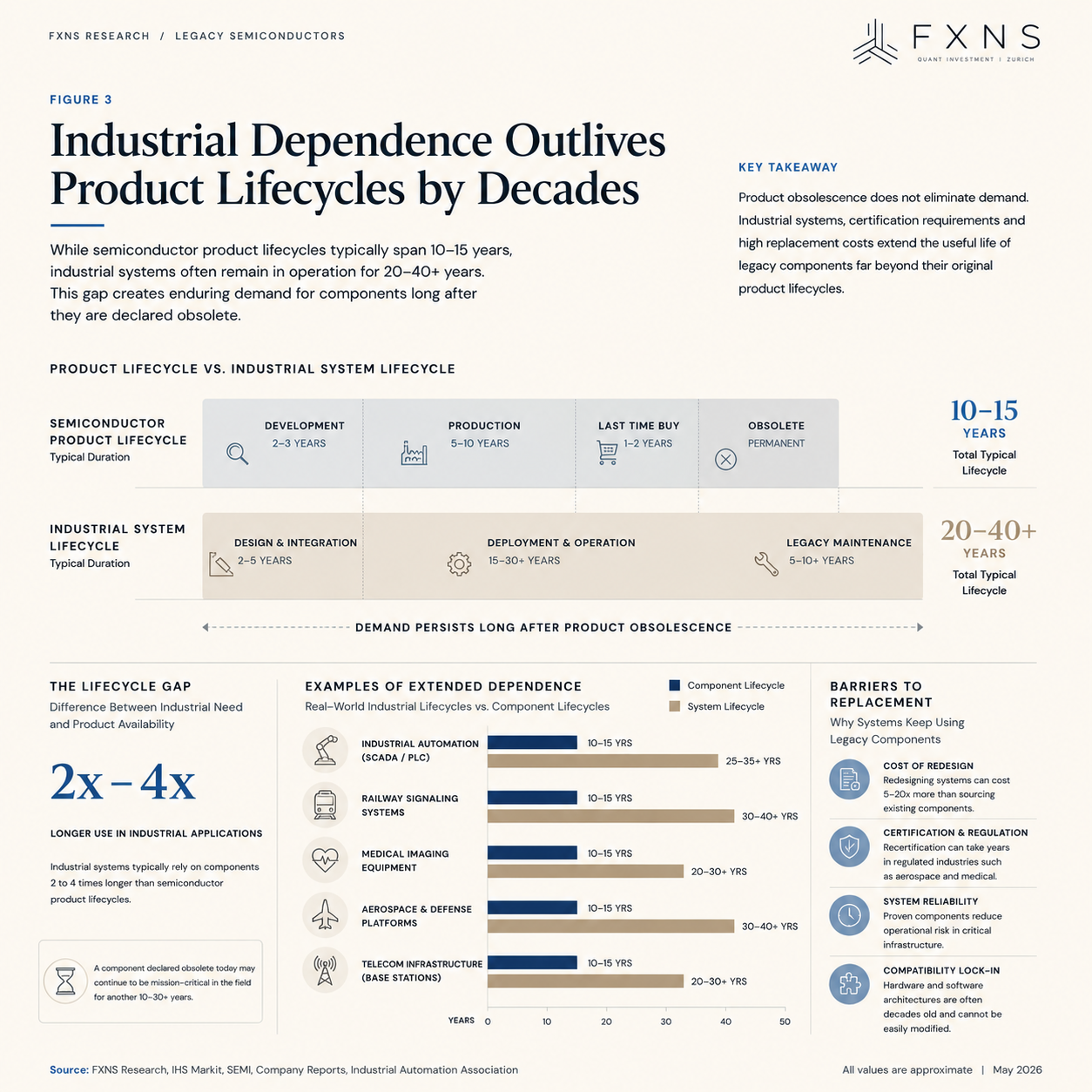
Legacy semiconductors represent one of the largest overlooked segments of the global electronics industry. Although they no longer attract significant research investment or media attention, mature integrated circuits remain deeply embedded across industrial automation, automotive systems, aerospace, medical devices, telecommunications infrastructure and defence applications. Millions of products currently operating around the world continue to depend on architectures developed decades ago, often because redesigning an entire electronic platform is technically complex, economically unjustifiable or subject to lengthy certification processes.
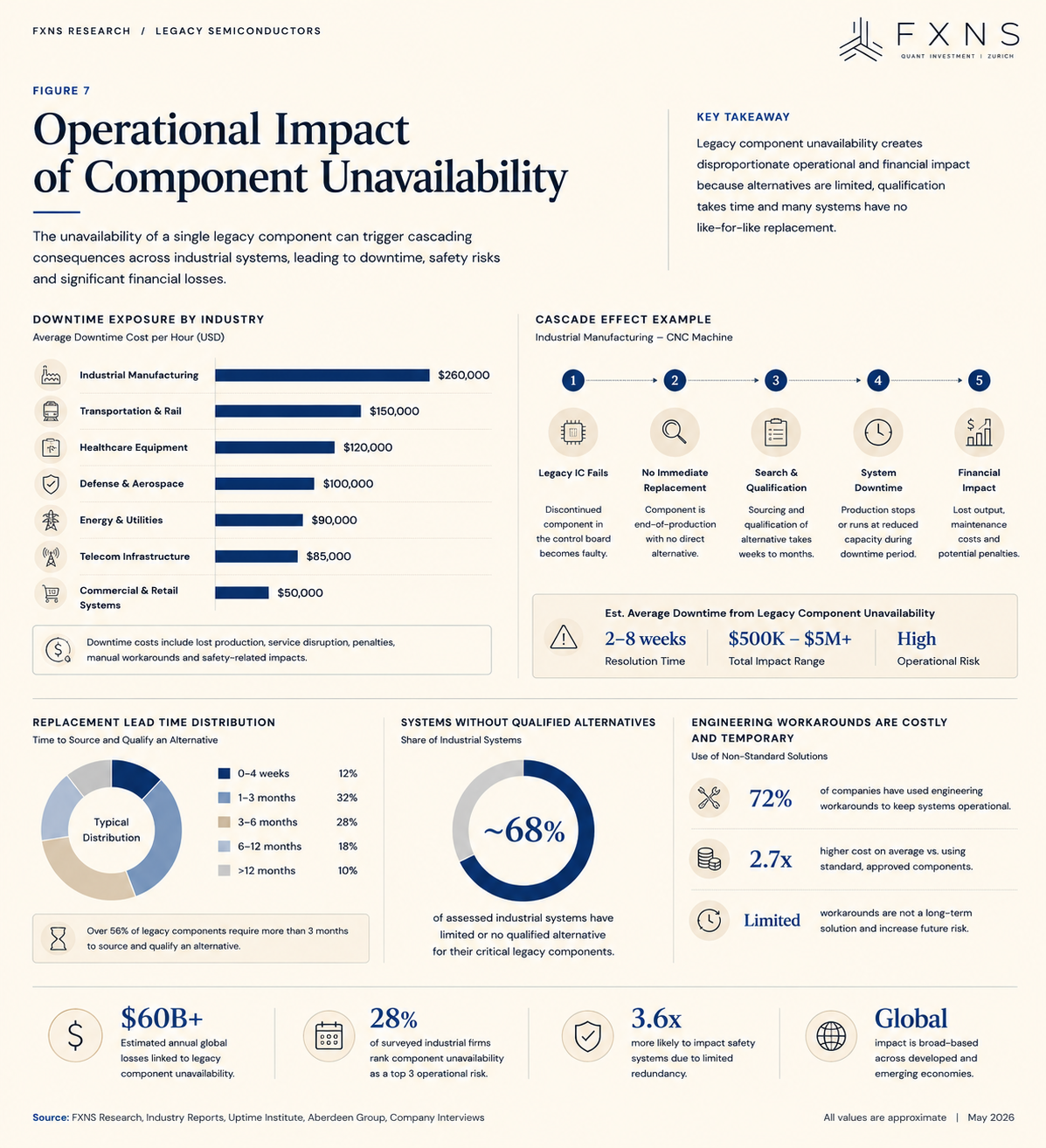
Unlike leading-edge semiconductors, the value of these components is not determined by computational performance but by compatibility, long-term reliability and guaranteed availability. Once a manufacturing process is discontinued, replacing an individual component frequently requires redesigning complete hardware platforms, rewriting firmware, repeating regulatory approvals and validating entire production systems. For many industrial operators, securing continued access to identical components therefore becomes substantially less expensive than redesigning equipment already deployed in the field.
This structural asymmetry creates an unusual market dynamic. Demand often remains remarkably stable while manufacturing capacity steadily contracts as foundries allocate capital toward more advanced process technologies. The resulting imbalance is gradual rather than cyclical, producing persistent reductions in available supply that accumulate over many years instead of emerging during temporary market disruptions.
The objective of this research is to distinguish cyclical semiconductor shortages from structural component scarcity. Rather than analysing innovation cycles, the framework focuses on manufacturing exits, inventory concentration, secondary-market liquidity and industrial replacement economics. Understanding these mechanisms helps identify when apparently obsolete inventories evolve into strategic industrial assets whose economic value increasingly reflects scarcity rather than production cost.
THE SECONDARY MARKET
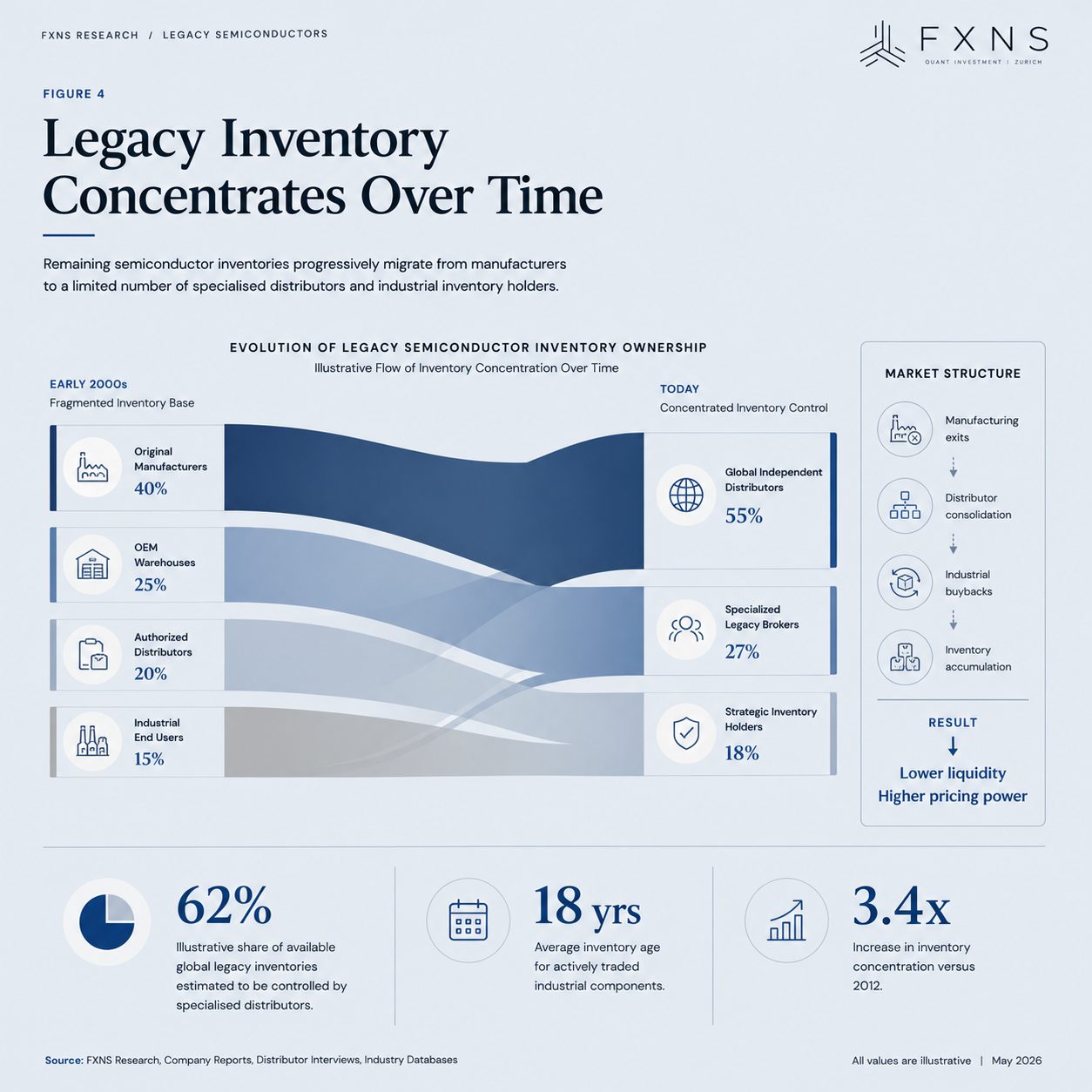
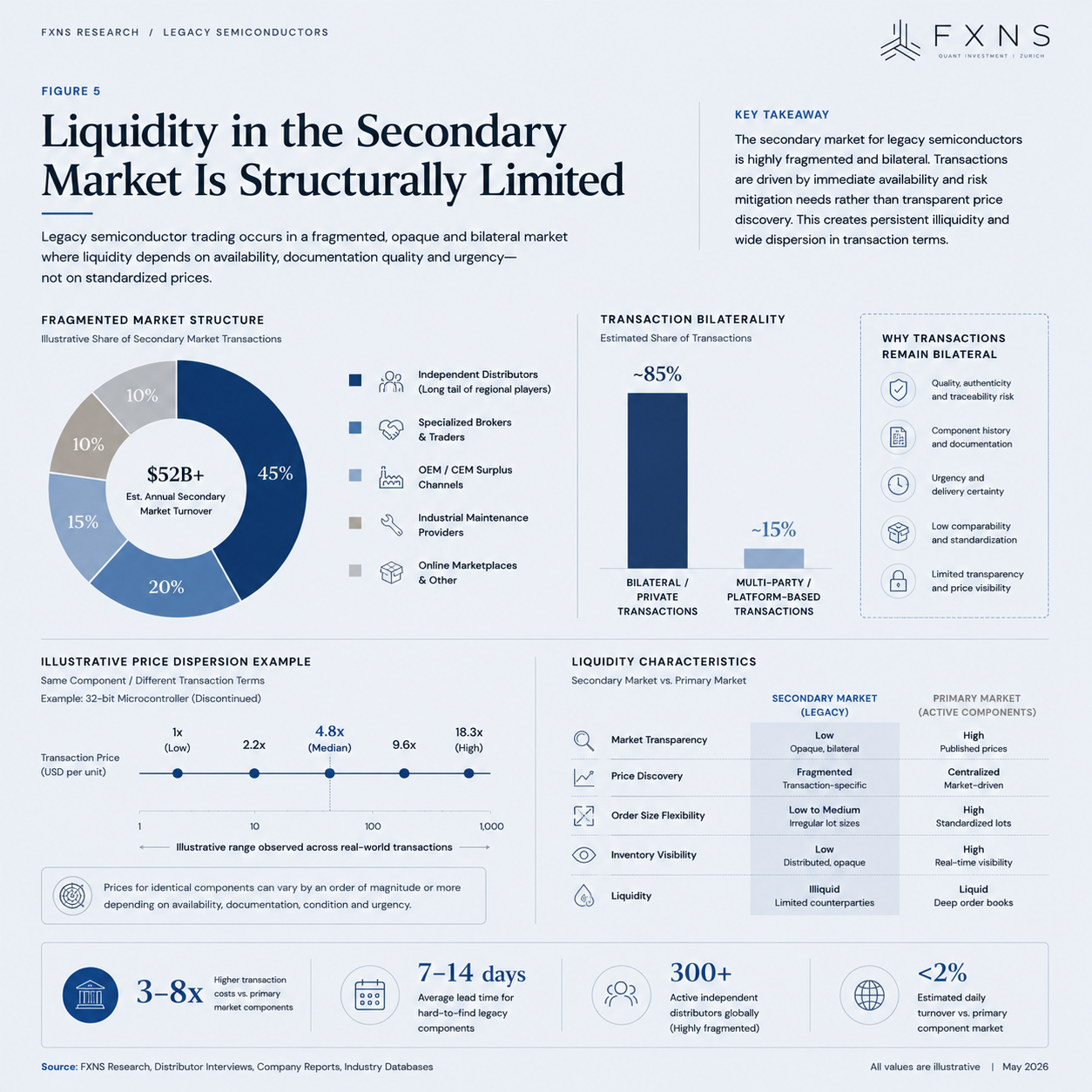
Once production ends, the economics of legacy semiconductors begin to diverge from traditional manufacturing logic. Supply is no longer determined by factory output but by inventories accumulated over decades across distributors, industrial service providers, maintenance operators and private component brokers. As available stock progressively concentrates in fewer hands, market liquidity declines while price discovery becomes increasingly fragmented and transaction-specific.
Unlike commodity markets, legacy semiconductor trading rarely takes place through transparent exchanges. Pricing depends on immediate availability, documentation quality, traceability, storage conditions and the urgency of the end user rather than on standardized quotations. Components that appear technically identical can trade at materially different prices depending on provenance, certification history and delivery certainty.
For this reason, the secondary market increasingly resembles an illiquid asset market rather than a conventional electronic components supply chain. Inventory holders effectively control optionality over future industrial maintenance, while buyers compete for certainty of supply instead of production cost advantages.
INVESTMENT RELEVANCE
The emergence of increasingly concentrated secondary inventories creates structural pricing power for specialised distributors and inventory owners. Understanding inventory concentration, liquidity deterioration and replacement risk provides a framework for identifying businesses whose competitive advantage originates from component availability rather than manufacturing scale.
THE INVESTMENT THESIS
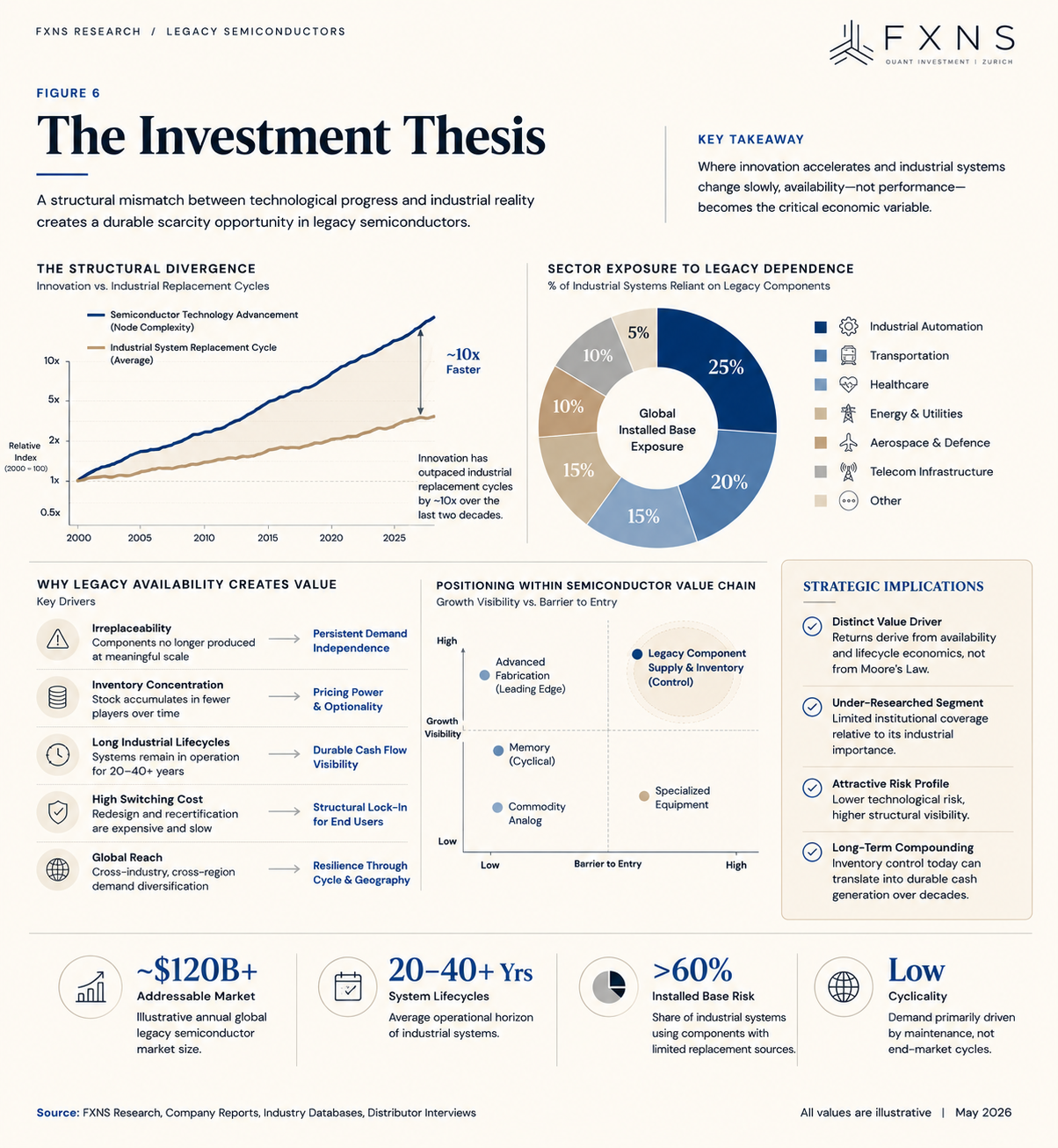
The economic value of legacy semiconductors ultimately depends on a structural mismatch between technological innovation and industrial replacement cycles. While the semiconductor industry continues allocating capital toward increasingly advanced process technologies, a substantial portion of the global industrial base remains dependent on mature architectures that can no longer be manufactured at meaningful scale. This divergence transforms availability into a scarce economic resource whose value is largely independent of technological performance.
Unlike conventional semiconductor investing—which typically focuses on leading-edge fabrication capacity, artificial intelligence demand or cyclical memory pricing—this research framework examines the less visible infrastructure supporting industrial continuity. Companies controlling specialised inventories, proprietary sourcing networks and long-term component traceability may increasingly capture pricing power as replacement risk compounds across manufacturing, transportation, healthcare, defence and critical infrastructure.
Rather than viewing legacy semiconductors as obsolete technology, the framework treats them as strategic industrial assets embedded within global maintenance ecosystems. The objective is not to forecast technological disruption, but to identify where persistent supply constraints create durable competitive advantages that conventional market analysis continues to underestimate.
STRATEGIC IMPLICATIONS
Structural scarcity within mature semiconductor ecosystems creates opportunities beyond traditional chip manufacturing. Businesses positioned around inventory ownership, specialised distribution, lifecycle support and industrial maintenance may represent a distinct segment of the semiconductor value chain where long-term pricing power derives from irreplaceability rather than innovation.