

In markets, liquidity is often treated as residual capital—the portion of a portfolio waiting to be deployed once a sufficiently attractive opportunity appears. That interpretation misses its strategic value. Cash is not simply an asset with a yield; it is a claim on future opportunity. It allows investors to respond when valuations dislocate, correlations break down or forced sellers create prices that would not exist under normal conditions. The value of that flexibility is rarely visible during stable markets, when remaining fully invested appears efficient and the opportunity cost of liquidity dominates the discussion.
Preserving the capacity to allocate capital
But optionality becomes most valuable precisely when markets stop behaving normally. Volatility changes the distribution of possible outcomes, and with it the economic value of being able to act without first having to sell another asset. An investor holding liquidity does not need to predict the next shock with precision. The advantage lies elsewhere: in preserving the capacity to allocate capital after uncertainty has created better information, wider dispersion and more asymmetric entry points.
This changes the way cash should be understood inside a portfolio. Rather than representing indecision, it can represent deliberate patience—a temporary allocation whose return cannot be measured by its yield alone. Part of its value comes from what it enables: the ability to purchase risk when others are reducing it, to exploit temporary mispricing and to convert volatility from a source of portfolio stress into a potential source of opportunity. In that sense, liquidity carries an embedded option whose value rises when uncertainty rises with it.
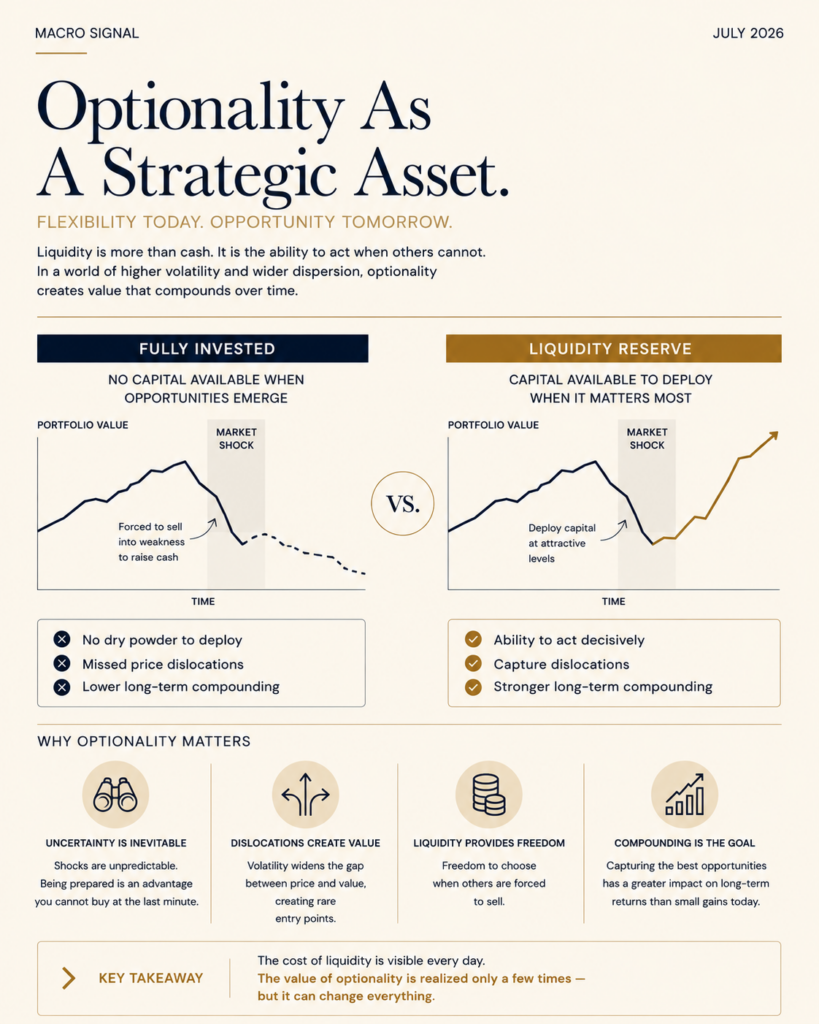
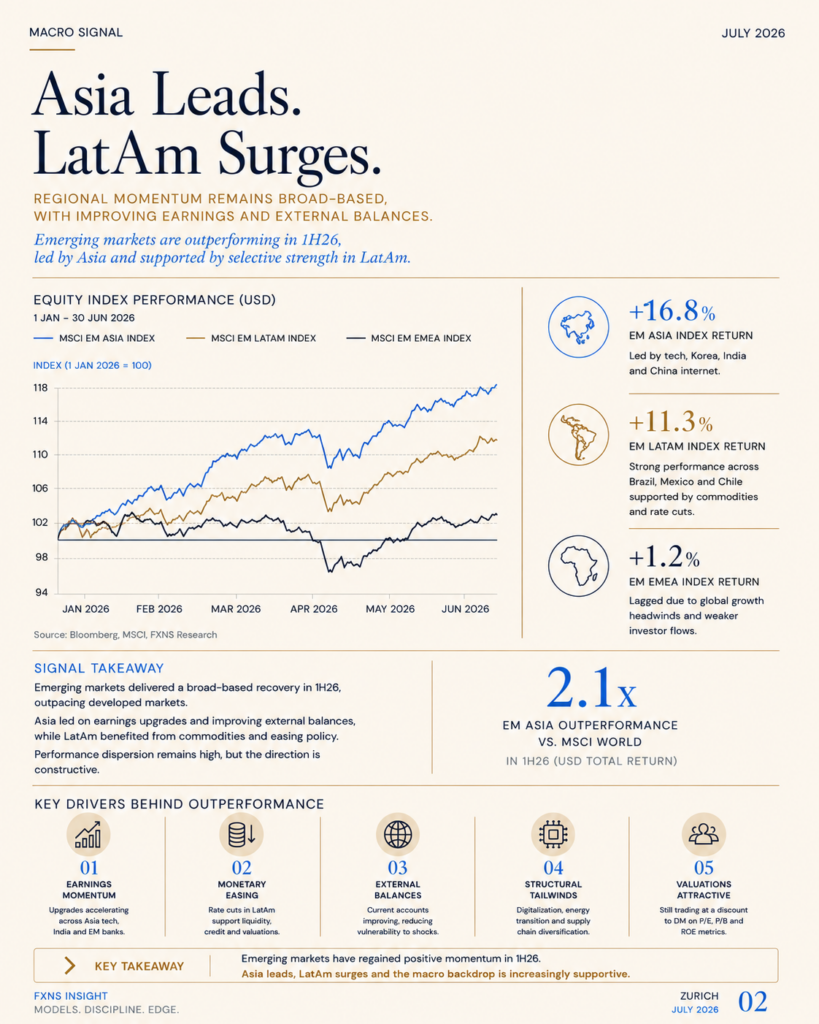
The economic value of optionality is not constant. It changes with the market environment. During periods of compressed volatility, abundant liquidity and narrow risk premia, the benefit of holding undeployed capital can appear limited. Asset prices move within relatively stable ranges, financing remains available and investors can rebalance portfolios without paying a significant liquidity premium. In these conditions, cash is easily perceived as a drag on performance because the opportunities it protects against have not yet emerged.
That relationship changes when volatility expands. Market stress rarely affects every participant symmetrically: leverage, margin requirements, redemptions and risk limits can force some investors to reduce exposure regardless of fundamental value. Prices can therefore move faster than underlying economic information would justify. The resulting dislocations create a temporary gap between market price and intrinsic value, and that gap is where optionality begins to acquire measurable economic importance.
When Volatility Creates Opportunity
Liquidity allows an investor to enter that gap without first dismantling existing positions. This distinction matters. Selling assets during a stressed market to finance a new opportunity can destroy part of the advantage the opportunity itself provides. Transaction costs rise, bid–ask spreads widen and correlations often converge precisely when diversification is supposed to provide funding flexibility. Capital that was deliberately kept available avoids this constraint and preserves freedom of action when the market is least willing to provide it.
The objective, therefore, is not to maximize cash holdings or to wait indefinitely for a crisis. It is to recognize that portfolio flexibility has a nonlinear payoff. Its apparent cost is highest when markets are calm, while its potential value increases sharply when liquidity becomes scarce and dispersion expands. The investor is effectively accepting a visible opportunity cost today in exchange for the ability to act decisively under conditions in which capital itself becomes more valuable.
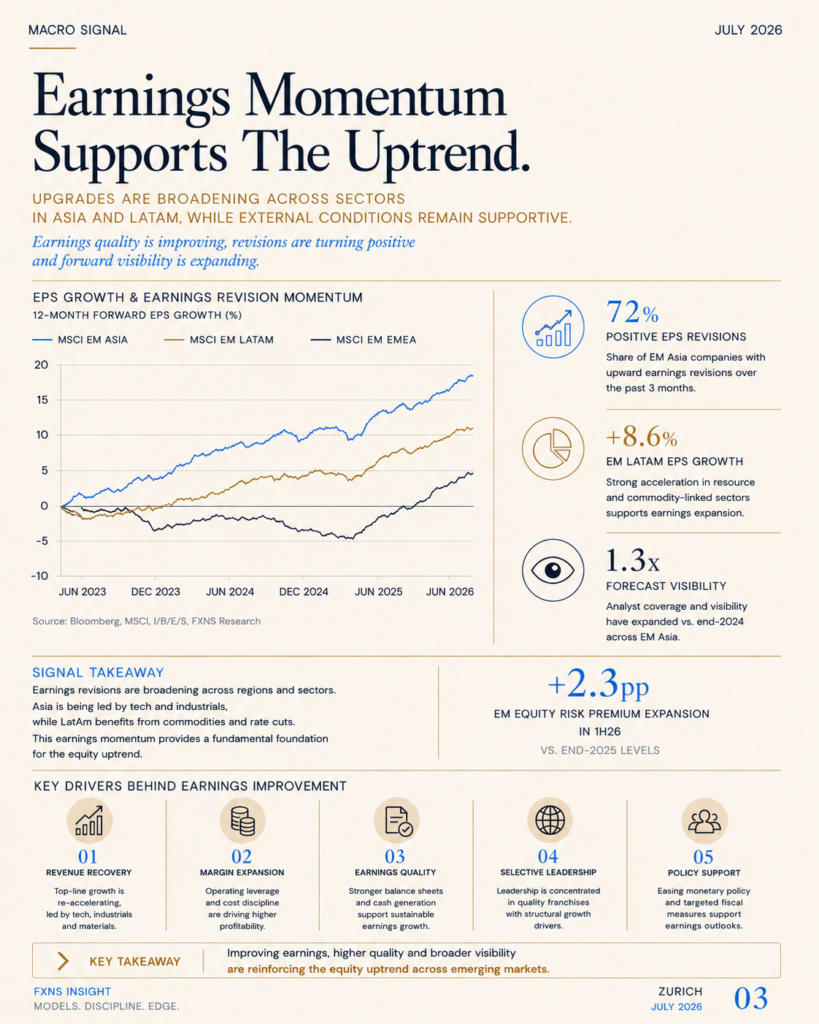
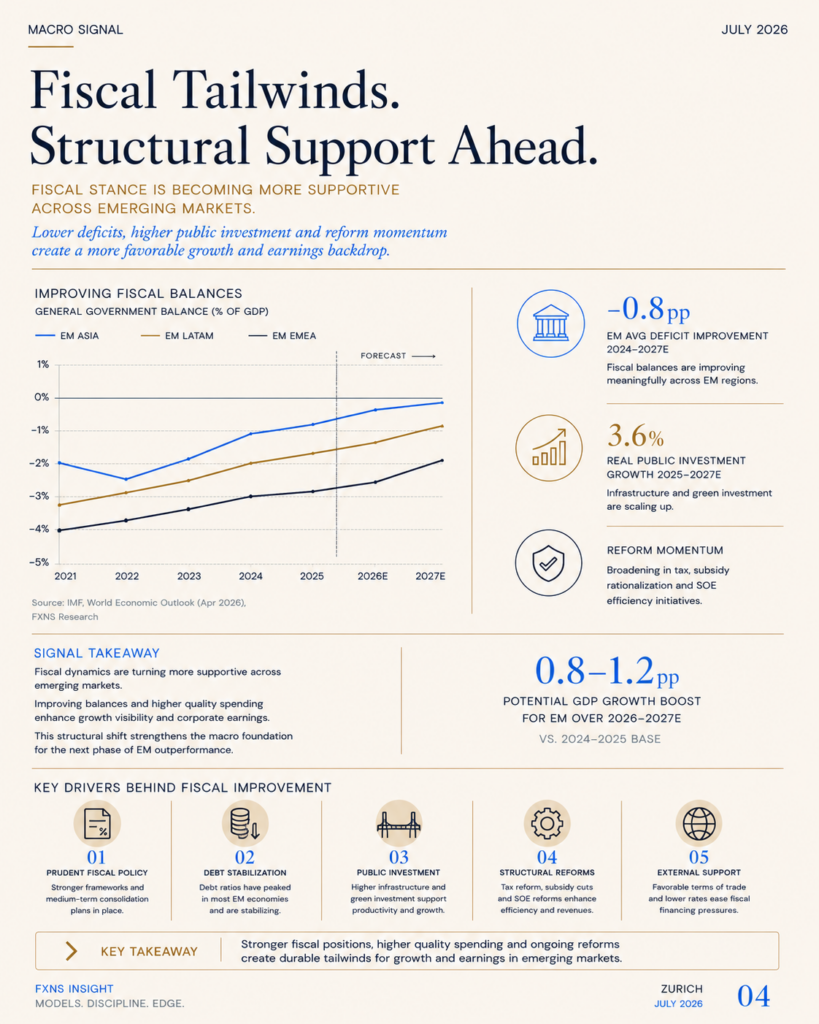
The Cost of Being Fully Invested
A portfolio can appear most efficient precisely when it has the least room to respond. In conventional allocation frameworks, idle capital is frequently evaluated against the return it could have earned if invested immediately. The comparison is mathematically intuitive, but incomplete: it measures the visible carry sacrificed by holding liquidity while ignoring the potential cost of having no deployable capital when expected returns suddenly improve. A fully invested portfolio maximizes exposure to today’s opportunity set, but it also commits the investor to today’s prices.
That constraint becomes particularly important during abrupt repricing events. When an attractive opportunity emerges, a fully invested investor must create liquidity before exploiting it. That means deciding which existing position to sell, absorbing transaction costs and potentially realizing losses at exactly the moment when market liquidity is deteriorating. In severe dislocations, the problem becomes more acute because correlations tend to rise and assets that were expected to provide diversification can decline simultaneously. The investor may recognize an exceptional entry point while lacking the balance-sheet flexibility required to act on it.
There is therefore an important distinction between capital efficiency and capital availability. Maximizing the percentage of a portfolio invested at all times may improve returns when markets rise continuously, but it can reduce the investor’s ability to reallocate when the opportunity set changes. A liquidity reserve introduces an intentional inefficiency into the portfolio: some capital earns less today so that it remains unconstrained tomorrow. The relevant question is not whether cash underperforms risk assets during favorable markets—it usually will—but whether the flexibility it preserves can generate sufficient value across an entire investment cycle to compensate for that foregone return.
Higher short-term yields have made this trade-off particularly interesting. When liquidity itself produces meaningful nominal income, the cost of waiting declines. Investors are no longer necessarily choosing between a productive risky asset and capital earning effectively nothing; they can maintain optionality while receiving compensation for postponing deployment. That changes the hurdle rate for committing incremental capital and makes patience economically easier to sustain.
The deeper implication is that being fully invested is itself an active portfolio decision, not a neutral default. It expresses confidence not only in existing holdings, but also in the assumption that retaining flexibility for future opportunities has less value than maximizing current exposure. In environments characterized by greater dispersion, episodic volatility and rapidly changing risk premia, that assumption deserves to be tested rather than accepted automatically.
Liquidity is not the absence of conviction. It is the capital reserved for the moment when conviction becomes actionable.
FXNS RESEARCH
Optionality as a Portfolio Asset
The final implication is that liquidity should not be evaluated only through the return it produces while it remains uninvested. Its economic value is also determined by the set of decisions it preserves. A portfolio with available capital retains the ability to respond to new information without first unwinding an existing position, to increase exposure when expected returns improve and to exploit temporary dislocations created by investors operating under different constraints. In this sense, liquidity behaves less like an inactive allocation and more like an option whose underlying asset is the future opportunity set itself.
That option becomes particularly valuable because investment opportunities are not distributed evenly through time. Markets can spend long periods offering relatively compressed risk premia before repricing abruptly. During those episodes, expected returns can change far faster than strategic asset allocations. Credit spreads widen, equity valuations reset, volatility rises and assets that appeared expensive only weeks earlier can suddenly offer materially different forward returns. The ability to deploy capital into those transitions can therefore matter disproportionately to long-term performance, even if such opportunities occur relatively infrequently.
This introduces an asymmetry that conventional performance measurement can struggle to capture. The cost of liquidity is continuous and visible: every period in which risk assets outperform makes undeployed capital appear inefficient. Its benefit, by contrast, is episodic. It may remain economically dormant for months before becoming valuable during a short window of market stress. Judging liquidity exclusively during benign conditions therefore risks measuring the insurance premium while ignoring the eventual payoff. The relevant horizon is not the next quarter, but the complete investment cycle.
Portfolio construction consequently becomes a question of balancing two competing forms of efficiency. Exposure efficiency seeks to maximize participation in the current opportunity set. Decision efficiency seeks to preserve the ability to change that exposure when the opportunity set itself changes. Neither should dominate mechanically. Too much liquidity can impose a persistent drag on compounding; too little can leave an investor structurally unable to exploit the very volatility that creates exceptional entry points. The optimal reserve is therefore contextual, depending on valuations, available yields, portfolio liquidity, leverage, expected cash flows and the degree of dispersion across markets.
The current rate environment adds another dimension. When short-duration instruments provide meaningful yield, optionality no longer needs to be purchased at the near-zero carry cost that characterized much of the post-financial-crisis period. Capital can remain liquid while continuing to generate income, reducing the penalty associated with waiting for a better risk-adjusted opportunity. This does not automatically make cash attractive relative to every asset, but it changes the economics of patience. The hurdle for deploying the next unit of capital can rise without requiring the investor to accept a completely unproductive allocation in the meantime.
For institutional investors, the principle extends beyond cash balances. Optionality can be embedded through maturity structures, liquid collateral, committed but undrawn capital, portfolio turnover capacity and the deliberate avoidance of excessive leverage. What matters is not the specific instrument but the preservation of balance-sheet freedom. An investor whose portfolio can absorb volatility and still deploy additional capital occupies a fundamentally different position from one forced to defend existing exposures when conditions deteriorate.
This is ultimately why liquidity deserves to be treated as a strategic asset rather than a residual allocation. Its purpose is not to predict crises, time market bottoms or express a permanently defensive view. It is to prevent every unit of capital from being committed before the future opportunity set is known. Markets continuously generate new information, and occasionally they generate prices that compensate investors unusually well for accepting risk. Capturing those moments requires more than conviction; it requires the capacity to act.
The value of optionality is therefore not what liquidity earns while nothing happens. It is what liquidity allows an investor to do when everything changes.



I look forward to seeing how these developments will improve service levels and customer satisfaction in the freight industry!