

Canada’s flow-through share market represents one of the rare cases in which fiscal policy does more than subsidize investment: it becomes part of the security itself. Exploration companies that generate eligible Canadian Exploration Expenses can renounce those deductions to investors, allowing tax capacity that would otherwise remain trapped inside a loss-making junior miner to acquire immediate economic value in the hands of taxable capital.
The Challenge: Financing Exploration Before Discovery
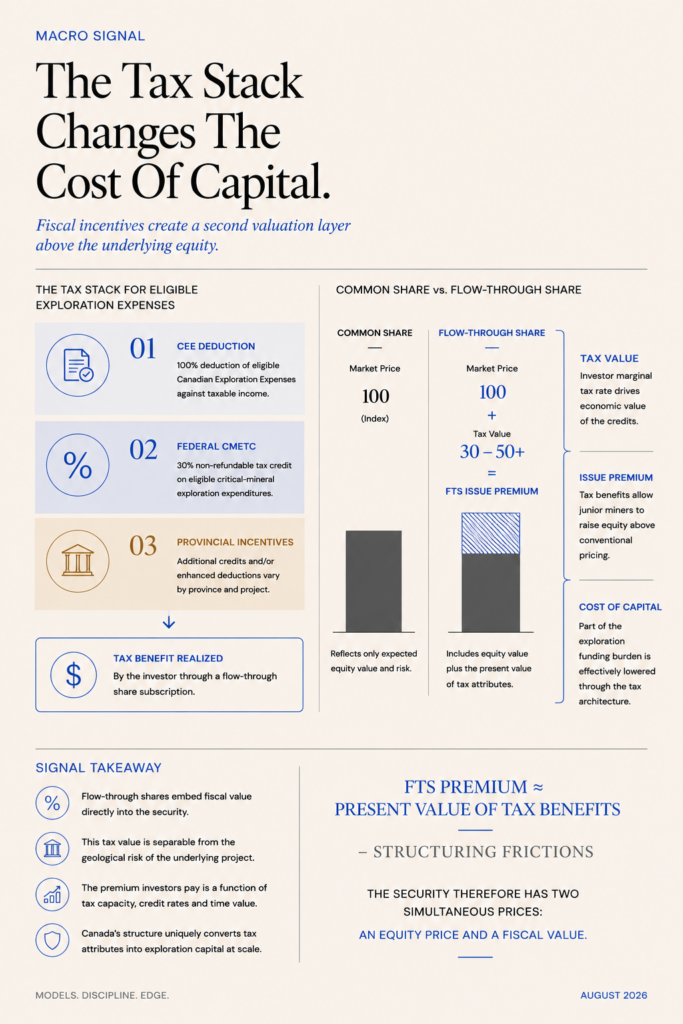
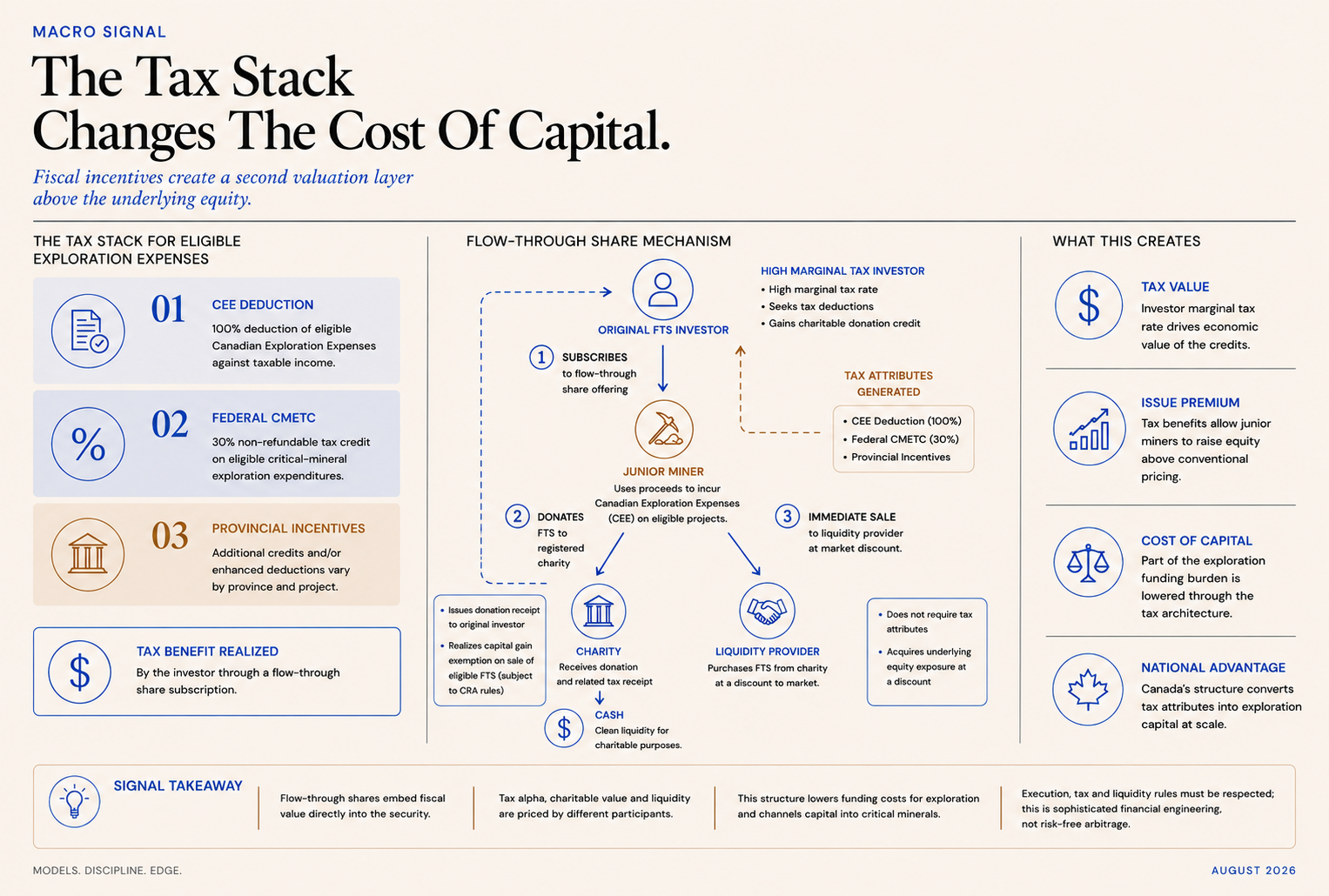
The consequence is a financing mechanism with two simultaneous layers of valuation. Investors are not purchasing exposure solely to the underlying exploration asset; they are also acquiring a package of fiscal attributes whose value depends on marginal tax rates, federal credits such as the CMETC and, where applicable, provincial incentives. That additional layer can support issuance above conventional equity pricing, effectively lowering the miner’s cost of capital while redirecting private savings toward strategically important exploration.
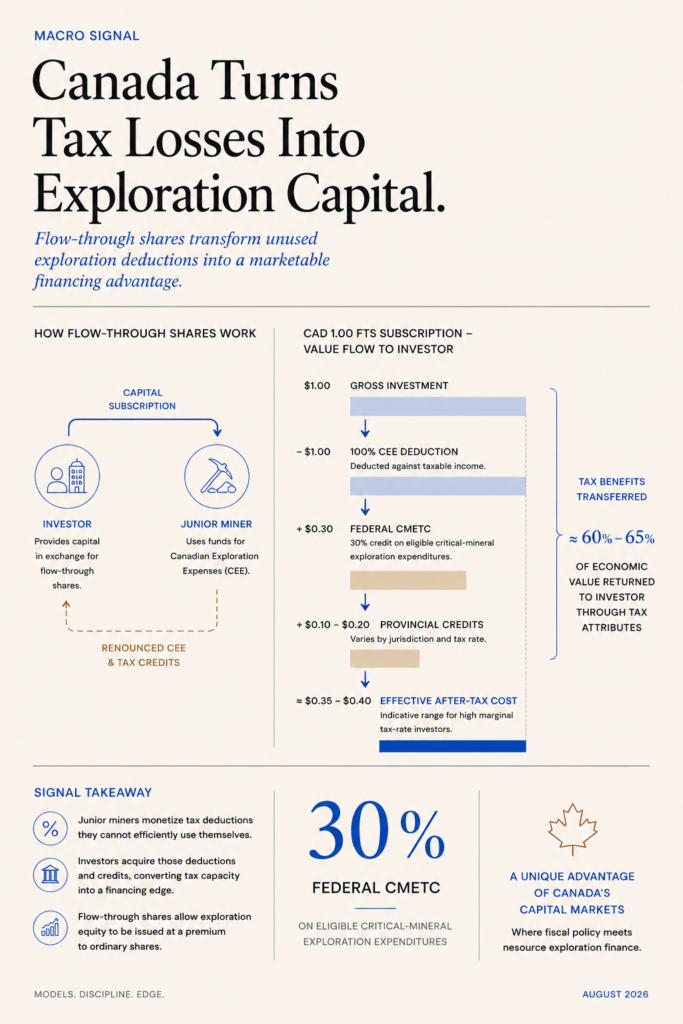
The economic advantage is therefore created before geological success is known. By transferring deductions and credits to investors able to use them immediately, the structure partially separates the financing decision from the timing and uncertainty of exploration outcomes. The result is not the elimination of geological risk, but a different allocation of that risk: part of the investor’s economics is generated through fiscal value rather than through future appreciation of the underlying equity.
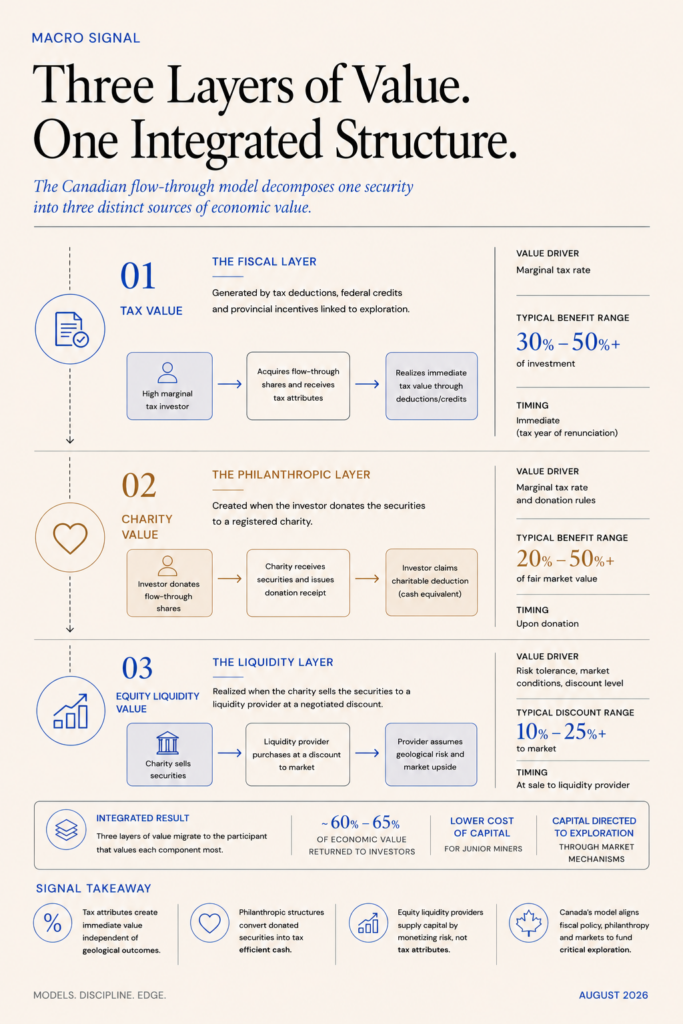
The Structure: One Security, Three Sources of Value
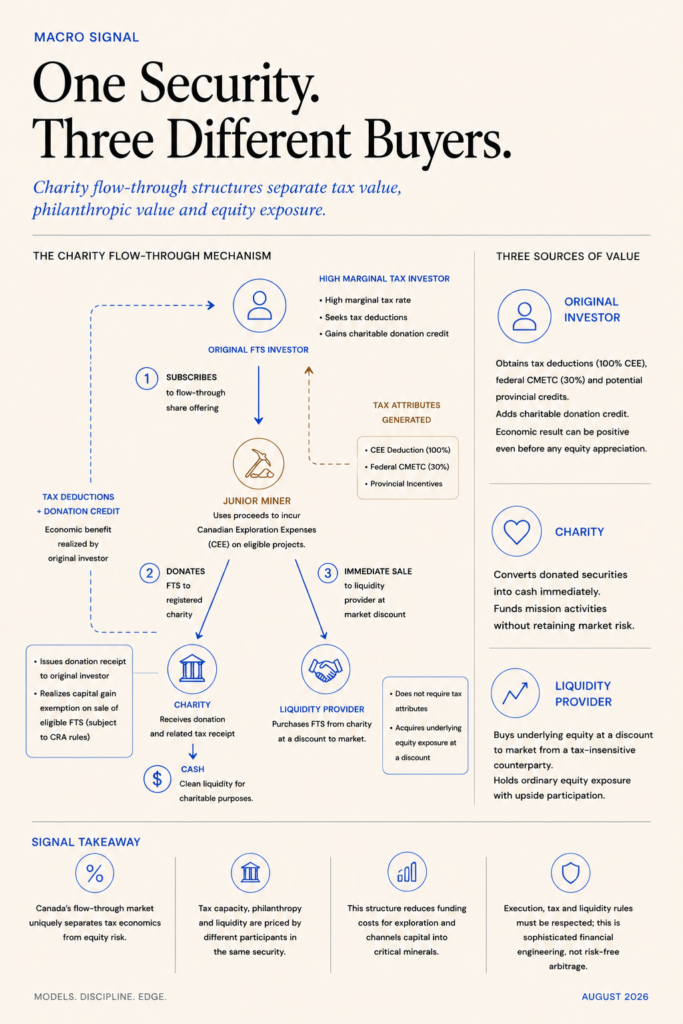
The architecture becomes more sophisticated when flow-through shares are incorporated into charitable transactions. A high-marginal-rate investor subscribes for the securities and receives the associated exploration deductions and credits. The shares can then be donated to a registered charity, creating an additional charitable tax benefit, while the charity monetizes the position through an immediate sale to a liquidity provider. What began as a single equity issuance is effectively decomposed into separate economic components, each valuable to a different participant.
For the original investor, value resides primarily in tax attributes and the charitable deduction. For the charity, the security becomes immediate funding rather than an investment position. For the liquidity provider, the relevant proposition is different again: acquiring the underlying equity at a negotiated discount without requiring the tax attributes attached to the original issuance. The same security therefore passes through three distinct valuation frameworks before ultimately returning to conventional market ownership.
This separation is what makes the Canadian model particularly unusual. Tax capacity, philanthropic demand and equity liquidity do not need to reside with the same investor. Financial engineering allows each component to migrate toward the participant that values it most, potentially reducing the effective financing burden for the exploration company while preserving market-based pricing of the underlying geological risk.
From Tax Capacity to Exploration Capital
The deeper significance of the Canadian flow-through market lies in how it reallocates risk between participants. Early-stage exploration companies typically generate substantial expenditures long before they produce taxable income. In a conventional corporate structure, the resulting deductions may therefore remain economically dormant for years. Flow-through financing allows that unused tax capacity to migrate toward investors who can monetize it immediately.
This transfer changes the economics of raising equity. Because investors attribute value to the deductions and credits attached to the security, they may accept an issuance price above what the underlying exploration exposure alone would justify. The premium effectively reduces the amount of equity dilution required to finance a given exploration programme, creating a lower effective cost of capital for qualifying issuers.
The mechanism does not eliminate geological risk. It separates part of the financing equation from it. Exploration success remains uncertain, but a portion of the security’s value is generated by fiscal attributes whose economics depend instead on tax rates, eligibility rules and investor tax capacity. That separation is what turns the tax system from a passive subsidy into an active component of capital-market infrastructure.
The innovation is not the tax deduction itself. It is making an otherwise stranded tax asset transferable, and therefore capable of influencing the price and availability of capital.
FXNS RESEARCH
From Financial Engineering to Strategic Capital
The Canadian flow-through market ultimately matters because it demonstrates how fiscal policy can be embedded directly into the architecture of capital formation. Rather than asking governments to select individual projects or provide capital through conventional subsidies, the structure creates a set of incentives and allows private investors to determine where that capital is deployed. Tax capacity, geological opportunity and market pricing meet inside the same security. The result is a financing mechanism in which public policy influences the economics of investment without replacing the market’s role in allocating risk.
This becomes particularly important in mineral exploration, where the timing mismatch between expenditure and economic return is unusually severe. Capital must be committed years before a commercially viable resource may be identified, developed or monetized. For a junior miner with little or no taxable income, deductions generated during that period have limited immediate value. For a high-marginal-rate investor, however, those same deductions can carry substantial economic value today. Flow-through shares connect those two balance sheets. What is unusable to one participant becomes valuable to another, and part of that value can be reflected back into the price at which exploration capital is raised.
Critical-mineral incentives deepen that mechanism. The CMETC and qualifying provincial programmes can increase the fiscal value associated with eligible expenditures, creating a larger potential wedge between the market value of ordinary equity and the price investors may be willing to pay for securities carrying transferable tax attributes. That wedge is not free money and should not be treated as such. Eligibility, investor circumstances, holding periods, execution costs and changing tax rules all matter. But when the structure works efficiently, part of the cost normally borne entirely by the issuer through equity dilution is effectively absorbed by the fiscal value embedded in the transaction.
Charity flow-through structures take the idea one stage further. They demonstrate that a single security can be valued differently by participants with fundamentally different objectives. The original investor may prioritize tax efficiency and charitable deductions. A registered charity values the ability to convert donated securities into immediate funding. A liquidity provider is interested primarily in acquiring the underlying equity at an appropriate discount. The security moves between those participants because each extracts a different component of its economic value. The sophistication lies not in eliminating risk, but in separating, pricing and reallocating different forms of value to the investors best equipped to absorb them.
That distinction is essential. Geological risk never disappears. Commodity prices remain volatile, exploration programmes can fail, equity prices can fall and regulatory conditions can change. Flow-through financing does not transform speculative exploration into a risk-free asset. What it can do is alter the financing boundary around that risk. By monetizing fiscal attributes independently of eventual geological success, the structure reduces the amount of economic value that must come exclusively from appreciation in the underlying equity.
For Canada, the broader consequence extends beyond individual transactions. A functioning flow-through ecosystem can channel private savings toward exploration activity at a scale that would be difficult to reproduce through direct government programmes alone. It can support junior miners, deepen specialist capital markets and direct financing toward resources considered strategically important to future supply chains. In an environment where critical minerals increasingly intersect with industrial policy, energy security and geopolitical resilience, that capacity has significance well beyond the mining sector.
The larger lesson is therefore about capital-market design. Markets do not operate independently of tax systems, regulation or institutional architecture; those frameworks help determine which risks can be financed, by whom and at what price. Canada’s flow-through model is an unusually explicit example. It takes a corporate tax attribute that might otherwise remain stranded, makes it transferable, allows the market to assign it a price and uses that price to influence the cost and availability of exploration capital.
For investors, that creates a second analytical layer beyond the underlying company. Understanding the asset is no longer sufficient; one must also understand the fiscal architecture surrounding it, the marginal tax characteristics of the buyer base, the liquidity path of the security and the rules governing each transfer of value. When those elements align, tax policy ceases to be merely an after-the-fact consideration. It becomes part of the security itself—and therefore part of the investment thesis.



I look forward to seeing how these developments will improve service levels and customer satisfaction in the freight industry!