

Local currencies do not need to replace the dollar to reduce their dependence on it. Across Southeast Asia, a quieter transformation is taking place beneath the surface of the monetary system. Domestic instant-payment networks are becoming interoperable across borders, allowing transactions that once required correspondent banks and USD intermediation to settle directly between regional currencies. What looks like a payments upgrade is gradually becoming a new layer of financial infrastructure.
The significance lies not in the creation of a rival reserve currency, but in the removal of a function the dollar has historically performed. Every transaction that can move directly from rupiah to baht, ringgit to Singapore dollar, or peso to another regional currency reduces the marginal need for USD liquidity as a vehicle currency. At first, the effect is transactional and almost invisible. At scale, however, payment architecture can begin to influence FX liquidity, corporate hedging behaviour and eventually the composition of monetary demand itself.
The Challenge: A System Built Around Dollar Intermediation
For decades, cross-border payments in Southeast Asia have relied on an architecture designed around correspondent banking and major international currencies. A transaction between two regional economies could involve two entirely local counterparties and still require conversion into US dollars before reaching its destination. The dollar was therefore doing more than storing value or denominating global assets: it was functioning as the connective tissue of regional commerce. This structure created persistent transactional demand for USD liquidity even where the underlying economic exchange had little direct connection to the United States.
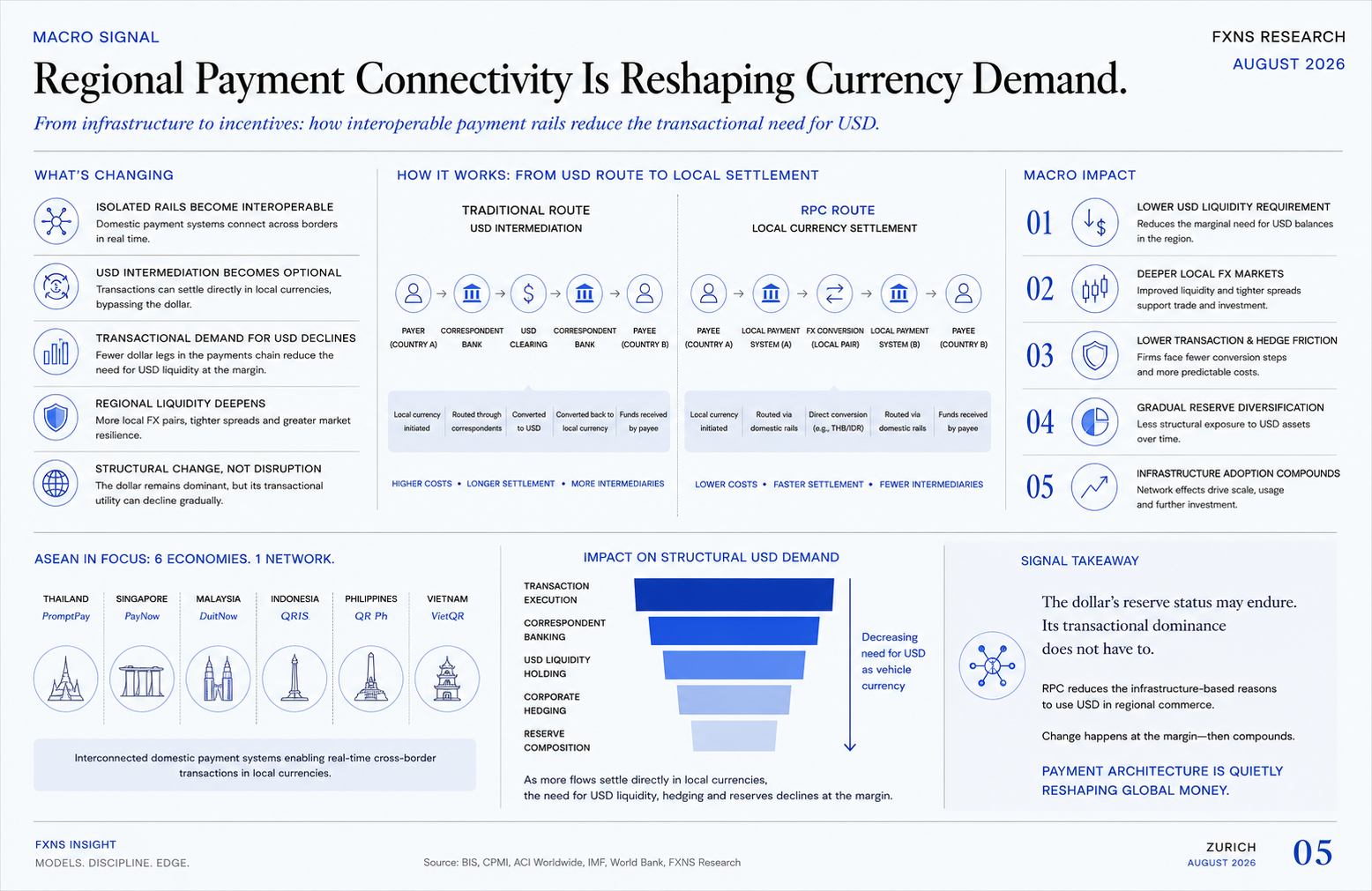
Regional Payment Connectivity begins to alter that architecture. By linking domestic instant-payment systems and enabling direct conversion between local currencies, participating economies can remove an intermediary currency from an increasing share of cross-border transactions. The immediate gains are practical—faster settlement, lower conversion costs and fewer intermediaries—but the monetary implication is more consequential. If regional trade can increasingly settle without first passing through the dollar, part of the structural demand for USD is no longer required. The dollar is not being replaced. One of the functions that made it indispensable is being bypassed.
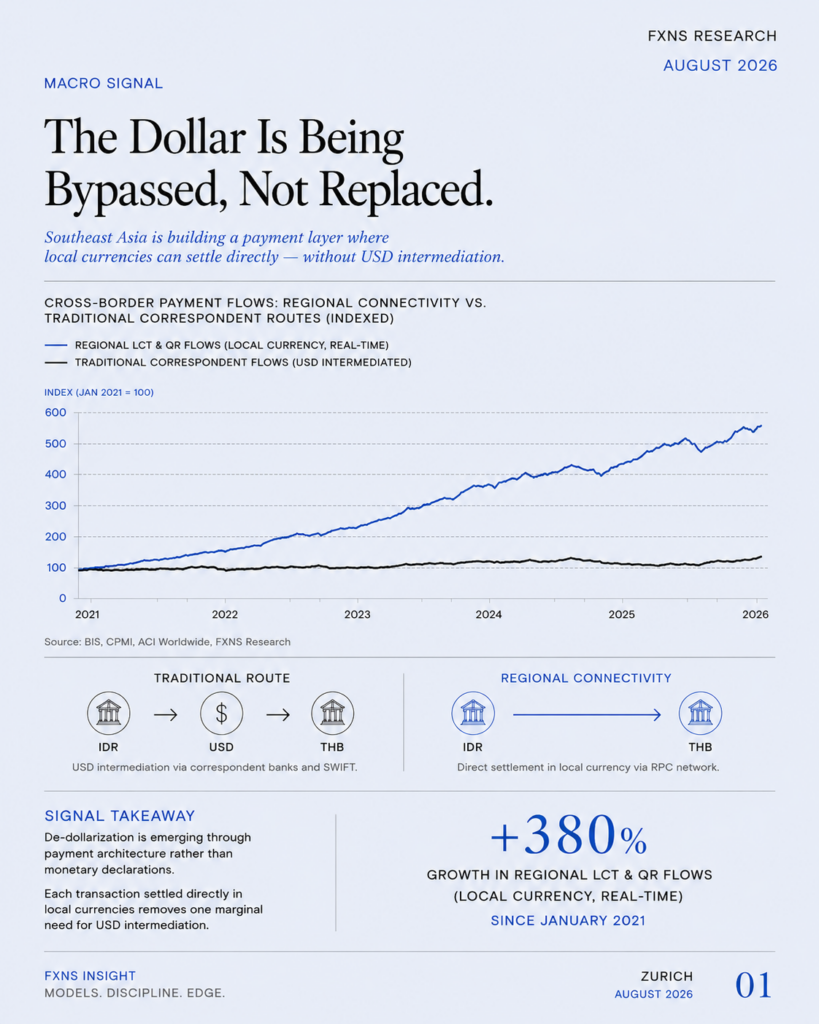
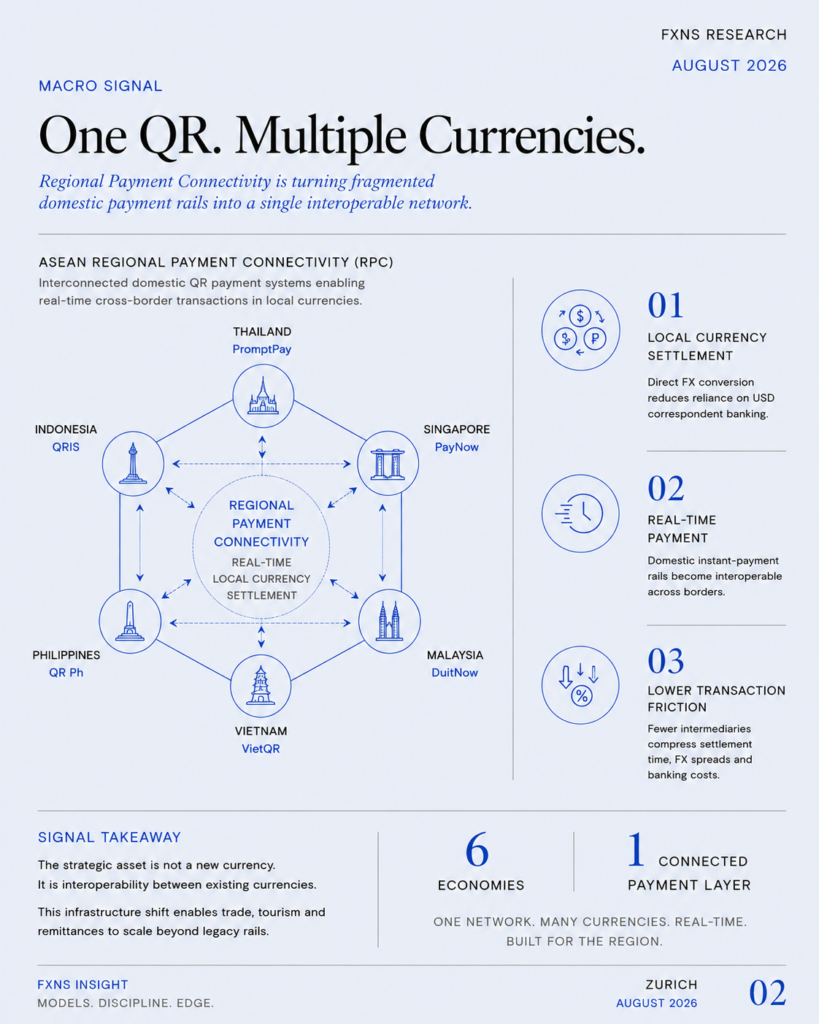
What changes is not the currency itself, but the route through which value moves. Once domestic payment systems become interoperable, the economics of a cross-border transaction begin to change: fewer intermediaries, fewer conversion legs and less dependence on a third currency simply to complete settlement.
When Payment Architecture Changes Currency Demand
Regional Payment Connectivity turns what were once isolated national payment rails into components of a broader financial network. Thailand’s PromptPay, Singapore’s PayNow, Malaysia’s DuitNow, Indonesia’s QRIS and other domestic systems were originally designed to make local payments faster and cheaper. Connecting those systems across borders extends the same logic to regional commerce. A consumer, merchant or business can increasingly initiate a payment in one local currency and have the recipient receive another without forcing the transaction through the traditional sequence of correspondent banks and dollar conversion. The innovation is therefore less about creating new money than about creating new paths for existing money to travel.
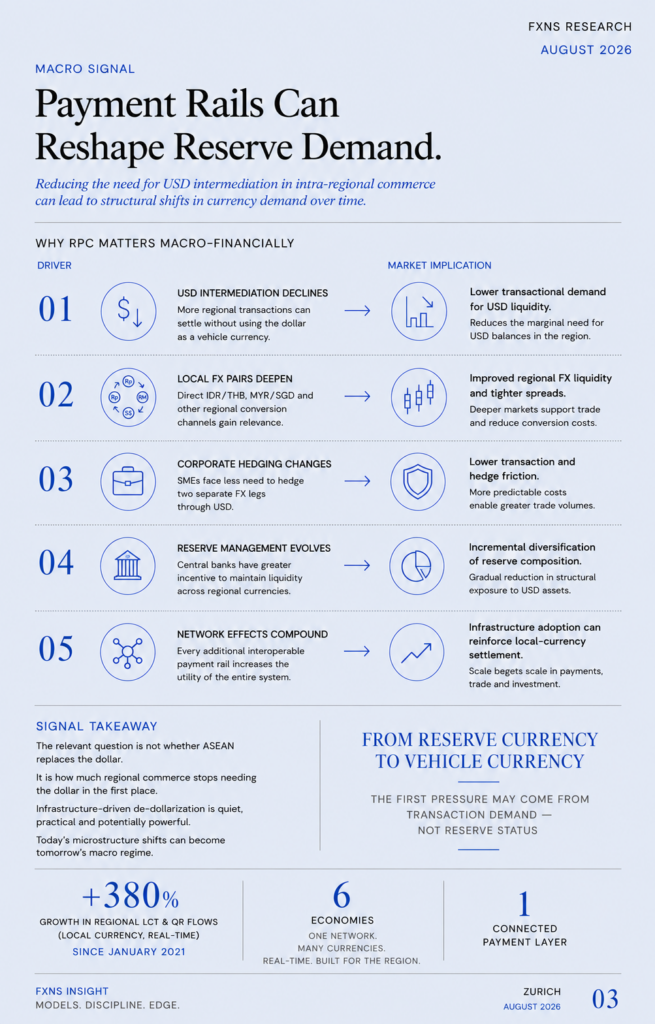
The macroeconomic consequence emerges gradually. When direct local-currency settlement becomes deeper and more frequent, demand begins to migrate toward the infrastructure required to support those currency pairs: local FX liquidity, market-making capacity, clearing arrangements and hedging instruments. Corporates gain an incentive to manage regional exposures directly rather than automatically routing them through USD; banks gain an incentive to quote and warehouse more local-currency liquidity; and central banks have greater reason to support resilient regional settlement channels. None of this implies an abrupt erosion of the dollar’s reserve status. It points instead to something subtler: the transactional utility of the dollar can decline at the margin even while its global monetary dominance remains intact.
The Second-Order Effect: When Payment Infrastructure Changes Currency Demand
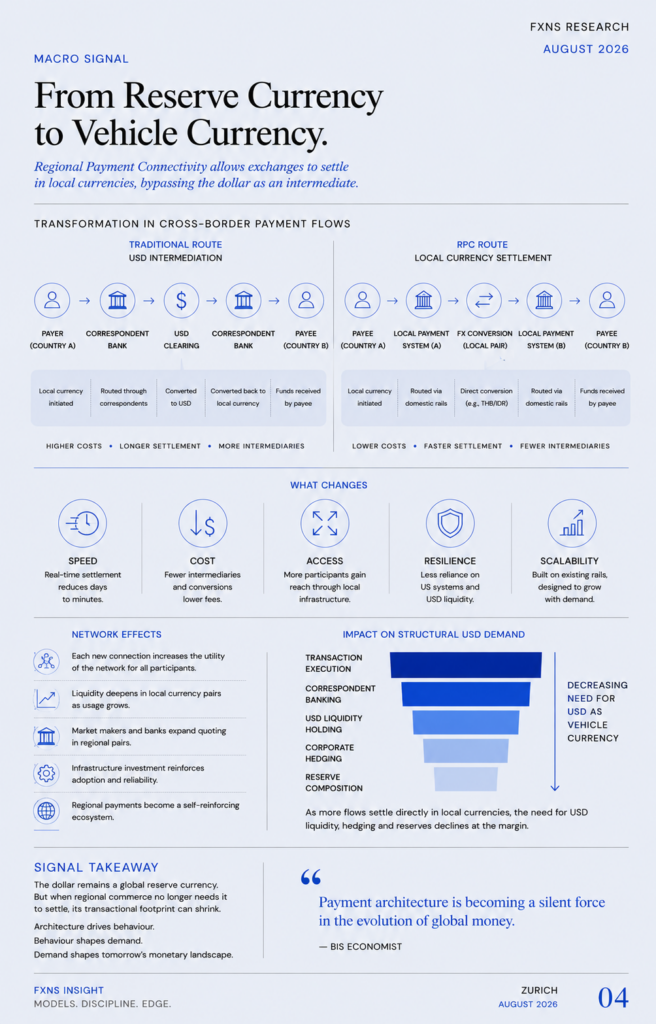
Regional payment connectivity matters not because it creates a new monetary system, but because it changes the mechanics through which existing currencies are used. For decades, a large share of cross-border commerce has relied on the US dollar not because either side of a transaction necessarily wanted dollar exposure, but because the dollar provided the deepest and most efficient bridge between otherwise fragmented currency markets. An Indonesian importer paying a Thai supplier, for example, could effectively generate two foreign-exchange transactions: rupiah into dollars, then dollars into baht. The dollar’s role was therefore partly monetary, but also infrastructural.
Regional Payment Connectivity begins to alter that architecture. When domestic instant-payment systems become interoperable and local currencies can be converted directly at the point of settlement, one layer of dollar intermediation becomes unnecessary. The transaction can still involve foreign exchange, but it no longer requires the same sequence of correspondent banks, offshore dollar balances and intermediary conversion legs. What disappears is not the dollar itself. What disappears is a specific transactional reason for holding and using dollars.
That distinction is important. Much of the debate around de-dollarization focuses on central-bank reserves, Treasury holdings or the emergence of a rival global currency. Those are visible measures, but they can obscure a quieter source of monetary change. A reserve currency is supported not only by official portfolios but by the enormous network of commercial transactions, funding arrangements, hedging practices and liquidity pools built around it. If some of those transactions migrate toward direct local-currency settlement, the marginal demand generated by the network can gradually change even while the dollar remains overwhelmingly dominant at the global level.
The first effects are likely to appear in market microstructure rather than reserve statistics. Greater use of direct regional currency pairs can encourage banks and market makers to quote those pairs more consistently. Higher transaction volumes can deepen liquidity; deeper liquidity can narrow spreads; narrower spreads can make direct settlement more attractive. The mechanism is potentially self-reinforcing. What begins as payment interoperability can therefore become an incentive for the surrounding foreign-exchange infrastructure to develop alongside it.
For corporates, the consequences extend beyond the payment itself. A company that previously needed to manage two currency legs through the dollar may increasingly be able to hedge a direct regional exposure. Treasury operations become simpler, settlement chains shorter and the amount of intermediary liquidity required for routine commerce potentially smaller. None of these changes is individually dramatic. At scale, however, they can alter where liquidity is held, which currency pairs banks prioritize and how businesses manage working capital across the region.
This is why ASEAN’s experiment should not be interpreted as an attempt to replace the dollar. The more consequential question is whether a growing share of regional economic activity can function efficiently without needing to touch the dollar at all. If the answer increasingly becomes yes, the monetary significance lies in bypass rather than substitution. Reserve status may remain intact while transactional dependence declines at the margin.
For investors, that is the signal worth watching. Monetary regimes rarely change because a single announcement declares that they have changed. They evolve as infrastructure alters incentives, incentives alter behaviour, and repeated behaviour eventually alters demand. Regional Payment Connectivity is still developing, and its global monetary impact should not be overstated. But it illustrates a broader principle: the architecture through which money moves can ultimately influence which money the system needs.
The dollar does not need to lose its reserve-currency status for its role in the global monetary system to change. If new payment infrastructure allows trade to settle directly between local currencies, the first adjustment may occur much earlier — in the transactional demand for dollars that international commerce has historically generated.
FXNS RESEARCH
Infrastructure Before Regime Change
The most important monetary shifts are not always announced by central banks, negotiated at summits or visible immediately in reserve statistics. Some begin much further down the financial architecture, in the systems through which ordinary transactions are cleared, converted and settled. Regional Payment Connectivity belongs to this quieter category of change. It does not challenge the dollar through a competing reserve asset or a coordinated political attempt to redesign the international monetary order. Instead, it changes something more elementary: the number of transactions for which the dollar is operationally necessary.
That distinction matters because the dollar’s international position is supported by several layers of demand that are often treated as if they were the same. Central banks hold dollars as reserves. Investors hold dollar assets because US capital markets offer exceptional depth and liquidity. Corporations borrow in dollars. Commodity markets price extensively in dollars. Banks use dollars for funding and collateral. And international trade frequently relies on the dollar as an intermediary currency even when neither the buyer nor the seller is American. These functions reinforce one another, creating the network effects that make monetary dominance extraordinarily persistent.
Regional payment infrastructure does not dismantle that system. It selectively removes one reason for participating in it.
When an Indonesian buyer can pay a Thai seller through interoperable domestic rails, with rupiah converted directly into baht, the transaction no longer needs to generate dollar demand simply to move value from one economy to another. Replicate that mechanism across thousands of companies, millions of consumers and progressively larger volumes of regional commerce, and what initially appears to be a technical improvement in payment efficiency begins to acquire macroeconomic significance. The relevant variable is not whether the dollar disappears from the transaction entirely, but whether its participation becomes optional where it was previously structural.
This also changes the economics surrounding the transaction. Direct settlement creates incentives for banks to provide liquidity in regional currency pairs. More liquidity can produce tighter spreads and better price discovery. Better execution makes direct settlement more competitive, encouraging additional transaction volume. Greater volume, in turn, gives financial institutions stronger incentives to deepen those markets. Payment infrastructure and foreign-exchange liquidity can therefore develop together, producing network effects that become increasingly difficult to reverse once sufficient scale has been reached.
The implications extend into corporate treasury management. Businesses operating across Southeast Asia have historically managed currency exposure within a financial architecture heavily organized around the dollar. As direct regional markets deepen, companies may gradually alter how they hedge receivables, manage working capital and distribute liquidity across currencies. Banks may adjust which currency pairs they quote most actively. Market makers may allocate balance sheet differently. Central banks may find that maintaining deeper regional liquidity becomes increasingly useful as commercial settlement patterns evolve. None of these adjustments requires an explicit policy of de-dollarization. They emerge from economic incentives created by the infrastructure itself.
This is precisely why reserve statistics may be a lagging indicator of the more interesting change. A central bank does not need to sell Treasury securities for the transactional relevance of the dollar to decline at the margin. The first evidence may instead appear in payment volumes, FX turnover, settlement patterns, hedging behaviour and the development of direct local-currency markets. Only later, if those changes become sufficiently large and persistent, could they influence the composition of liquidity buffers and eventually reserve portfolios.
There are also clear limits to the thesis. The dollar retains advantages that regional payment connectivity cannot replicate: unparalleled capital-market depth, global collateral utility, enormous offshore liquidity and an established role in trade invoicing and financial contracts. ASEAN interoperability does not provide an alternative to the US Treasury market, nor does it create a single regional currency capable of absorbing global savings. The distinction between reducing dollar intermediation and replacing dollar dominance is therefore fundamental. Conflating the two would exaggerate what the current infrastructure can achieve.
But the absence of immediate regime change does not make the development irrelevant. Monetary systems evolve at the margin before the aggregate data reveal a new equilibrium. Each transaction that can settle efficiently without dollar intermediation slightly reduces the infrastructure-based demand that previously accompanied regional commerce. Each additional connection increases the usefulness of the network. Each improvement in local FX liquidity makes the next transaction easier to execute directly.
For investors, this suggests a different framework for thinking about de-dollarization. The question is not simply which currency might someday replace the dollar. That framing assumes monetary change must occur through substitution at the top of the hierarchy. Southeast Asia points toward another possibility: the hierarchy can remain intact while the infrastructure beneath it becomes progressively less dependent on the currency at its centre.
The dollar may therefore remain the world’s dominant reserve currency for a very long time while simultaneously becoming less necessary for specific categories of international transactions. Those two outcomes are not contradictory. They describe different layers of the same monetary system.
And that may ultimately be the more consequential signal. Before currencies lose status, they can lose functions. Before monetary regimes change, the infrastructure supporting them can change first.



I look forward to seeing how these developments will improve service levels and customer satisfaction in the freight industry!