

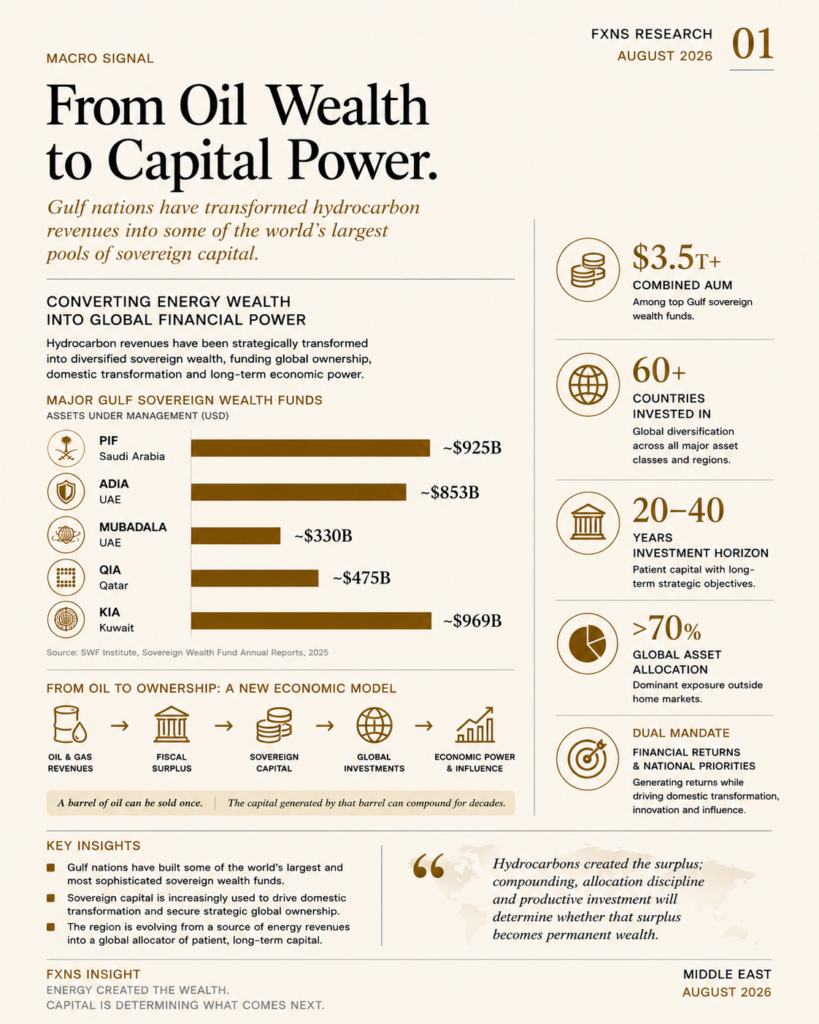
For most of the modern economic history of the Gulf, hydrocarbons defined both the source of wealth and the structure of the state. Oil and gas revenues generated extraordinary fiscal surpluses, financed infrastructure and public services, and allowed relatively small populations to accumulate financial resources on a scale rarely seen elsewhere. Yet the most consequential decision was not simply to spend that wealth domestically. Governments across Saudi Arabia, the United Arab Emirates, Qatar and Kuwait progressively converted part of their underground reserves into diversified financial assets through sovereign wealth funds. In doing so, they began transforming a finite natural resource into something potentially more durable: ownership of productive assets, companies, infrastructure and financial claims across the global economy. The economic logic is simple but powerful. A barrel of oil can be sold once; the capital generated by that barrel can compound for decades.
This transformation has created some of the largest pools of sovereign capital in the world. Institutions such as Saudi Arabia’s Public Investment Fund, Abu Dhabi’s ADIA and Mubadala, the Qatar Investment Authority and the Kuwait Investment Authority collectively control enormous portfolios spanning public equities, private markets, real estate, infrastructure, technology, credit and strategic corporate stakes. Their role is also evolving. The traditional sovereign wealth model emphasised preservation and diversification: accumulate surplus revenues at home, invest them internationally and reduce the national balance sheet’s exposure to fluctuations in energy prices. The emerging model is considerably more ambitious. Sovereign capital is increasingly expected not only to generate financial returns, but also to accelerate domestic transformation, attract foreign investment, create new industries and position Gulf economies inside the sectors likely to define global growth over the coming decades.
From Oil Wealth to Capital Power
Saudi Arabia provides perhaps the clearest expression of this shift. The PIF has become a central instrument of the country’s economic strategy, deploying capital across tourism, entertainment, infrastructure, technology, mobility, mining and large-scale urban development while simultaneously building an international portfolio. Abu Dhabi follows a somewhat different architecture, distributing sovereign capital across several institutions with distinct mandates and combining long-established global investment portfolios with increasingly active positions in technology, energy transition and private markets. Qatar has used its accumulated gas wealth to construct a globally diversified portfolio, while Kuwait operates one of the oldest sovereign investment structures in existence. The models differ, but the underlying objective is increasingly similar: convert hydrocarbon rents into assets capable of generating economic value after hydrocarbons become relatively less dominant within the global energy system.
The scale of this capital also changes the Gulf’s relationship with global markets. Sovereign wealth funds from the region are no longer peripheral investors allocating excess reserves into conventional Western portfolios. They can provide multibillion-dollar anchor investments, participate in large private-market transactions, finance infrastructure, recapitalise companies and establish long-duration partnerships with governments and multinational corporations. Their willingness to deploy patient capital is particularly valuable in an environment where higher interest rates have made financing more expensive and traditional sources of liquidity more selective. As a result, Riyadh, Abu Dhabi and Doha increasingly occupy the other side of the negotiating table from global asset managers, technology companies and industrial groups seeking capital. Financial power begins to create commercial leverage, access to expertise and, ultimately, influence over where future investment takes place.
There is nevertheless an important distinction between possessing capital and allocating it productively. Sovereign wealth can absorb volatility and finance transformation, but enormous balance sheets can also encourage projects whose economic returns would struggle to attract private capital independently. The challenge becomes more acute when investment mandates simultaneously pursue financial performance, employment creation, national development and geopolitical objectives. These goals can complement one another, but they can also conflict. A world-class portfolio is evaluated by risk-adjusted returns; a national transformation programme may deliberately accept lower financial returns in exchange for infrastructure, technology transfer or domestic employment. Understanding Gulf capital therefore requires looking beyond headline assets under management and asking what each pool of capital is actually designed to achieve.
This is the deeper significance of the Middle East’s capital transformation. Oil remains indispensable to the region and will continue to finance a substantial portion of its ambitions for years to come. But the strategic objective is increasingly to ensure that national wealth no longer depends exclusively on producing the next barrel. By converting energy revenues into globally diversified financial assets, domestic productive capacity and ownership positions in strategic industries, Gulf states are attempting to change the nature of their economic power. Hydrocarbons created the surplus; compounding, allocation discipline and productive investment will determine whether that surplus becomes permanent wealth.
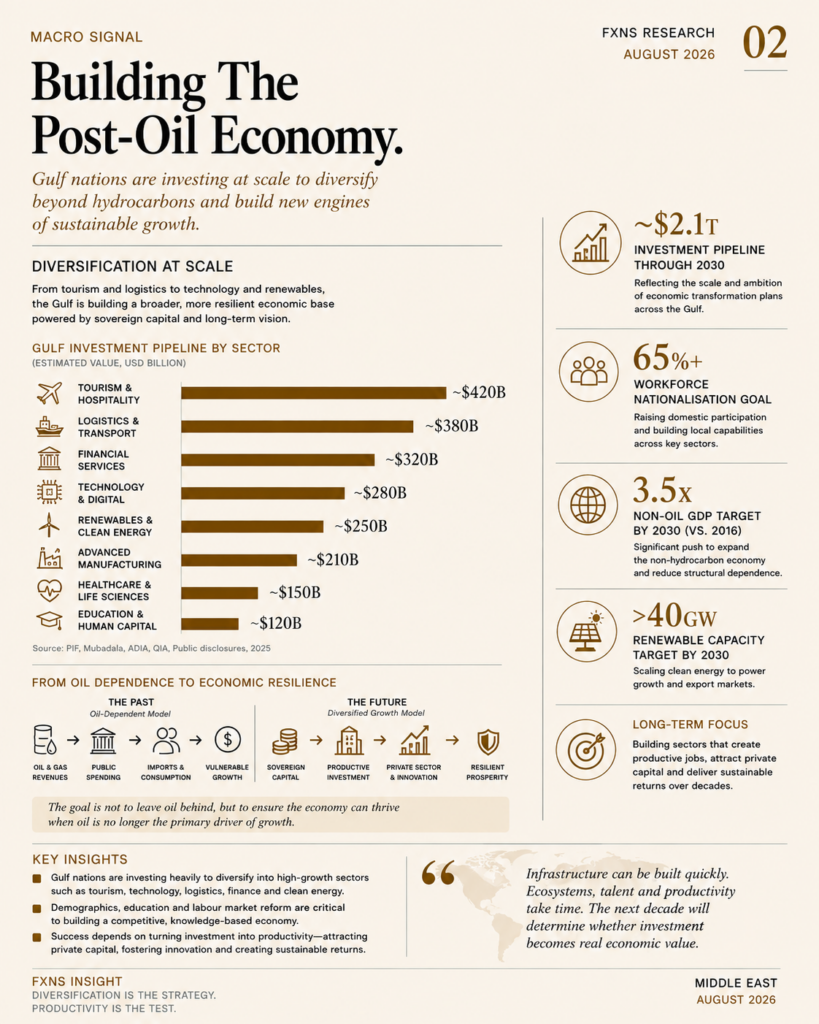
The phrase “post-oil economy” can be misleading when applied to the Gulf. Saudi Arabia, the United Arab Emirates, Qatar and their neighbours are not preparing for hydrocarbons to disappear from their economic systems in the near future, nor would it be rational for them to do so. Oil and gas remain extraordinarily valuable assets, and the region retains some of the world’s lowest-cost production capacity. The transformation underway is therefore not an attempt to abandon energy, but to reduce the degree to which national income, employment and future growth depend on it. Hydrocarbon revenues are being used as the financial bridge toward a broader productive base: aviation, logistics, tourism, financial services, advanced manufacturing, renewable energy, digital infrastructure and technology. In economic terms, the Gulf is attempting something unusually ambitious — using the cash flows of its dominant industry to finance the creation of industries capable of eventually reducing that dominance.
The scale of the investment reflects the scale of that ambition. Across the region, airports are expanding, new tourism destinations are being developed, logistics corridors are being strengthened and entire urban districts are being designed around financial, technological and commercial activity. Saudi Arabia’s Vision 2030 represents the most visible expression of this strategy, combining infrastructure investment with regulatory reform and the development of sectors ranging from tourism and entertainment to mining, manufacturing and digital services. The UAE is pursuing a more mature version of diversification, building on Dubai’s established position in aviation, trade, tourism and finance while Abu Dhabi deploys capital into advanced industry, artificial intelligence, renewable energy and technology. Qatar, supported by its enormous gas resources, has similarly invested in aviation, infrastructure, finance and international connectivity. Different economies are following different trajectories, but the strategic direction is unmistakable: the Gulf increasingly wants to produce, intermediate and own more of the economic activity that previously passed through other global centres.
Building the Post-Oil Economy
Geography gives this strategy a structural advantage. The Gulf sits between Europe, Asia and Africa, within relatively short flying distance of billions of consumers and many of the world’s fastest-growing economies. Dubai has already demonstrated how aggressively that location can be monetised. A relatively small domestic market became the foundation for a global aviation hub, a major transshipment centre, an international tourism destination and a regional headquarters economy. The broader Gulf is now attempting to replicate elements of that success across multiple sectors. Ports and airlines become more than infrastructure: they create networks. Financial centres attract professional services; data centres attract cloud and technology ecosystems; tourism supports hospitality, retail and real estate; manufacturing clusters can leverage energy availability, logistics and access to capital. Successful diversification therefore depends not merely on creating individual industries, but on building interconnected economic ecosystems in which one investment increases the productivity of another.
Technology is becoming particularly important within this architecture. Artificial intelligence, cloud computing and data infrastructure offer Gulf economies an opportunity to enter industries that are less constrained by population size or traditional industrial legacy. The region possesses several ingredients that matter: abundant capital, competitive energy resources, governments capable of executing large infrastructure programmes and a willingness to form strategic partnerships with leading global technology companies. Renewable energy follows similar logic. Solar economics are naturally attractive across much of the region, while existing expertise in large-scale energy projects can be redeployed into renewables, hydrogen and associated infrastructure. The objective is not simply to become a consumer of new technologies but, increasingly, to secure a position within their capital, infrastructure and supply chains.
Yet this is precisely where the distinction between investment and productive investment becomes essential. Governments with enormous financial resources can construct infrastructure, subsidise industries and attract international companies with incentives. They cannot guarantee that the resulting economic activity will generate sustainable returns. Megaprojects create impressive headline investment figures, but their long-term value depends on utilisation, productivity and whether genuine private-sector demand eventually emerges around them. The risk is that diversification becomes measured by money spent rather than economic value created. If a new sector survives primarily because sovereign capital continuously supports it, the economy may have changed its composition without truly reducing its dependence on hydrocarbon wealth. The ultimate test is whether new industries can become competitive enough to attract capital without requiring the state to remain their permanent marginal investor.
Human capital represents another constraint. Building knowledge-intensive industries requires more than physical infrastructure. It requires engineers, entrepreneurs, researchers, managers and specialised professionals, together with regulatory systems capable of attracting and retaining them. Gulf economies have historically relied heavily on expatriate labour, giving them unusual flexibility to import skills rapidly. But the next stage of diversification requires deeper domestic capabilities as well: education, labour-force participation, entrepreneurship and productivity growth among national populations. This makes economic diversification simultaneously an industrial and institutional project. Buildings can be constructed quickly; ecosystems, expertise and corporate culture take considerably longer to compound.
The success of the post-oil transition will therefore not be determined by whether Riyadh, Abu Dhabi or Doha can deploy enough capital. They clearly can. It will be determined by whether that capital creates businesses and economic networks capable of standing increasingly on their own. The Gulf has a rare opportunity because its existing energy wealth provides both the resources and the time required to attempt the transition before declining hydrocarbon relevance forces it. But that advantage is temporary by definition. The real objective is not to build an economy without oil; it is to build an economy that can continue compounding even when oil is no longer responsible for most of the compounding.
The New Geography of Global Capital
For decades, the relationship between the Gulf and global finance followed a relatively simple direction. Energy revenues accumulated in Riyadh, Abu Dhabi, Doha and Kuwait City, while a substantial portion of those surpluses was invested through financial centres elsewhere. London, New York, Paris, Geneva and, increasingly, Asian markets provided the institutions, asset managers, legal infrastructure and investment opportunities through which Gulf wealth was deployed. The region was an extraordinarily important source of capital, but much less frequently the place where global capital itself was organised. That distinction is now beginning to disappear. The Gulf is attempting to move from being primarily an exporter of financial wealth to becoming one of the locations through which international capital is raised, allocated, managed and ultimately reinvested. If successful, this would represent a more profound transformation than diversification alone: it would change the region’s position within the architecture of global finance.
The UAE has moved furthest along this path. Dubai has spent decades constructing an international business ecosystem around trade, aviation, real estate and financial services, while the Dubai International Financial Centre developed into an increasingly important base for banks, asset managers, insurers, law firms, family offices and professional-services companies operating across the Middle East, Africa and South Asia. Abu Dhabi has followed with a different proposition. Rather than replicating Dubai directly, it combines enormous sovereign balance sheets with a rapidly expanding financial centre, deep institutional relationships and access to some of the world’s largest pools of deployable capital. The growth of Abu Dhabi Global Market reflects this evolution. For an international investment firm, establishing a Gulf presence is increasingly not simply about covering local clients; it can provide proximity to sovereign funds, private wealth, regional transactions and investment opportunities stretching far beyond the UAE itself.
Saudi Arabia introduces another dimension because its principal advantage is scale. The Kingdom possesses the Gulf’s largest domestic economy and population, substantial government purchasing power and an investment programme capable of creating opportunities across infrastructure, real estate, tourism, mining, technology and industrial development. Riyadh is using these advantages deliberately to encourage international companies to establish a deeper physical presence inside the country rather than serving the Saudi market remotely from Dubai, London or elsewhere. Regulatory reforms, regional-headquarters policies and the expanding role of the Public Investment Fund are gradually changing the incentives facing multinational corporations and financial institutions. Saudi Arabia is effectively arguing that access to one of the region’s largest pools of future economic activity should increasingly require participation in the ecosystem where that activity is being created.
This competition between Gulf centres is economically significant because financial hubs benefit from powerful network effects. Asset managers attract investors; investors attract advisers and service providers; those firms attract specialised professionals; deeper talent pools then make the jurisdiction more attractive to additional capital. Once sufficiently developed, the ecosystem can begin to compound. This is precisely what made London, New York, Singapore and Hong Kong difficult to replicate: their advantage was never merely taxation or regulation, but the density of institutions, expertise, liquidity and relationships operating within them. The Gulf cannot manufacture those network effects instantly, regardless of how much capital it possesses. But it can accelerate their formation by combining competitive regulation, favourable taxation, high-quality infrastructure, sovereign investment relationships and access to rapidly growing regional markets.
The geography itself strengthens the proposition. From the Gulf, investors can operate across time zones connecting Asian markets with Europe while maintaining proximity to India, Africa and Central Asia. This matters increasingly as the global economy becomes more multipolar. Capital flows are no longer organised exclusively around a simple axis between the United States, Europe and developed Asia. Indian growth, African demographics, Asian supply chains and expanding South-South trade are creating investment opportunities across regions for which the Gulf is geographically well positioned. Dubai and Abu Dhabi can therefore present themselves not simply as Middle Eastern financial centres, but as intermediation platforms between multiple economic regions. Riyadh, meanwhile, can leverage the gravitational pull of its own domestic transformation to create another node within the same emerging network.
Private wealth adds another layer. The Middle East already contains significant concentrations of family capital, while the migration of entrepreneurs, investors and high-net-worth individuals into the UAE has broadened the region’s financial ecosystem. Family offices, private banks, alternative asset managers and wealth-management firms tend to cluster around one another, creating pools of capital that can participate in private equity, venture capital, credit, real estate and direct investments. This matters because the global financial system itself is changing. Private markets have become increasingly important relative to traditional public-market financing, and relationships with large pools of patient capital can be decisive in transactions where liquidity, speed and investment horizon matter. Gulf financial centres are therefore developing at a moment when the characteristics of Gulf capital are particularly valuable.
There are nevertheless substantial limits to how quickly financial gravity can move. New York and London possess deep capital markets, extensive institutional expertise and legal frameworks refined over generations. Singapore and Hong Kong retain powerful positions within Asian finance. The Gulf still has relatively shallow domestic public markets by comparison, limited local institutional depth in certain asset classes and a significant dependence on imported professional talent. There is also a risk that rapid expansion becomes excessively dependent on incentives. A financial centre becomes genuinely durable when institutions remain because the ecosystem itself is valuable, not merely because taxation, subsidies or access requirements make presence advantageous. The transition from attracted capital to embedded capital will therefore be one of the most important measures of success.
The broader direction, however, is increasingly difficult to ignore. Global asset managers, hedge funds, private-equity firms, banks, family offices and multinational corporations are treating the Gulf with greater strategic importance than they did a decade ago. At the same time, regional sovereign funds are becoming larger, more sophisticated and more active across global private markets. These two flows — international institutions moving toward Gulf capital and Gulf capital expanding deeper into international markets — reinforce one another. The result could be a new financial geography in which the Middle East is neither simply a commodity producer nor merely a source of investment funds. The ambition is to become a marketplace for capital itself: a place where East meets West, public wealth meets private finance, and an increasing share of the world’s investment decisions are made rather than merely funded.
“The Middle East’s transformation is not about replacing oil, but converting the wealth it creates into something more durable: productive capacity, global ownership and strategic influence. Energy built the balance sheet; the next chapter will be defined by how intelligently that capital is deployed, how effectively it compounds, and how much economic power remains when hydrocarbons no longer define the region.
FXNS RESEARCH
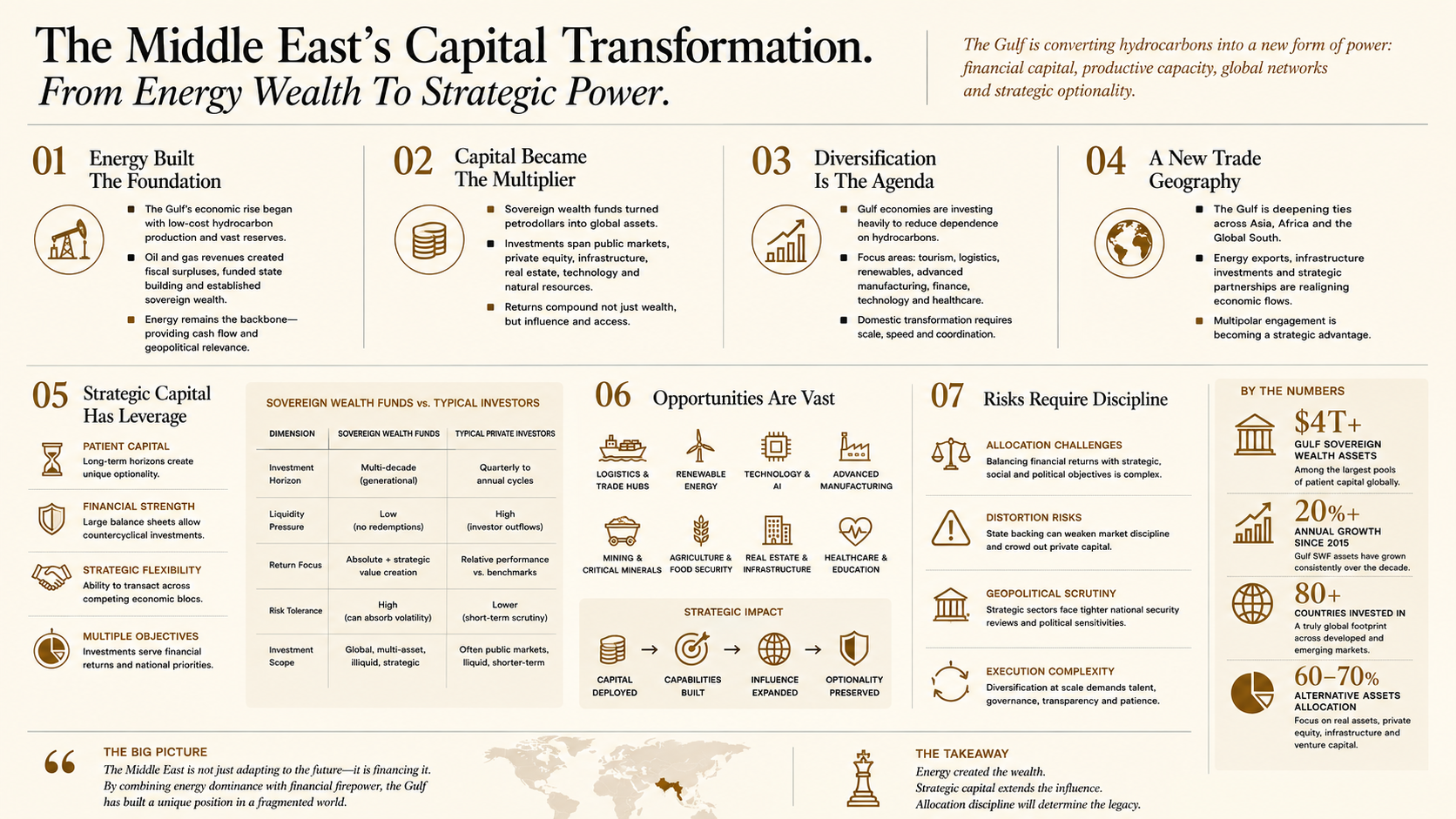
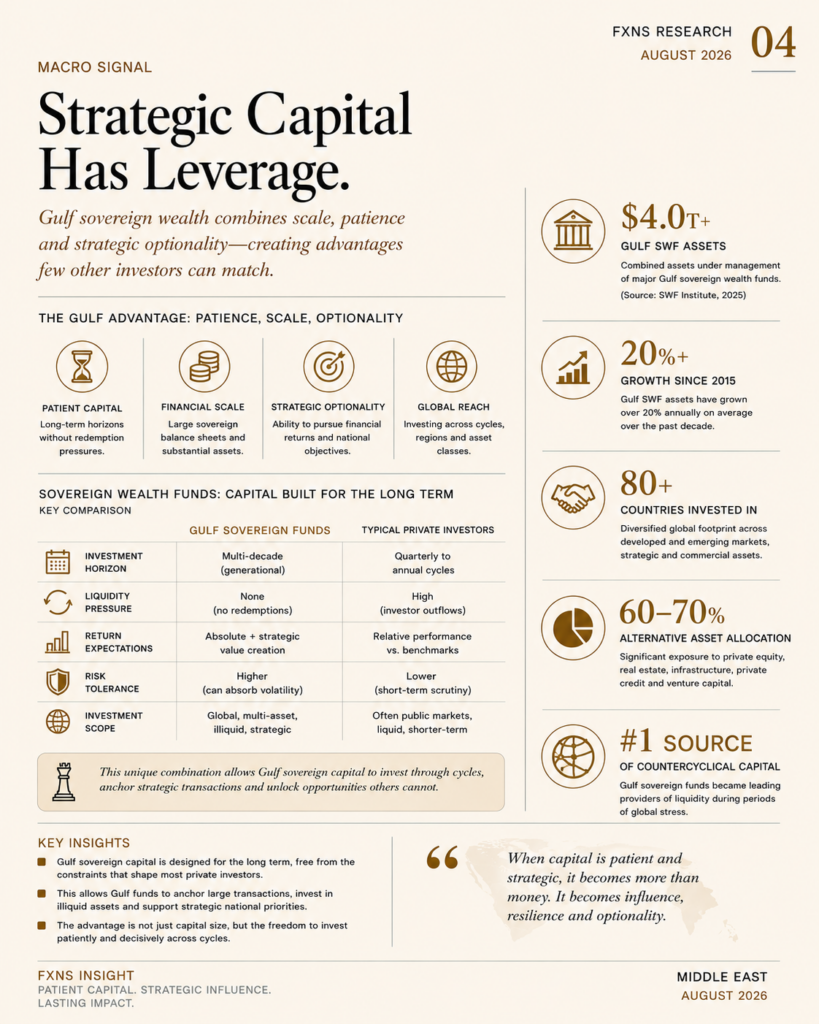
Strategic Capital Has Leverage
Capital becomes strategically different when its owner is under no immediate pressure to deploy it. This is one of the Gulf’s most important advantages. Saudi Arabia, the United Arab Emirates, Qatar and Kuwait combine hydrocarbon revenues, substantial foreign assets and sovereign balance sheets with investment horizons that can extend far beyond those of conventional private investors. Their sovereign funds do not face redemptions in the same way as mutual funds, nor must every investment satisfy the quarterly expectations imposed on listed corporations. This ability to provide patient capital creates optionality: Gulf investors can enter markets during periods of stress, anchor large transactions, finance infrastructure with long payback periods and negotiate strategic partnerships that combine money with technology, market access and political relationships. As the global cost of capital has risen and governments have become increasingly concerned with economic security, that optionality has become more valuable.
The significance extends far beyond portfolio returns. A sovereign investment can simultaneously serve several objectives. A stake in a technology company may provide financial upside while creating access to expertise that can later support domestic industry. An infrastructure investment abroad can deepen commercial relationships with a strategically important country. Financing a renewable-energy project can generate returns while building capabilities that are subsequently deployed within the Gulf. Investments in ports, logistics networks, semiconductor ecosystems, artificial intelligence, mining and advanced manufacturing can therefore sit at the intersection of finance and national strategy. This does not mean that every Gulf investment should be interpreted geopolitically. It means that the boundary between financial allocation and strategic policy is becoming increasingly difficult to separate.
This flexibility is particularly powerful because Gulf states maintain relationships across competing economic blocs. The region remains deeply connected to the United States and Europe through security, finance, technology and investment, while China has become an essential trading partner and major buyer of Gulf hydrocarbons. India is simultaneously rising in importance as an energy customer, commercial partner and source of human capital. Across Africa, Gulf investors are expanding into ports, logistics, agriculture, telecommunications, renewable energy and infrastructure. Rather than aligning their economic systems exclusively with one bloc, the major Gulf states are attempting to preserve relationships across several. In an increasingly fragmented world economy, this ability to transact simultaneously with Washington, Beijing, New Delhi, Brussels and emerging markets can itself become a form of strategic leverage.
Energy reinforces that leverage. The Gulf’s financial transformation is sometimes discussed as though capital were replacing hydrocarbons, but the two are better understood as mutually reinforcing assets. Low-cost oil and gas production generates cash flow and geopolitical relevance; accumulated sovereign wealth provides financial resilience and the ability to invest through commodity cycles. Together, they give the region a combination that relatively few economies possess: control over strategically important energy supply alongside control over large pools of deployable capital. During periods of energy scarcity, the value of production capacity increases. During periods of financial stress, liquidity becomes more valuable. Gulf states can possess both simultaneously, allowing them to negotiate economic relationships from a position that extends well beyond their population size or share of global GDP.
But strategic capital also creates difficult allocation problems. The larger sovereign funds become and the more objectives they are asked to pursue, the harder it becomes to distinguish economic investment from national ambition. A transaction designed to generate attractive risk-adjusted returns can be evaluated relatively clearly. A project expected simultaneously to create jobs, transfer technology, enhance geopolitical influence, support domestic transformation and generate financial returns requires a much more complicated framework. These objectives may reinforce one another, but they can also conflict. Capital deployed primarily for strategic reasons may tolerate returns that private investors would reject, while prestige projects can absorb enormous resources without creating corresponding productivity. The very abundance of capital that gives the Gulf its advantage can therefore weaken allocation discipline if financial constraints cease to operate as an effective filter.
Domestic transformation makes this risk particularly relevant. The Gulf is attempting to build multiple industries at extraordinary speed, and sovereign capital frequently acts as the catalyst. This can solve the coordination problem that prevents new sectors from emerging: governments can finance infrastructure, provide anchor demand, attract foreign partners and absorb early-stage risk simultaneously. Yet a sustainable private economy eventually requires price signals and commercial discipline. If companies remain dependent on sovereign procurement, subsidised financing or continuous state investment, diversification may become an extension of the hydrocarbon-funded public sector rather than a genuine alternative to it. The ultimate measure of success is therefore not how much sovereign capital can be deployed, but how much independent private capital that deployment eventually attracts.
External investments face a similar test. As Gulf funds become larger global shareholders, they must generate returns across increasingly competitive markets while navigating political scrutiny and geopolitical fragmentation. Strategic sectors such as semiconductors, artificial intelligence, telecommunications and critical infrastructure are becoming subject to tighter national-security considerations. Access to capital alone may no longer guarantee access to the most sensitive technologies or assets. Gulf states therefore need to balance relationships carefully: maintaining deep technological and financial connections with Western economies while expanding commercial ties with China and other emerging powers. The more fragmented the international system becomes, the more valuable neutrality can be — but the more difficult it may also become to preserve.
This is ultimately what makes the Middle East’s capital transformation more significant than a conventional diversification story. The region is converting energy wealth into something that can survive beyond the individual commodity cycle: financial ownership, productive capacity, global networks and strategic optionality. Whether this produces enduring economic power will depend less on the absolute size of Gulf balance sheets than on the quality with which they are allocated. Capital can purchase assets, accelerate industries and create influence, but it cannot permanently substitute for productivity. The Gulf’s greatest advantage is that it still possesses the resources to make this transition from a position of strength. Energy created the wealth; strategic capital can extend its influence — but allocation discipline will determine whether that influence compounds.



I look forward to seeing how these developments will improve service levels and customer satisfaction in the freight industry!