Canada Has Turned Exploration Tax Losses Into Investable Financial Value.
Flow-Through Shares transform unused deductions and tax credits into a source of capital for the country’s critical-minerals ecosystem.
The brief
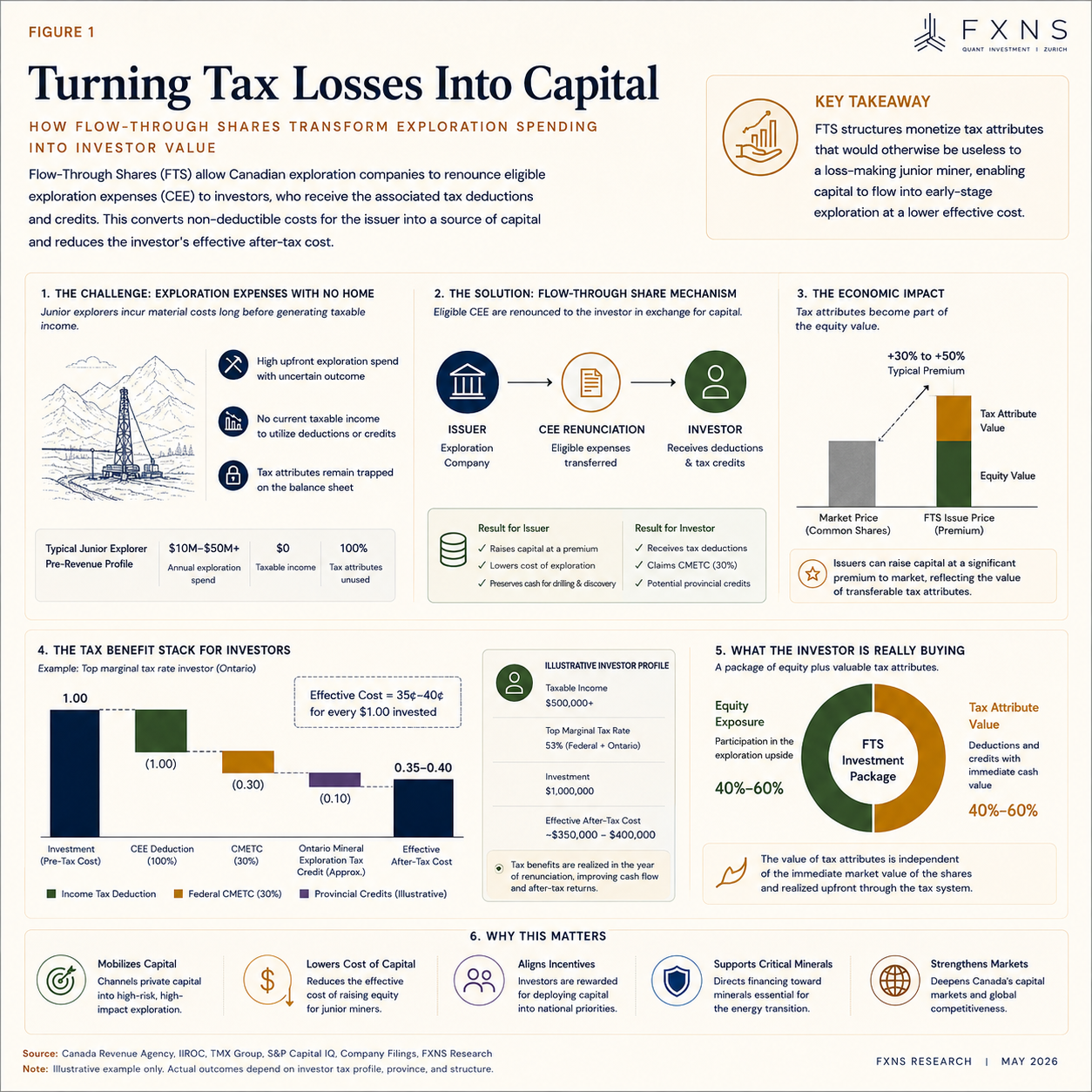
Canada has developed a distinctive capital-market mechanism for financing early-stage mineral exploration. Through Flow-Through Shares (FTS), eligible exploration expenditures that may have limited immediate value to loss-making junior miners can be renounced to investors, transferring the associated tax deductions directly to those providing the capital.
For qualifying critical-mineral exploration, the structure becomes more powerful through the Critical Mineral Exploration Tax Credit (CMETC), while provincial incentives can add further layers of fiscal value. The result is an unusual financing architecture in which tax attributes become an integral component of equity pricing.
At its most sophisticated, the market extends into structured charity flow-through transactions, where tax deductions, donation economics, equity liquidity and execution pricing interact within a single transaction.
RESEARCH FOCUS
Flow-Through Share financing and CEE renunciation
Critical Mineral Exploration Tax Credit (CMETC)
Federal and provincial tax stacking
FTS issuance premiums and effective cost of capital
Charity flow-through structures and liquidity mechanics
KEY QUESTION
Can transferable tax attributes transform geological risk into a systematically financeable asset?
Turning Tax Losses Into Capital
Canada’s Flow-Through Share market is built around an unusual financial principle: exploration expenses that have little immediate value to a loss-making mining company can become highly valuable when transferred to an investor with taxable income. Junior exploration companies typically consume capital for years before generating revenue, accumulating Canadian Exploration Expenses (CEE) that they may be unable to use efficiently themselves. Through a Flow-Through Share agreement, eligible expenditures can instead be renounced to the subscribing investor, allowing the associated deductions to effectively travel with the capital raised. This fundamentally changes the economics of financing early-stage mineral exploration. Investors are not purchasing equity exposure alone; they are acquiring a package consisting of shares plus transferable tax attributes whose value depends on their marginal tax position and the eligibility of the underlying expenditures. For qualifying critical-mineral exploration, the federal Critical Mineral Exploration Tax Credit (CMETC) can add another layer of value, further reducing the investor’s effective after-tax cost. Because these benefits exist independently of the immediate market value of the underlying shares, issuers can often raise Flow-Through capital at a premium to their ordinary share price, effectively monetizing tax attributes that would otherwise remain trapped inside a company with insufficient taxable income. The resulting transaction therefore separates two forms of value that conventional equity issuance leaves combined: the economic value of the company and the fiscal value of its exploration spending. For the mining company, that separation can lower the effective cost of exploration capital; for the investor, it creates an optimization problem in which marginal tax rates, credit eligibility, issuance premium and eventual share value jointly determine the true return. What appears on the surface to be a specialized equity financing mechanism is therefore better understood as a market for transferring tax capacity—one that allows Canada to redirect private capital toward geological exploration by attaching monetizable fiscal value to the risk of discovering the next generation of mineral resources.
Engineering the Tax Stack
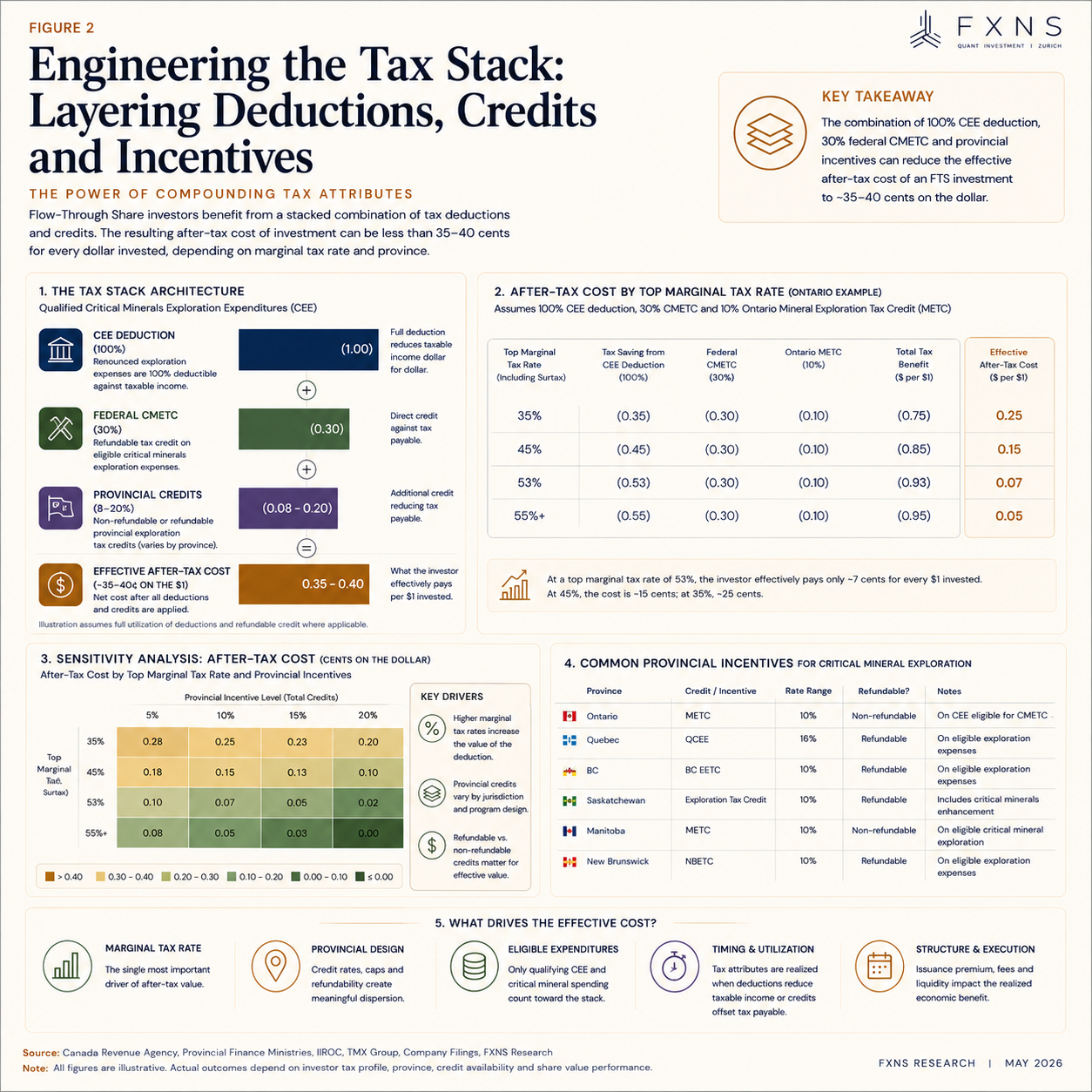
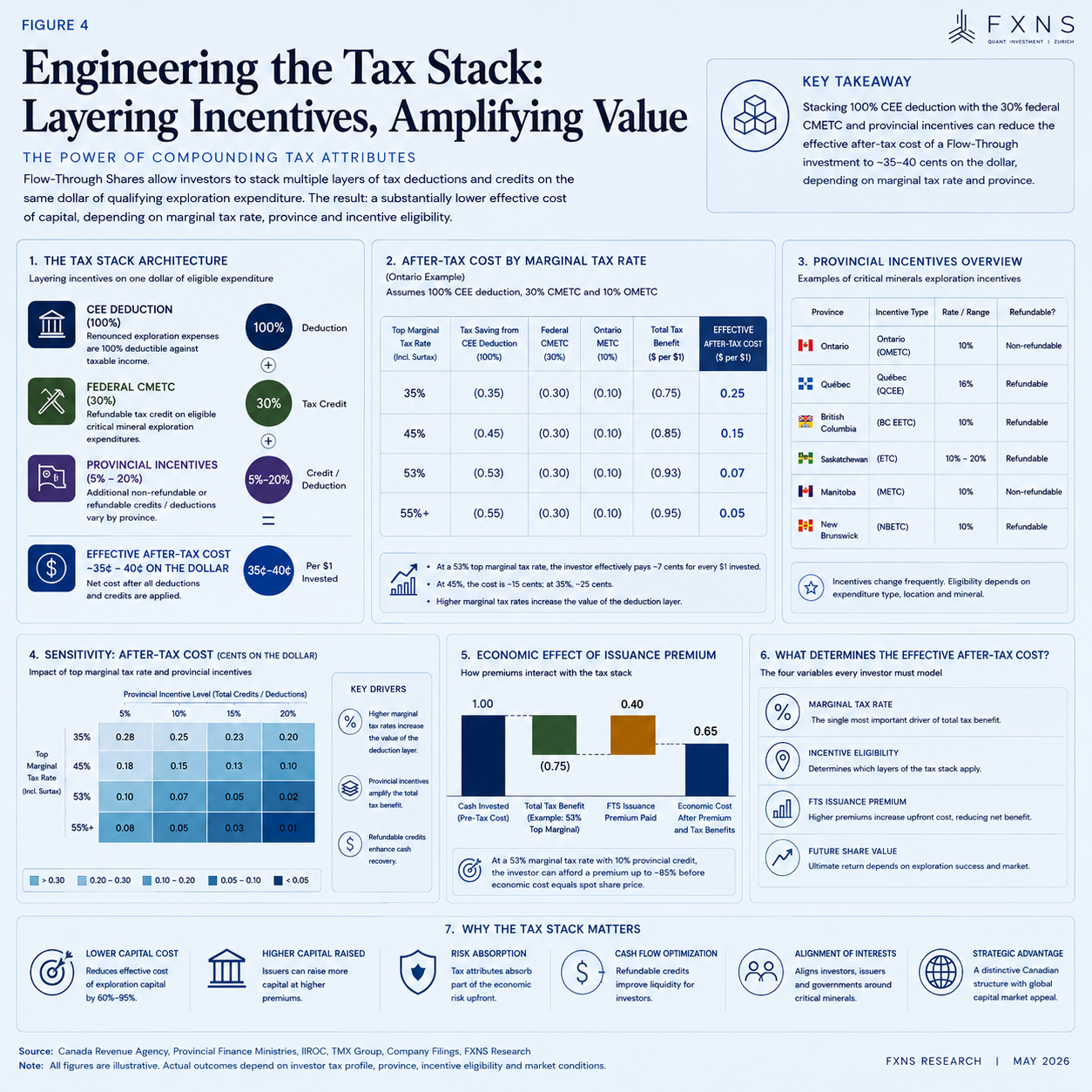
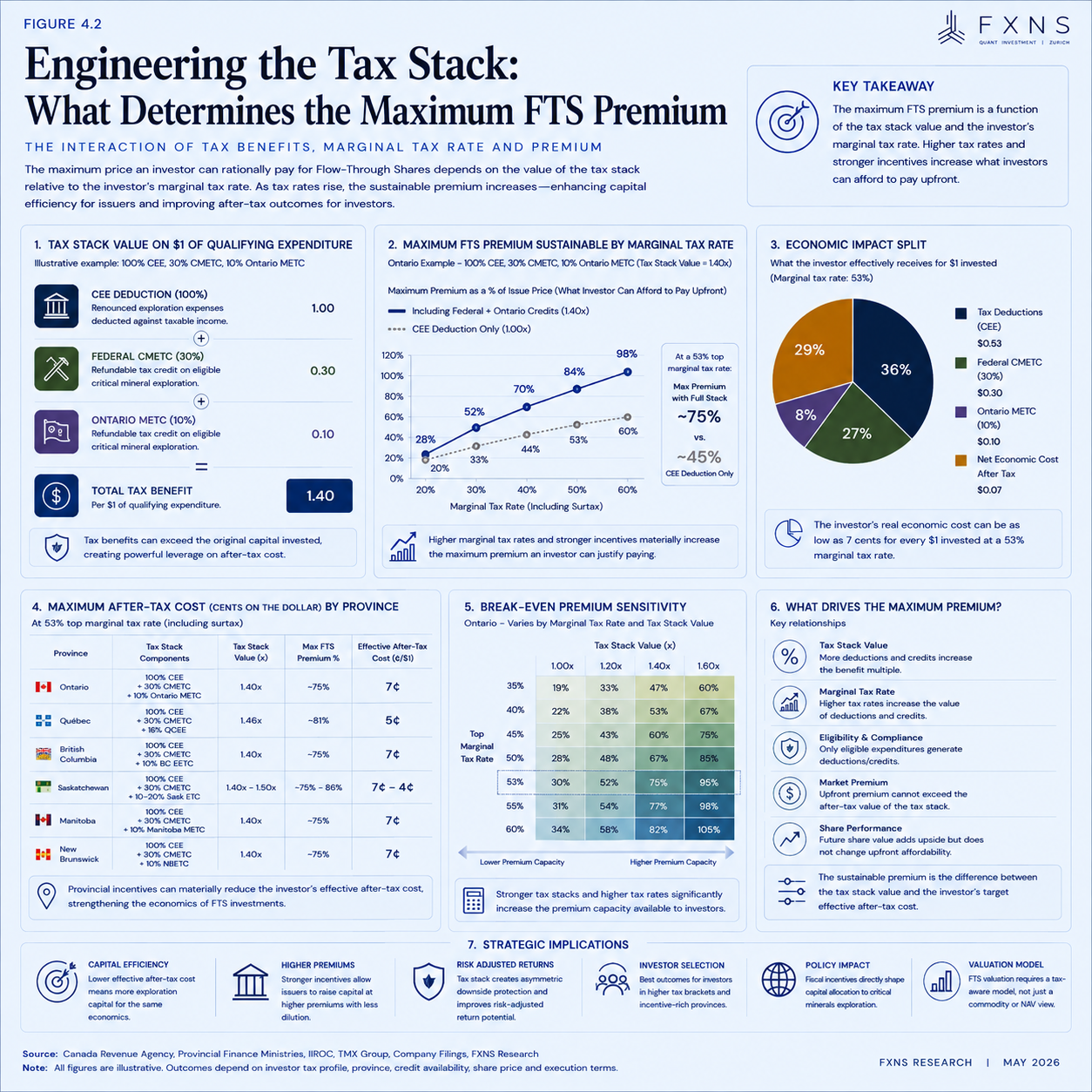
The economics of Flow-Through Shares become considerably more powerful when multiple fiscal incentives are layered onto the same dollar of qualifying exploration expenditure. At the foundation of the structure is the renunciation of eligible Canadian Exploration Expenses, allowing the investor to deduct qualifying amounts against taxable income. For exploration related to designated critical minerals, the federal Critical Mineral Exploration Tax Credit can provide an additional 30% investment tax credit, while certain provinces may offer further deductions or credits depending on the location and nature of the exploration program. The result is a highly asymmetric financing structure: the investor commits one dollar of capital, but the economic exposure retained after tax can be substantially lower than the original subscription amount. Crucially, however, there is no universal “after-tax cost” of a Flow-Through investment. Its value is a function of the investor’s marginal tax rate, province of residence, eligibility of the exploration expenditures, applicable credits, the premium paid for the Flow-Through Shares and their subsequent market value. This makes FTS pricing fundamentally quantitative. The relevant question is not simply whether a mining company deserves a particular equity valuation, but how much of the subscription price can be economically recovered through the tax stack before geological and market risk are considered. As marginal tax rates and available incentives change, so does the maximum premium a rational investor can pay for the shares. The same mechanism works in reverse for issuers: stronger tax benefits increase investors’ willingness to accept higher issuance premiums, allowing junior miners to raise more exploration capital with less conventional equity dilution. In effect, Canada has created a market in which fiscal policy becomes part of the security’s valuation model—turning tax attributes into a measurable component of the cost of capital.
When Tax Engineering Meets Liquidity
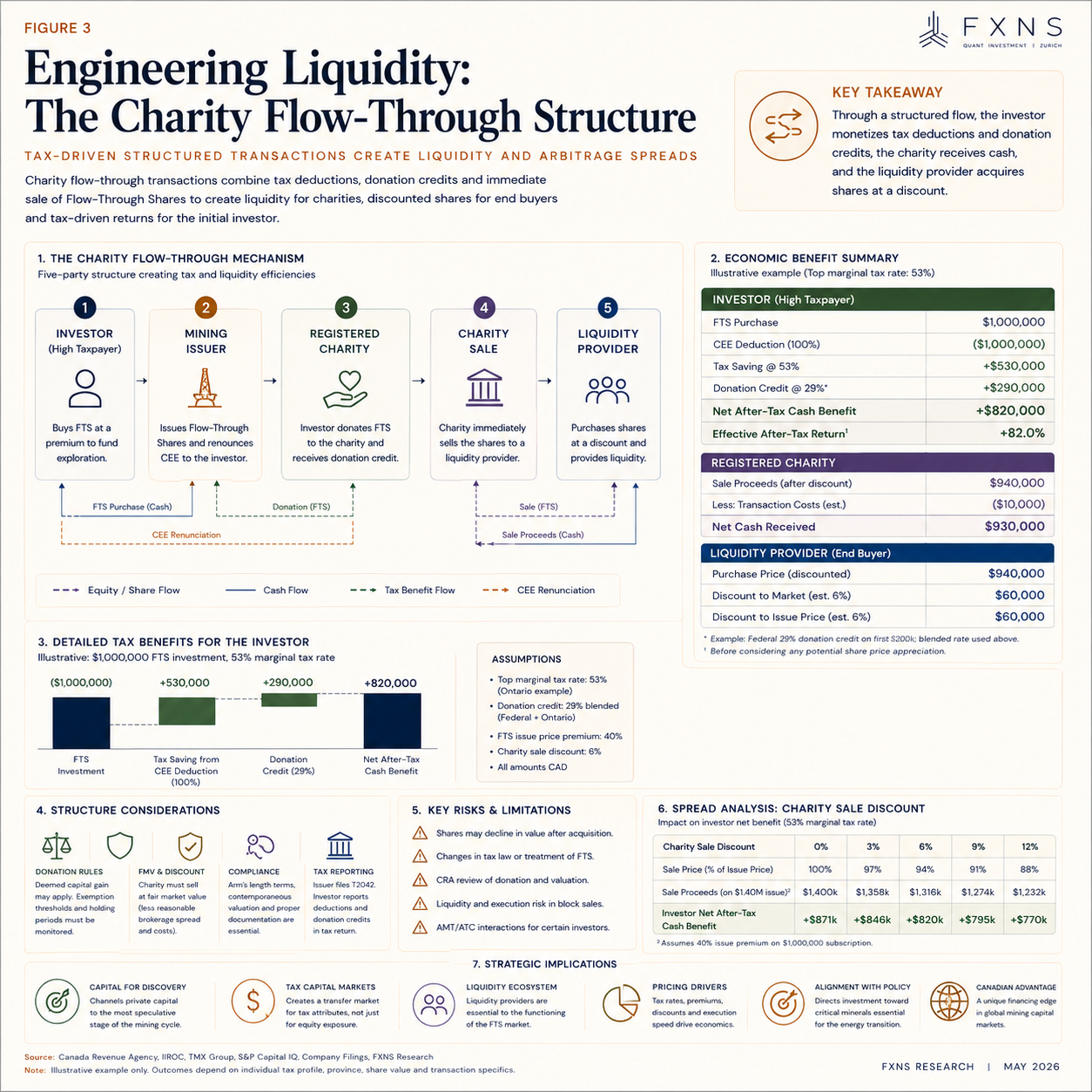
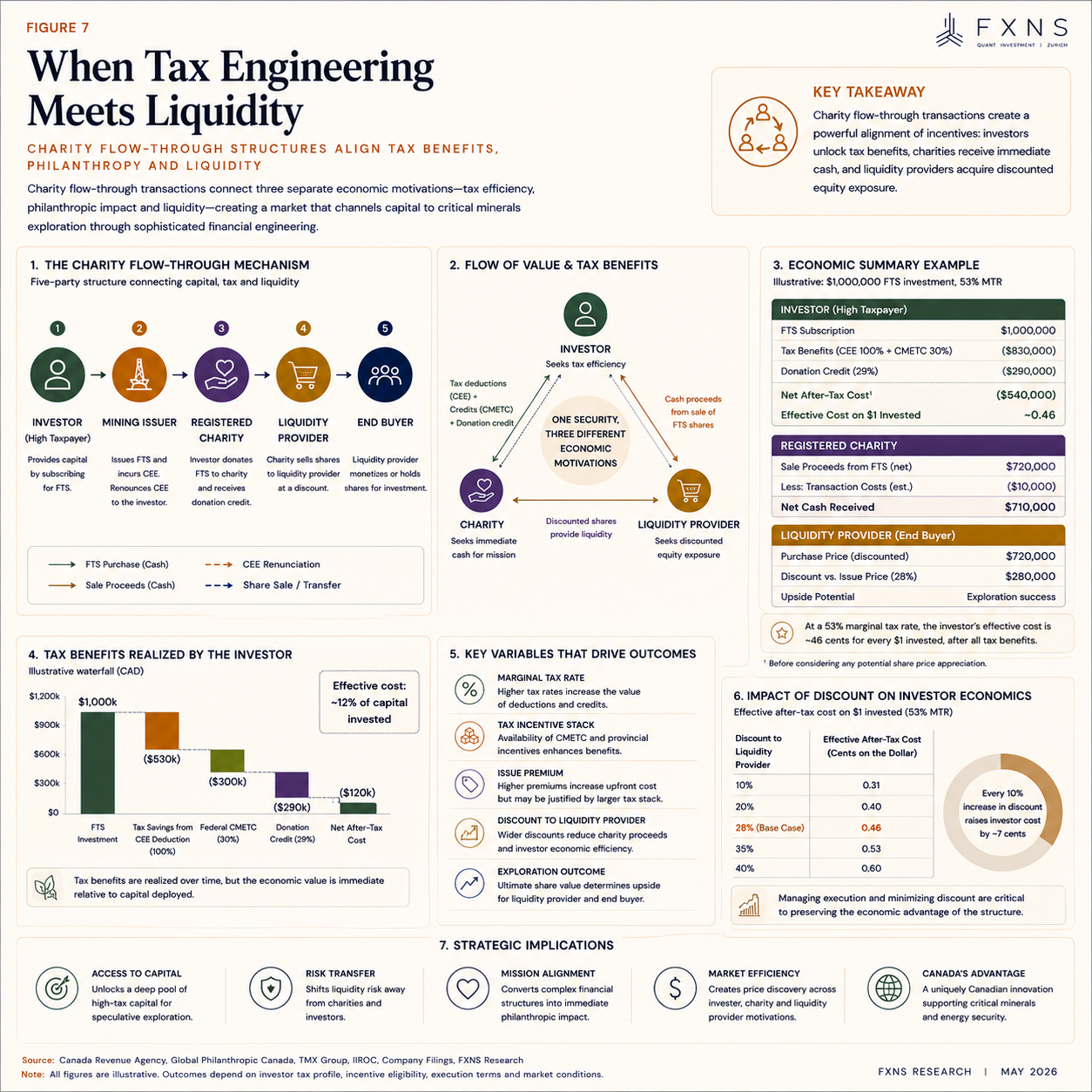
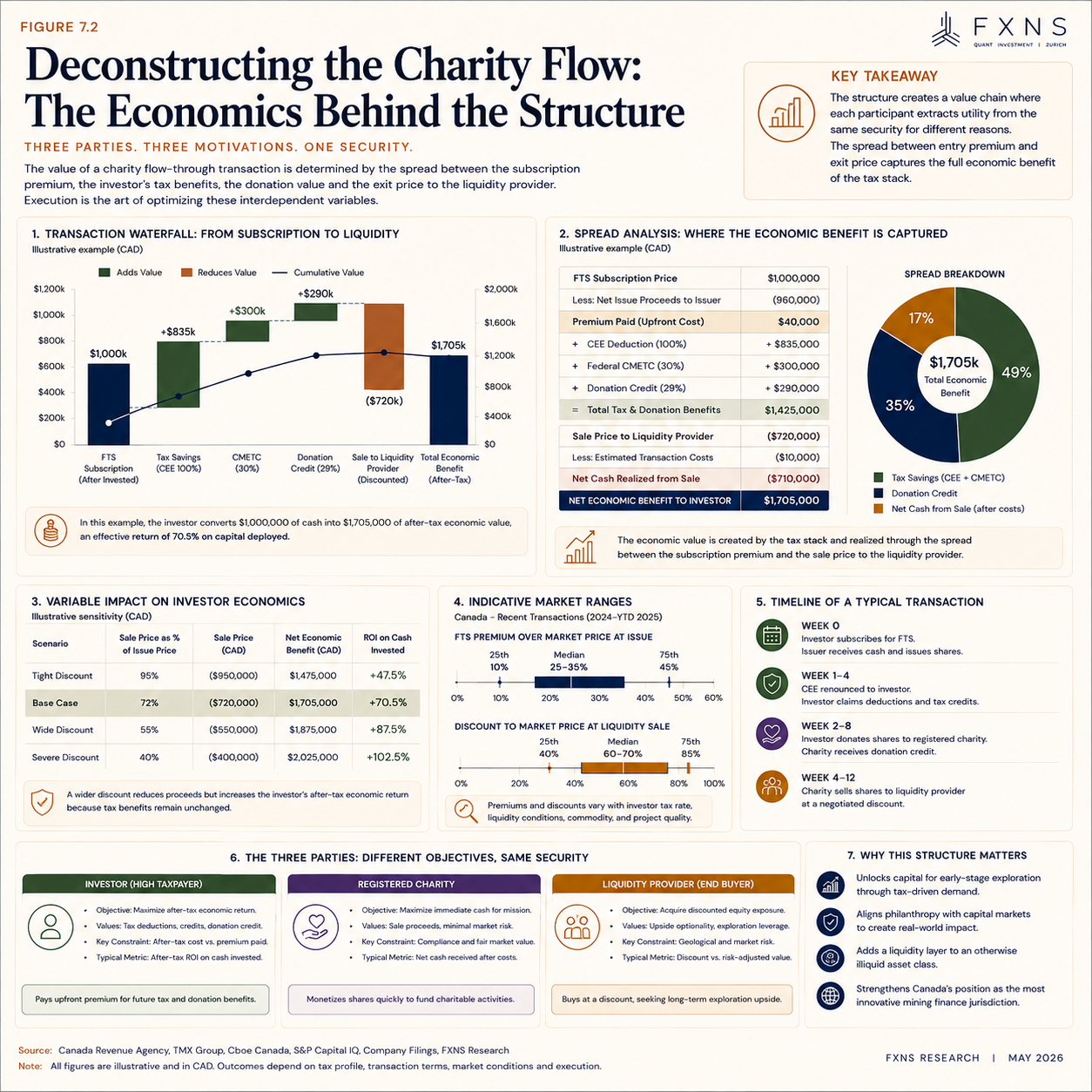
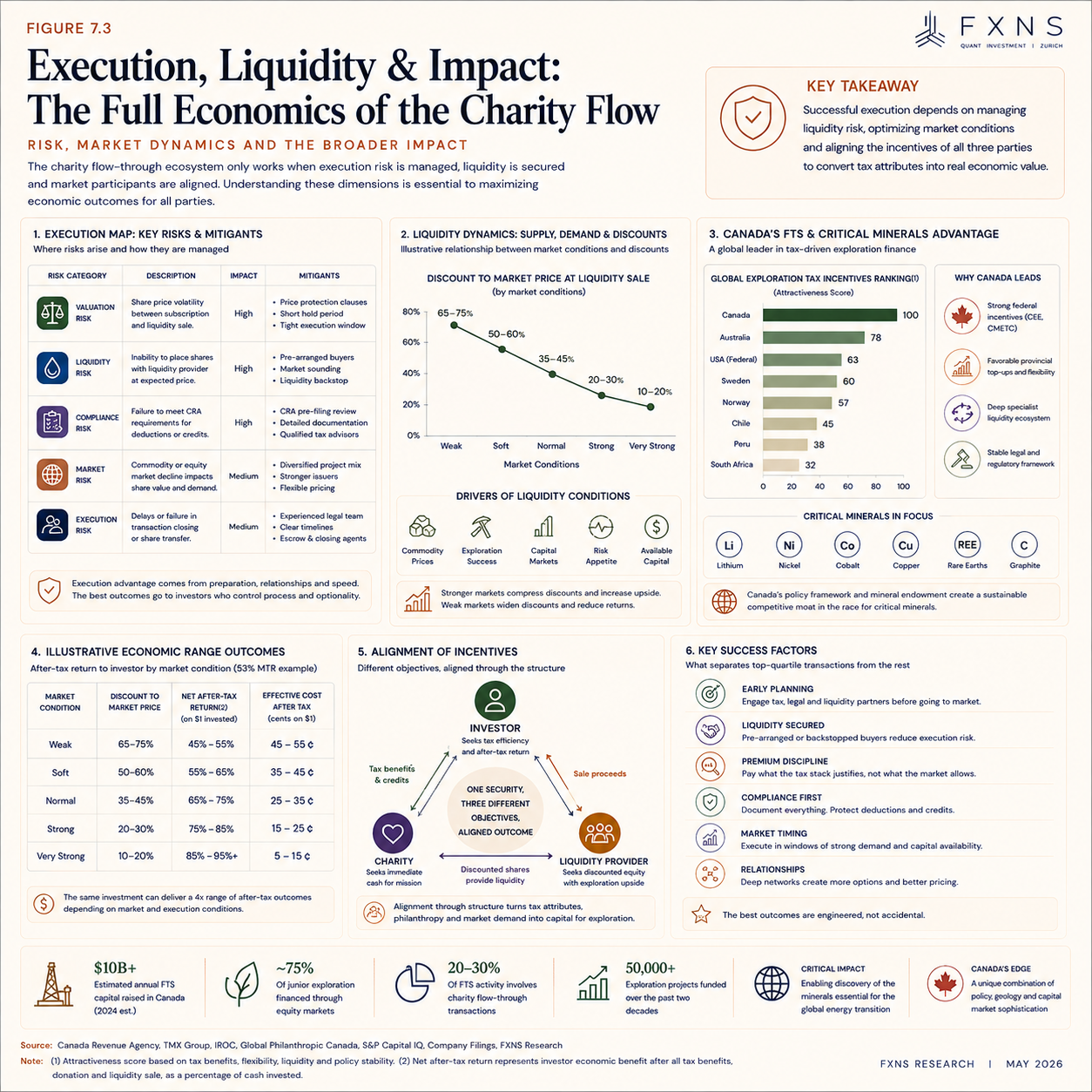
The most sophisticated expression of Canada’s Flow-Through Share market emerges when tax engineering is combined with philanthropy and secondary-market liquidity. In a typical charity flow-through transaction, an investor subscribes for newly issued Flow-Through Shares and receives the associated exploration deductions and, where eligible, critical-mineral tax credits. Rather than retaining the equity exposure, the investor subsequently donates the shares to a registered charity, creating a second layer of tax economics through the charitable donation regime. The charity has little reason to remain exposed to a speculative junior mining company, so the shares are generally monetized through a pre-arranged liquidity mechanism, with an end buyer acquiring the block at a negotiated discount. The result is a transaction in which three participants value the same security for entirely different reasons: the initial investor values its tax attributes, the charity values its immediate cash proceeds, and the liquidity provider values the discounted equity exposure. This separation of incentives is what makes the structure economically powerful. The critical variable is no longer simply the quoted market price of the mining company, but the spread between the subscription premium, the investor’s realized tax benefits, the donation value and the price at which the shares can ultimately be placed with the liquidity provider. Execution therefore becomes a quantitative exercise in optimizing several interconnected variables while controlling valuation, compliance, liquidity and market risk. If the discount required by the final buyer widens, part of the economic advantage disappears; if tax benefits increase, the original investor may rationally tolerate a larger Flow-Through premium. Canada has therefore created something unusual within public equity markets: a financing ecosystem in which tax capacity and market liquidity are effectively supplied by different participants, allowing speculative geological exploration to access capital through a structure whose economics extend far beyond the underlying share price.