

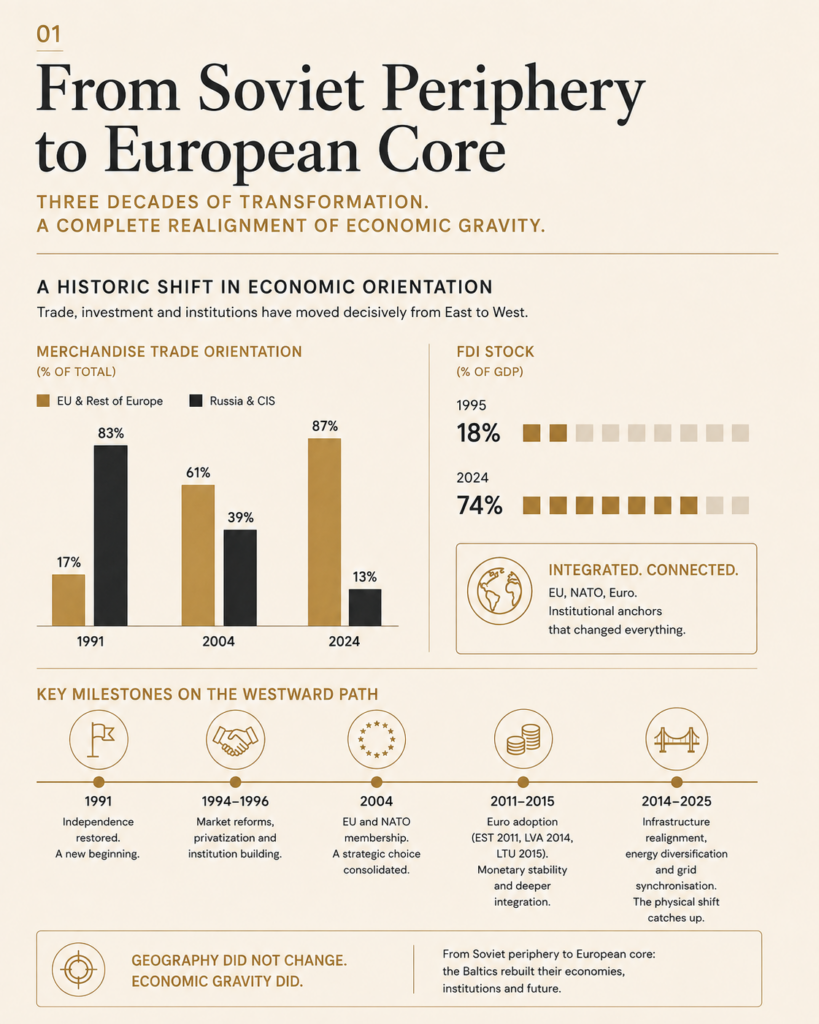
When Estonia, Latvia and Lithuania restored their independence in 1991, they inherited economies whose geography and institutions pointed overwhelmingly east. Production networks had been designed around the Soviet system, trade relationships were concentrated within the former USSR, energy infrastructure was deeply connected to Russia, and domestic institutions had spent decades operating without the mechanisms that underpin a modern market economy. The challenge was therefore considerably larger than conventional economic reform. The Baltic states were not simply attempting to improve an existing model; they were attempting to replace one economic architecture with another. Prices had to be liberalised, currencies established, state assets privatised, financial systems reconstructed and trade redirected toward markets with completely different competitive standards. The initial adjustment was severe. Output collapsed during the early transition years, inflation surged and industries built for Soviet supply chains suddenly found themselves exposed to international competition. Yet the speed of the disruption also created the conditions for unusually rapid institutional change.
The response was characterised by a degree of reform intensity that became one of the defining features of the Baltic economic model. Estonia moved particularly aggressively, introducing a currency board, simplifying taxation, liberalising trade and building institutions around a deliberately open economy. Latvia and Lithuania followed different paths but pursued the same broad strategic direction: macroeconomic stabilisation, private ownership, integration with Western capital markets and eventual membership of European institutions. Foreign investment became critical because the Baltic economies possessed limited domestic capital after decades under the Soviet system. Nordic banks, manufacturers, retailers and telecommunications groups progressively entered the region, bringing not only financing but managerial expertise, technology and access to broader European commercial networks. Sweden and Finland became particularly important economic anchors. The Baltic Sea, once effectively a boundary between competing economic systems, increasingly became the infrastructure through which the Baltic states connected themselves to Northern Europe.
The Challenge: From Soviet Periphery to European Core
European Union accession in 2004 accelerated that transformation. Membership provided access to the Single Market, structural funding, regulatory convergence and a powerful institutional anchor for investors. The importance of this process went beyond increased exports. Baltic companies were progressively incorporated into European production networks, while workers, capital and services gained much greater mobility across the continent. NATO membership in the same year reinforced the geopolitical component of the westward shift, reducing the perceived separation between the Baltic states and the institutions of Western Europe. Adoption of the euro completed another part of the economic transition: Estonia joined in 2011, Latvia in 2014 and Lithuania in 2015. For three small economies with highly open financial systems, monetary integration reduced currency friction and further embedded them within the European economic architecture. In barely two decades, countries that had begun the 1990s without independent monetary systems had become members of one of the world’s largest currency areas.
The transformation was not linear. The global financial crisis exposed how vulnerable small, highly open economies can become when domestic credit expands faster than productive capacity. Baltic property markets and private borrowing had accelerated rapidly before 2008, much of it financed through foreign banking systems. When global liquidity contracted, the adjustment was brutal. Estonia, Latvia and Lithuania experienced some of the deepest output contractions in Europe. Latvia became the most dramatic case, confronting a simultaneous banking, fiscal and economic crisis. Rather than abandoning their European convergence strategy, however, the Baltic states pursued severe internal adjustment, restoring competitiveness through wage restraint, fiscal consolidation and restructuring. The social cost was substantial, and emigration intensified, but the economies subsequently recovered without reversing their strategic orientation. The episode reinforced a characteristic that would repeatedly define the region: when confronted with structural shocks, the Baltics have tended to adjust the system rather than defend the status quo.
Trade geography consequently changed almost beyond recognition. Russia remained economically relevant, particularly in energy, transit and certain export sectors, but the centre of gravity progressively shifted toward the European Union and Nordic economies. Germany, Poland, Sweden and Finland became embedded within Baltic commercial networks, while European supply chains replaced many of the relationships inherited from the Soviet period. The transformation was especially significant because geography itself had not changed. Tallinn remained roughly the same distance from St Petersburg; Riga remained connected to the transport corridors of the former Soviet space; Lithuania continued to border Belarus and Russia’s Kaliningrad region. What changed was the economic meaning of that geography. Infrastructure, regulation, ownership, finance and trade increasingly pulled the three countries westward even while their physical location left them permanently exposed to the East.
That distinction became dramatically more important after Russia’s full-scale invasion of Ukraine in 2022. Economic relationships that had once been treated primarily through the lens of efficiency increasingly came to be evaluated through resilience and security. Russian energy dependence, transit flows and infrastructure connections acquired a strategic cost that conventional economic models had often understated. The Baltic states accelerated efforts to reduce remaining dependencies, strengthen connections with Poland and Scandinavia and integrate critical infrastructure more deeply into European networks. The process reached a particularly symbolic milestone in 2025, when Estonia, Latvia and Lithuania disconnected their electricity systems from the Russian and Belarusian network and synchronised with continental Europe. What appears technically to be an electricity-grid project represented something much larger: one of the final pieces of physical infrastructure inherited from the Soviet economic system had been replaced by a European connection.
Yet integration has not eliminated the structural constraints associated with being small economies. Estonia, Latvia and Lithuania together contain only around six million people. Domestic markets are limited, demographic trends are difficult and decades of outward migration have reduced the available labour force. Their companies therefore cannot rely on domestic scale in the way firms in Germany, France or Poland can. This has pushed the Baltic model toward openness almost by necessity. Exports, foreign investment, cross-border services and participation in larger European networks are not merely sources of additional growth; they are fundamental components of economic viability. Smallness creates vulnerability to external shocks, but it can also reduce institutional inertia. Regulatory changes can be implemented quickly, government systems can be redesigned with fewer legacy structures and new technologies can diffuse across the economy faster than in much larger states.
This is what makes the Baltic transition economically more interesting than a simple story of successful convergence. Estonia, Latvia and Lithuania did not overcome geography; they redefined the networks through which geography matters. In little more than three decades, their economic centre of gravity moved from Moscow toward Brussels, Stockholm, Helsinki, Warsaw and the broader European market. The transformation required accepting considerable short-term adjustment in exchange for long-term institutional integration, and it remains incomplete. Demography, productivity and regional security continue to impose serious constraints. But the strategic direction is now extraordinarily difficult to reverse. The Baltic states did not move west. Their borders remained exactly where they were. Their capital, institutions, infrastructure and economic incentives did — and that changed what being on Europe’s eastern frontier means.
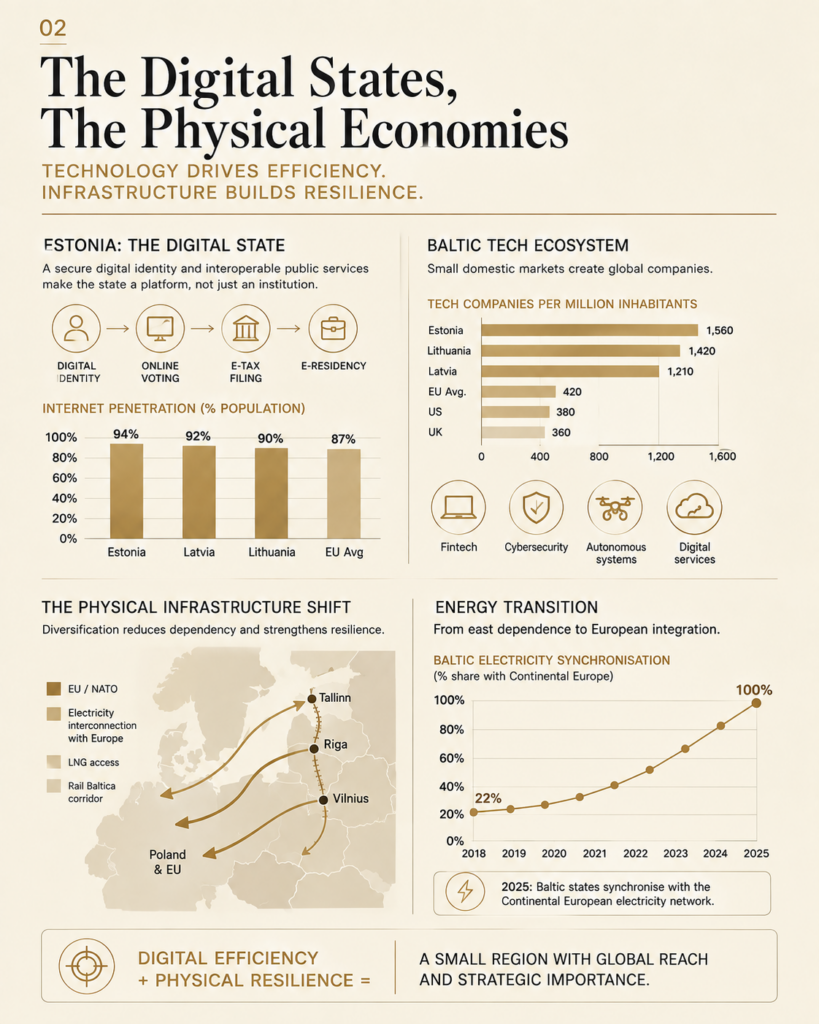
The Baltic digital story is often reduced to Estonia’s most visible achievements: electronic identification, online voting, digital tax filing, e-residency and a startup ecosystem that has produced an unusually large number of technology companies relative to the country’s population. Those achievements matter, but they risk obscuring the more important economic lesson. Digitalisation in the Baltics was never simply a technology policy. It emerged partly as a response to scarcity. Estonia, Latvia and Lithuania entered independence with limited administrative resources, small domestic markets and institutions that needed to be rebuilt rapidly. They could not reproduce the bureaucratic structures of much larger European states at comparable scale. Technology therefore became a way to compress administrative costs, accelerate institutional development and make small economies easier to operate within. What began as a constraint became an incentive to redesign the relationship between citizens, businesses and the state around digital infrastructure rather than legacy processes.
Estonia remains the clearest expression of this model. A secure digital identity became the foundation upon which an expanding range of public and private services could operate, allowing citizens to interact with government, banks, healthcare providers and businesses through a common digital architecture. Tax declarations can be completed rapidly, companies can be established online and public records can communicate through interoperable systems rather than requiring citizens repeatedly to provide the same information to different authorities. The significance is economic as much as administrative. Every hour not spent navigating bureaucracy is effectively a reduction in transaction costs. For a country with fewer than two million inhabitants, reducing friction matters disproportionately because administrative complexity cannot be diluted across a large population or domestic market. Estonia effectively treated the state itself as infrastructure: not merely an institution that regulates economic activity, but a platform designed to make that activity easier to conduct.
Digital States, Physical Economies
The broader Baltic region has developed complementary strengths. Lithuania, and particularly Vilnius, has built a significant fintech ecosystem, using regulatory responsiveness, European market access and a comparatively efficient licensing environment to attract payments companies, financial-technology firms and specialised service providers. Latvia has developed capabilities across financial services, telecommunications, logistics and digital infrastructure, while Riga remains the largest metropolitan economy in the Baltic states. Across all three countries, high internet penetration, digitally literate populations and relatively compact administrative systems have created environments in which new services can be adopted quickly. The region has also generated technology businesses whose commercial reach vastly exceeds the size of their home markets. Skype’s Estonian origins became the early symbol of this phenomenon, followed by companies across mobility, fintech, software, cybersecurity and digital services. Small domestic markets effectively force successful Baltic technology companies to think internationally almost from inception.
This produces an important structural characteristic: the domestic market functions less as the final destination and more as a testing ground. A company founded in Tallinn or Vilnius cannot realistically build a very large business by serving only Estonia or Lithuania. Internationalisation is therefore not a later stage of corporate development; it is embedded into the business model from the beginning. English-language operations, cross-border hiring, European regulation and access to international venture capital become natural components of the ecosystem. This can create a form of economic discipline. Businesses that survive cannot depend indefinitely on the purchasing power of a large protected domestic market. They must develop products capable of competing elsewhere. The same logic applies to government innovation: when administrative systems serve relatively small populations, new architectures can be tested and deployed with less institutional complexity than would be possible in a country of tens of millions of inhabitants.
But digital efficiency cannot repeal physical economics. This is where the Baltic story becomes more interesting than the conventional narrative of a frictionless digital society. Software can allow a company in Tallinn to serve customers in Berlin, London or New York, but manufacturing still requires energy, transportation and labour. Data centres require electricity and physical connectivity. Exports require ports, roads and railways. Workers require housing, healthcare and urban infrastructure. Supply chains remain exposed to geography. The Baltics occupy the northeastern edge of the European Union, adjacent to Russia and Belarus and connected to the rest of continental Europe through a relatively narrow geographic corridor. Their ports provide access to the Baltic Sea, but physical trade with Central Europe remains dependent on infrastructure whose strategic importance has increased substantially since 2022. A digital state can eliminate paperwork; it cannot eliminate distance.
Energy demonstrates the same constraint. For years, the Baltic states could modernise their institutions faster than they could replace infrastructure inherited from the Soviet system. Electricity networks, gas supply and transport links retained an eastward orientation long after financial and political institutions had moved west. Diversification therefore required physical investment: LNG capacity, electricity interconnectors with Nordic and continental European markets, new pipelines and grid infrastructure. The 2025 synchronisation of the Baltic electricity systems with continental Europe represented the culmination of years of engineering and capital expenditure that no digital platform could substitute. Rail Baltica embodies a similar logic. Its strategic objective is fundamentally physical: improve north-south rail connectivity between Tallinn, Riga, Kaunas, Warsaw and the wider European network. These projects demonstrate the limit of the digital advantage. Institutional agility can accelerate decisions, but resilience ultimately requires concrete, cables, railways, ports and generation capacity.
Demography imposes an even harder constraint. Estonia, Latvia and Lithuania have all confronted combinations of ageing populations, low birth rates and significant historical emigration. Digitalisation can make each worker more productive and automate portions of public administration, but it cannot indefinitely compensate for a shrinking labour pool. Technology companies can recruit internationally and remote work can expand the effective talent market, yet housing availability, immigration policy, wages and quality of life determine whether skilled workers actually choose to relocate. The Baltic economic experiment therefore increasingly depends on converting digital sophistication into productivity growth. If output per worker rises sufficiently, smaller populations can sustain higher living standards. If productivity stagnates, demographic decline becomes progressively more difficult to offset regardless of administrative efficiency.
Cybersecurity adds another dimension because digitalisation creates both resilience and vulnerability. A state that moves critical functions online becomes dependent on the security and continuity of its digital infrastructure. Estonia learned this particularly early following the major cyberattacks of 2007, an experience that accelerated investment in cyber defence, distributed systems and institutional expertise. Cybersecurity subsequently became not only a defensive necessity but an economic capability, contributing to a broader ecosystem around secure digital infrastructure and defence technology. The Baltics therefore illustrate an important paradox of modernisation: the more efficient an economy becomes through connectivity, the more valuable the systems underlying that connectivity become — and the more costly their disruption would be.
The result is a model in which digital and physical infrastructure should not be viewed as substitutes. They are complementary forms of capital. Digital systems reduce administrative friction, allow businesses to scale beyond national borders and enable governments to operate with unusual efficiency. Physical infrastructure determines whether energy, goods, people and data can move securely through the region. Human capital determines whether either system can generate sustained productivity. The next stage of Baltic development will depend on connecting all three. The strategic advantage of the Baltics is not that technology allows them to escape the constraints of being small. It is that digital efficiency allows them to extract more economic value from limited scale — while investing in the physical networks required to ensure that smallness does not become isolation.
Initial Concepts: The Great Decoupling
For much of the period following independence, the Baltic states lived with an unusual economic contradiction. Politically, institutionally and financially, Estonia, Latvia and Lithuania were moving decisively toward the West. Their accession to the European Union and NATO in 2004 formalised that trajectory, while euro adoption and integration into Nordic banking and European trade networks progressively embedded them within the Western economic system. Yet beneath that institutional architecture, important parts of the region’s physical economy continued to point east. Electricity networks remained synchronised with Russia and Belarus, Russian gas retained a significant role in regional energy supply, ports and railways carried substantial east-west transit flows, and infrastructure inherited from the Soviet period continued to shape the movement of energy and goods. The Baltics had changed economic systems faster than they had changed the physical networks beneath them. For years, that mismatch appeared manageable. After Russia’s full-scale invasion of Ukraine in 2022, it became a strategic vulnerability.
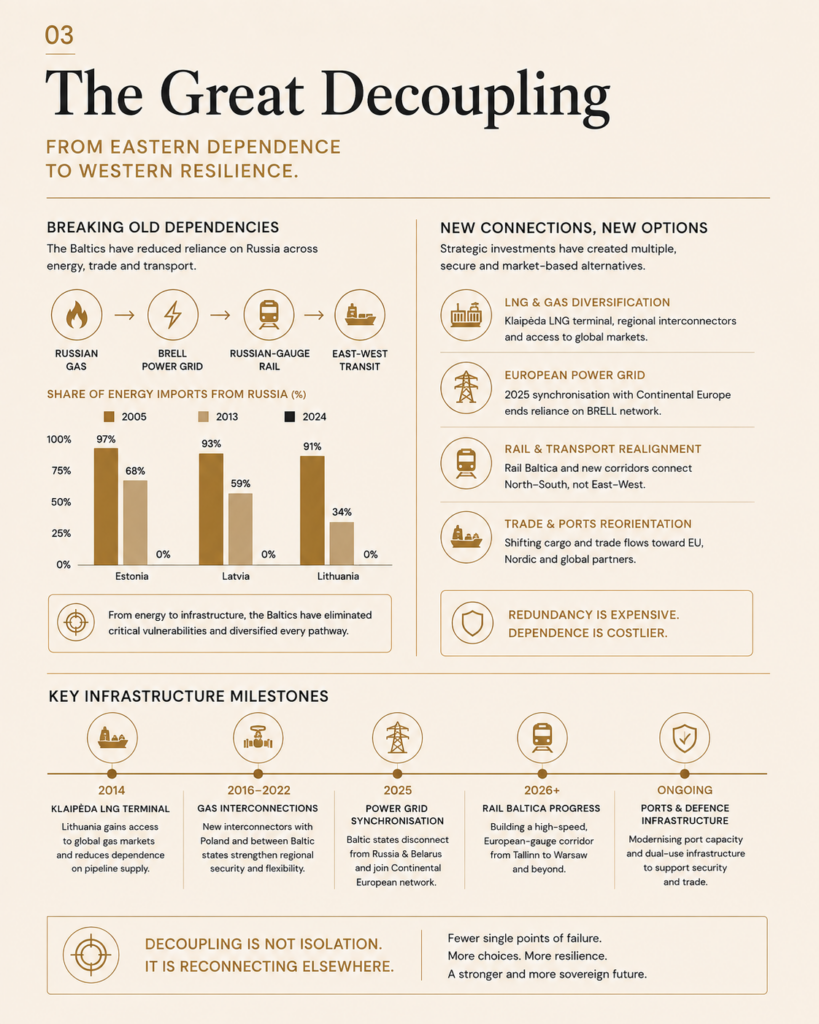
Energy was the most obvious point of exposure. Lithuania, Latvia and Estonia had historically depended to varying degrees on Russian oil, gas and electricity, reflecting infrastructure designed during an era in which national borders were economically irrelevant inside the Soviet system. Cheap and accessible supply had an obvious commercial logic, but it also created concentration risk. Lithuania began addressing that vulnerability before the geopolitical rupture of 2022. The opening of the Klaipėda LNG terminal in 2014 gave the country access to seaborne natural gas and created an alternative to pipeline dependence. Its floating storage and regasification vessel was deliberately named Independence, an unusually explicit acknowledgement that energy infrastructure had become an instrument of national sovereignty. What initially looked like expensive redundancy later demonstrated its strategic value: infrastructure that may appear inefficient under normal conditions can become extraordinarily valuable when the underlying geopolitical regime changes.
The same logic progressively reshaped the regional gas system. New interconnections allowed gas to move more flexibly between the Baltic states and neighbouring European markets, while the Gas Interconnection Poland–Lithuania strengthened access to the broader continental network. Latvia’s underground storage capacity acquired greater regional importance, and LNG infrastructure across the Baltic Sea expanded the number of potential supply routes. Following the invasion of Ukraine, the Baltic states moved rapidly to eliminate or drastically reduce direct dependence on Russian gas. The economic consequence was not costless. Alternative energy could be more expensive, infrastructure required capital and European energy prices experienced extreme volatility. But the objective function had changed. The relevant question was no longer simply which supplier could deliver a marginal unit of energy at the lowest price. It was whether the system could continue functioning if a politically unreliable supplier disappeared entirely.
Electricity represented an even deeper legacy because the Baltic power systems remained physically connected to the Russian-controlled BRELL network decades after independence. Estonia, Latvia and Lithuania could join the European Union, adopt the euro and integrate their financial systems with Western Europe while their electricity frequency was still managed within an infrastructure architecture linking them to Russia and Belarus. Changing that required far more than signing new commercial contracts. Interconnectors had to be built, grid stability strengthened, reserve capacity developed and technical systems prepared for independent operation. In February 2025, the three Baltic states disconnected from the Russian and Belarusian electricity system and synchronised with the Continental European Network. Economically, the event was technical. Strategically, it was historic. One of the last major pieces of Soviet-era systemic integration had been physically removed.
Transport is undergoing a comparable, though slower, transformation. Baltic rail infrastructure historically reflected an east-west economic geography, using the Russian-gauge system and supporting freight flows between the former Soviet space and Baltic ports. That model generated transit revenues for years, particularly in Latvia and Lithuania, but its strategic and commercial relevance has weakened as trade with Russia and Belarus declined. Rail Baltica represents the opposite geography. The project is designed to connect Tallinn, Riga and Kaunas with Poland and the wider European rail network using European standard gauge. Its economics are often debated because major cross-border infrastructure projects are expensive, complex and vulnerable to delays and cost overruns. But evaluating Rail Baltica purely through conventional passenger or freight demand misses part of its purpose. It is simultaneously a transport corridor, a European integration project and an element of strategic mobility along NATO’s northeastern frontier.
Trade itself has followed the infrastructure. Russia once represented a much larger share of Baltic commercial activity, while ports and logistics businesses benefited from handling Russian and Belarusian cargo moving toward international markets. That relationship has progressively contracted under the combined effects of sanctions, deliberate diversification and Russia’s own development of alternative ports and routes. Baltic businesses have consequently redirected commercial relationships toward the EU, Scandinavia and other international markets. The adjustment has created losers. Transit-dependent companies cannot instantly replace freight volumes, and businesses built around eastern trade have faced structural decline. Yet at the aggregate level, reduced exposure to Russia also decreases the ability of a single external market to transmit economic or political pressure through trade.
This transformation illustrates an important distinction between efficiency and resilience. Globalisation encouraged economies to optimise supply chains around cost, speed and comparative advantage. Redundant infrastructure often looked economically wasteful because maintaining multiple suppliers, routes or energy connections increased expense. Geopolitical fragmentation changes that calculation. A second LNG source, an additional electricity interconnector or a rail corridor with spare capacity may produce a lower financial return under normal conditions while possessing enormous option value during disruption. The Baltics have become an unusually clear laboratory for this new economic logic. Their exposure is sufficiently high that resilience cannot remain an abstract policy objective; it must be built physically into the network.
Decoupling, however, should not be confused with isolation. Estonia, Latvia and Lithuania are not attempting to become self-sufficient economies. For countries of their size, autarky would be economically destructive. Their strategy is almost exactly the opposite: replace concentrated dependence with deeper diversification and broader integration. Russian gas is replaced not necessarily by domestic gas, but by access to global LNG markets. The Russian-controlled electricity system is replaced by synchronisation with continental Europe. East-west rail dependence is supplemented by north-south connections to Poland and Central Europe. Commercial exposure to Russia is replaced by participation in the much larger European Single Market. The objective is therefore not independence from external networks; it is freedom from dependence on any network that can become a single point of failure.
There is a price attached to this architecture. Energy security requires investment. New infrastructure can raise costs before it raises productivity. Defence considerations increasingly influence projects that would once have been judged almost entirely on commercial returns. And geographic exposure cannot be engineered away: Estonia, Latvia and Lithuania will remain located beside Russia and Belarus regardless of how many interconnectors they build. But infrastructure changes the economic consequences of that geography. A border can remain fixed while the networks crossing it become fundamentally different.
The Great Decoupling is therefore not simply the story of the Baltics disconnecting from Russia. It is the story of reconnecting themselves elsewhere. Over three decades, political integration with Europe came first, financial and commercial integration followed, and the physical infrastructure underneath the economy is now catching up. Ports, pipelines, electricity grids, railways and digital networks are progressively being redesigned around a north-south and westward economic orientation. The process is expensive and remains incomplete, but its strategic logic is increasingly clear. Resilience does not mean having fewer connections. It means having enough connections that no single one can determine your economic future.
The Baltic story is not about overcoming geography, but redesigning the systems that make geography matter. Small markets demanded openness, vulnerability demanded resilience, and limited scale demanded speed — proving that strategic relevance is determined not by size, but by the ability to adapt when inertia is not an option.
FXNS RESEARCH
The Economics of the Frontier
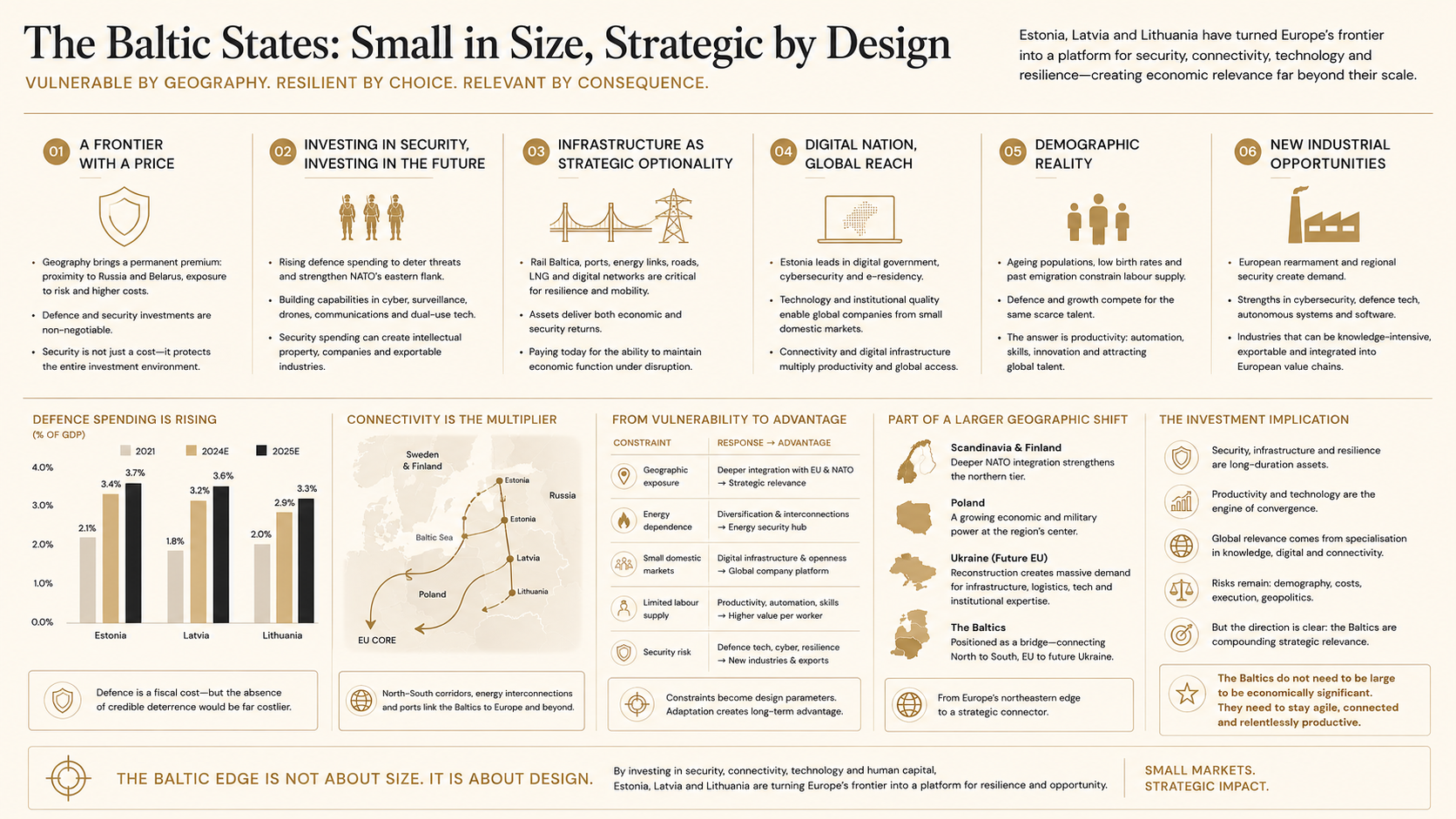
The Baltic states occupy a position in Europe where geography carries an unusually high economic price. Estonia, Latvia and Lithuania are small, open economies located at the intersection of the European Union, Scandinavia and the post-Soviet space, with Russia and Belarus immediately beside them and the Baltic Sea connecting them to the Nordic economies. For much of the post-independence period, this location could be interpreted simultaneously as a vulnerability and a commercial advantage. Ports handled east-west trade, proximity to Russia supported transit activity and relatively low operating costs helped attract foreign investment into economies progressively integrating with Western Europe. That balance has changed. As geopolitical risk has increased and economic relationships with Russia have contracted, the Baltic frontier has acquired a different meaning. Geography is no longer primarily a question of access to neighbouring markets. It increasingly determines how much these countries must invest simply to guarantee the security, connectivity and continuity that economies further west can largely take for granted.
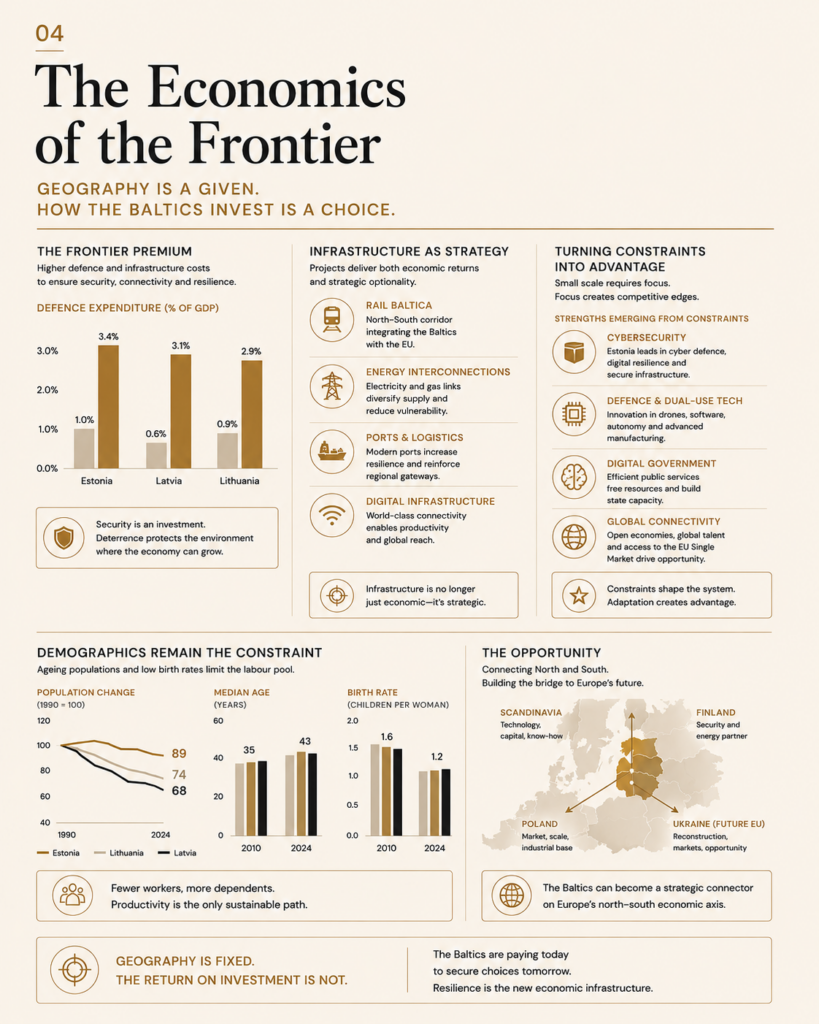
Defence is the clearest expression of this frontier premium. Estonia, Latvia and Lithuania have progressively increased military expenditure as security conditions in the region have deteriorated, committing a growing share of national resources to capabilities that would otherwise have been available for infrastructure, education, healthcare or tax reduction. For larger economies, additional defence spending can be absorbed across a broad fiscal base. For countries with populations measured in the low millions, the trade-offs are more visible. Yet defence expenditure should not be understood exclusively as a fiscal burden. In the Baltic context, credible security is itself a component of the investment environment. Factories, data centres, technology companies and foreign investors make long-duration decisions partly on assumptions about political stability and infrastructure continuity. A credible security architecture therefore protects the value of the civilian capital stock. The frontier premium is expensive, but the absence of credible deterrence could be considerably more expensive.
This is beginning to alter the region’s industrial opportunity set. European rearmament and the growing importance of NATO’s northeastern flank create demand for defence manufacturing, cybersecurity, surveillance, communications, drones and dual-use technologies. The Baltics are unusually well positioned in several of these areas because security requirements overlap with capabilities developed through their digital transformation. Estonia in particular has accumulated significant expertise in cybersecurity and digital resilience, while companies across the region are increasingly active in autonomous systems, defence software and military technology. These sectors possess characteristics that suit small economies: they can be knowledge-intensive rather than dependent on enormous domestic markets, exportable from inception and integrated into wider European or NATO procurement networks. Security expenditure can therefore generate economic spillovers if it produces intellectual property, specialised manufacturing and companies capable of competing internationally rather than remaining dependent on domestic government contracts.
Infrastructure is undergoing a similar strategic repricing. Rail Baltica, electricity interconnections, ports, roads, LNG infrastructure and digital networks can no longer be evaluated purely through conventional commercial metrics. A railway may have value because it carries passengers and freight, but also because it provides an additional logistical corridor between the Baltic states and the rest of Europe. A port may generate revenue from commercial cargo while simultaneously increasing strategic mobility. Electricity infrastructure can improve market efficiency while reducing vulnerability to external coercion. This creates a more complicated capital-allocation environment because assets increasingly produce both economic and security returns. Traditional cost-benefit analysis remains necessary, but it becomes incomplete when the value of redundancy is revealed primarily during periods of disruption. The Baltics are effectively investing in optionality: paying today for the ability to maintain economic function under conditions they hope never occur.
Demography, however, remains the structural constraint that security investment cannot solve. Latvia and Lithuania experienced particularly significant population declines following independence, driven by low birth rates, ageing and outward migration, while Estonia has faced similar pressures on a smaller scale. European integration increased economic opportunity but also made it easier for workers to relocate to higher-wage markets elsewhere in the EU. As income levels converge, some of that incentive diminishes and migration patterns can become more balanced, but the underlying arithmetic remains difficult. Smaller working-age populations must support ageing societies while companies compete for scarce labour. Defence requirements can tighten that constraint further by increasing demand for engineers, technicians and other skilled workers already sought by civilian industries.
The economic response must therefore rely heavily on productivity. Small economies cannot create labour that does not exist, but they can increase the amount of value generated by each worker. Automation, digital public services, advanced manufacturing, software, fintech and high-value professional services all fit this requirement. So does attracting international talent. The next stage of Baltic convergence may consequently depend less on reproducing the industrial structure of larger European economies and more on specialising in sectors where knowledge, connectivity and institutional quality matter more than domestic scale. This is also why the region’s digital infrastructure is strategically important: it allows companies operating from small home markets to address customers across Europe and globally without requiring a proportional expansion of physical distribution networks.
The Baltics may also gain relevance from changes occurring beyond their borders. Finland and Sweden’s deeper integration into NATO changes the strategic geometry of Northern Europe, while Poland’s economic and military importance continues to grow. Ukraine’s eventual reconstruction could create substantial demand for logistics, infrastructure, digital systems, financial services and engineering expertise. Estonia, Latvia and Lithuania possess geographic proximity, historical knowledge of post-Soviet institutional transformation and direct experience integrating their own economies into European structures. If Ukraine moves progressively closer to the European Union over the long term, the Baltic region could become part of a larger north-south economic corridor connecting Scandinavia, Finland, the Baltic states, Poland and eventually Ukraine. What was once viewed as Europe’s northeastern edge could begin to function more like a strategic connector.
That possibility illustrates the distinction between periphery and frontier. A periphery is defined by distance from the economic centre. A frontier can be defined by what lies beyond it and by the networks that converge there. The Baltic states remain far smaller than the major European economies and will never possess comparable domestic scale. But systemic relevance does not require scale in every dimension. Singapore demonstrates the importance a small state can acquire through trade and finance; Switzerland through capital and specialised industries; the Nordic economies through technology and institutional quality. The Baltic version will necessarily be different, but the principle is similar. Cybersecurity expertise, energy interconnection, military mobility, digital government and strategic logistics can make a region economically significant beyond what conventional GDP rankings suggest.
There are obvious risks to this thesis. Higher defence expenditure can crowd out productive civilian investment. Large infrastructure projects can suffer delays and cost overruns. Government support for strategic industries can produce inefficient allocation if political objectives replace commercial discipline. Persistent demographic weakness can constrain growth even when productivity improves. And geopolitical proximity can itself discourage investment if businesses perceive the risk premium as too high. The Baltic investment case should therefore never be romanticised as a simple story in which adversity automatically produces innovation. Vulnerability creates incentives to adapt; it does not guarantee that adaptation will succeed.
The deeper lesson is that Estonia, Latvia and Lithuania have increasingly learned to treat constraints as design parameters. Small domestic markets encouraged openness. Limited administrative capacity encouraged digitalisation. Energy dependence encouraged diversification. Geographic exposure encouraged deeper European integration. Security risk is now encouraging investment in defence, infrastructure, cybersecurity and resilience. None of these advantages eliminates the original vulnerability, but each changes the economic response to it. The Baltics do not need to become large economies to become strategically important ones. Their opportunity is to turn Europe’s frontier from a source of permanent vulnerability into a platform for connectivity, technology and resilience — making their economic relevance substantially larger than their physical scale.



I look forward to seeing how these developments will improve service levels and customer satisfaction in the freight industry!