

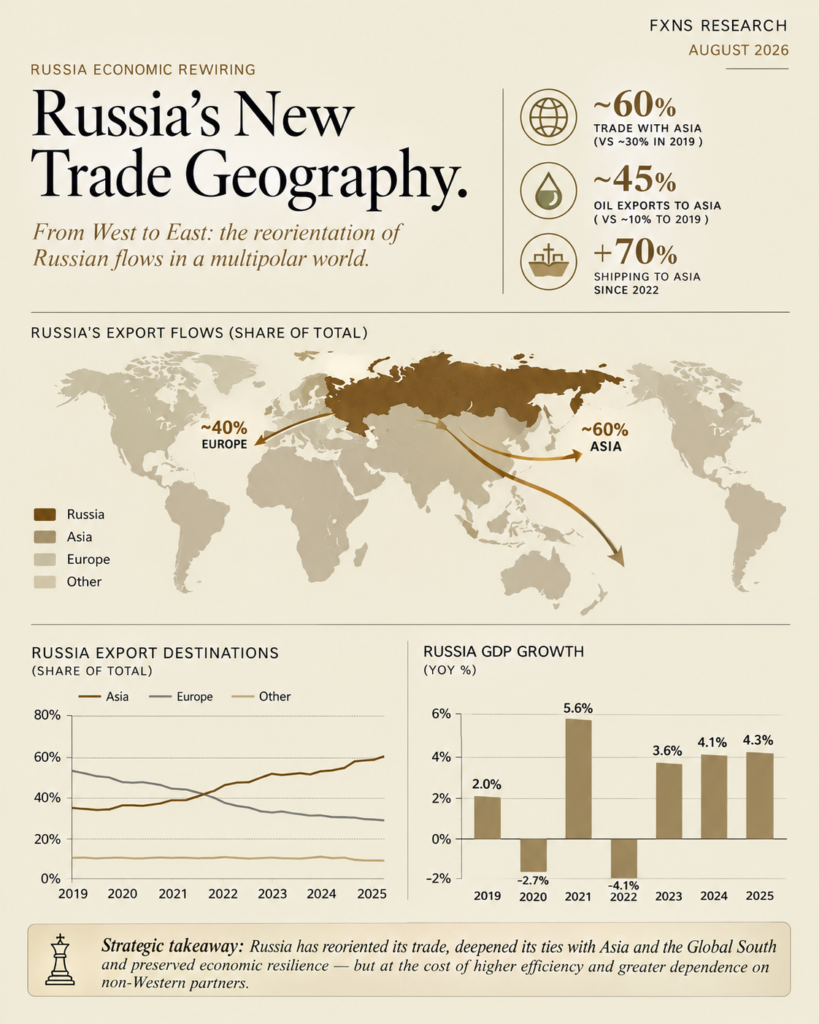
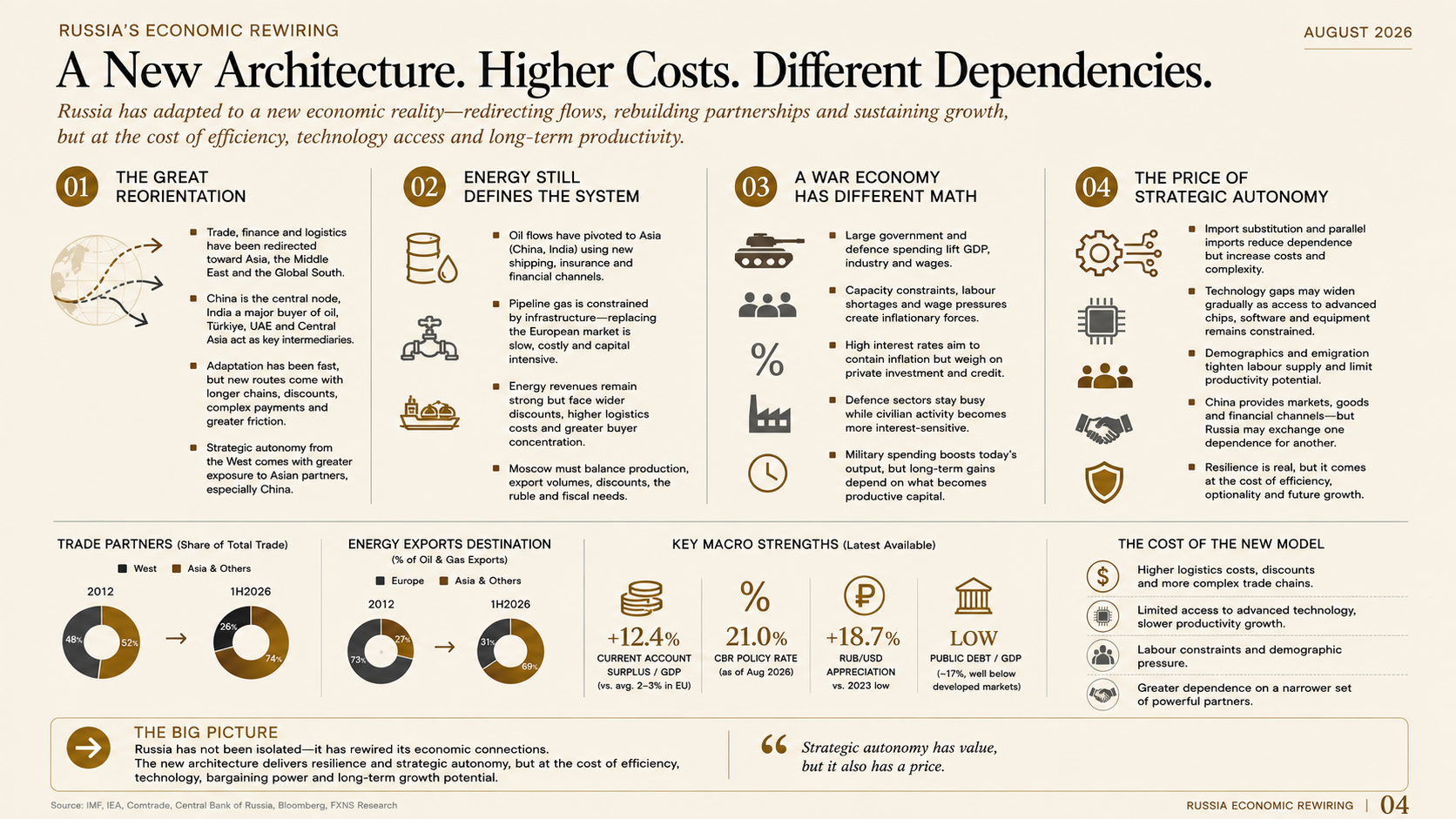
For decades, Russia’s economic geography was fundamentally oriented westward. Europe was not simply another export market: it was the natural destination for Russian energy, the source of sophisticated machinery and technology, an important provider of capital and, through decades of accumulated infrastructure, the endpoint of a deeply integrated commercial system. Pipelines, rail networks, ports and corporate relationships had been built around that geography. The rupture with the West after 2022 therefore represented far more than a conventional trade shock. Russia suddenly faced the challenge of redirecting a substantial part of an economic architecture that had taken decades to construct. What followed was not complete isolation, but an extraordinary re-routing of trade, payments and logistics toward a different set of counterparties.
China has become the central node of this new configuration. Russian commodity exports increasingly move eastward, while Chinese machinery, vehicles, electronics and industrial components have replaced part of the supply previously sourced from Europe. India has emerged as a major buyer of Russian crude, transforming bilateral trade that had historically been relatively modest. Türkiye, the United Arab Emirates and several Central Asian economies have simultaneously expanded their role as commercial intermediaries, logistics hubs and channels through which goods can reach the Russian market. The result is a more complex trading system in which direct relationships have often been replaced by longer supply chains, alternative currencies, new shipping arrangements and jurisdictions capable of operating between Russia and the Western financial system.
The Challenge: The Great Reorientation
This adaptation has demonstrated an important distinction between economic isolation and economic fragmentation. Russia remains deeply connected to the global economy because the commodities it produces remain globally relevant and because large non-Western economies have continued to trade with it. But connectivity has changed in both direction and quality. Redirecting a barrel of oil from Europe to Asia is possible; reproducing an entire ecosystem of finance, technology, specialised equipment and high-value industrial inputs is considerably more difficult. Longer transport routes, greater intermediation, price discounts and more complicated payment structures introduce friction into the system. Trade can survive while becoming less efficient. Resilience, in other words, does not imply that the economic cost of adjustment is zero.
The reorientation also changes Russia’s negotiating position. Its previous relationship with Europe contained mutual dependencies: European economies required Russian energy, while Russia benefited from proximity to wealthy customers, sophisticated financial markets and advanced industrial suppliers. The emerging relationship with Asia is structurally different. China in particular possesses greater economic scale and a much broader range of alternative suppliers than Russia possesses alternative markets for many of its exports. As bilateral trade expands, Moscow therefore gains strategic distance from the West while simultaneously increasing its exposure to Beijing. Diversification away from one economic sphere can create concentration within another.
For investors and policymakers, this is the essential feature of Russia’s new economic map. The country has not disappeared behind an economic wall; it has reconstructed many of its external connections through different markets, currencies and intermediaries. The remarkable element is the speed with which those flows have adapted. The more consequential question, however, is what this new architecture ultimately costs in productivity, bargaining power and access to technology. Russia’s great reorientation should therefore be understood not as a retreat from globalization, but as a migration from one version of globalization to another — one that is more fragmented, more politically conditioned and increasingly centred on the economic networks of the Global South and Asia.
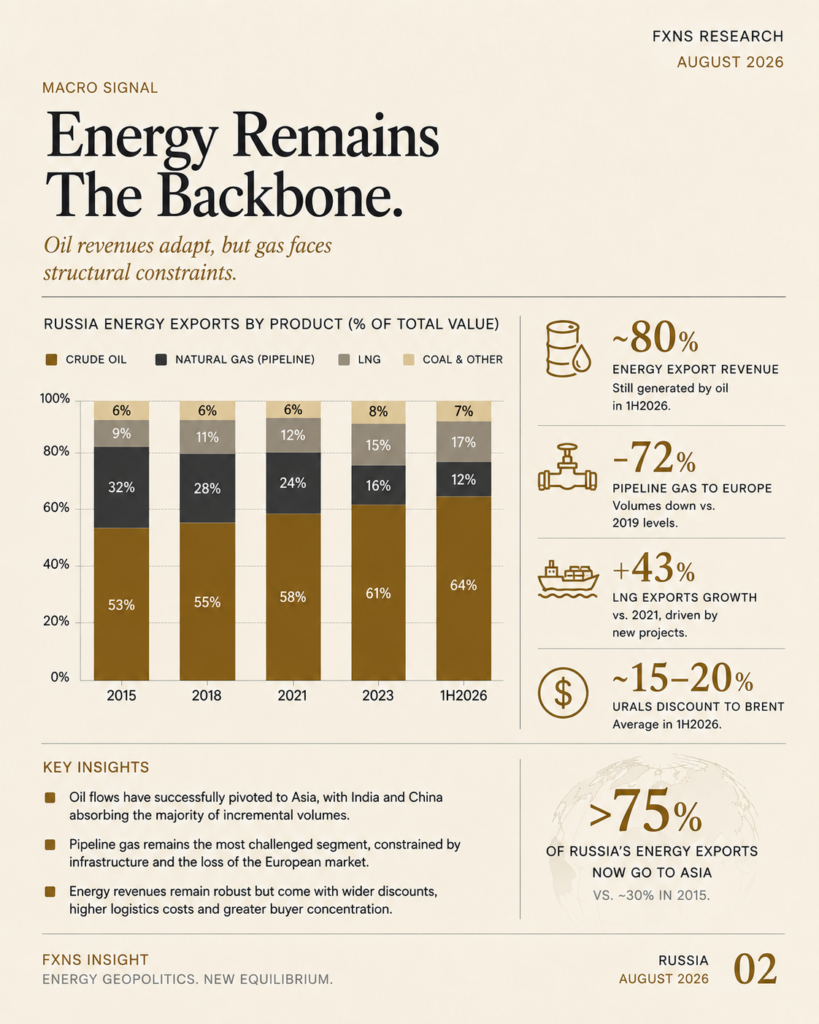
Energy remains the economic foundation of modern Russia. Oil and gas revenues have historically provided the country with export earnings, fiscal resources and the foreign currency required to finance imports, while extensive pipeline infrastructure created a uniquely profitable relationship with nearby European consumers. Geography was a powerful economic advantage: Russia could deliver enormous volumes of hydrocarbons directly into some of the world’s wealthiest industrial economies through infrastructure that had already been built and amortised over decades. The breakdown of that relationship has not eliminated Russia’s energy relevance, but it has fundamentally altered the economics surrounding it. Moscow still possesses vast reserves and substantial production capacity; what has changed is where those molecules can be sold, how they reach the buyer and how much value Russia can capture along the way.
Oil has proven considerably more adaptable than pipeline gas. Crude is inherently global: cargoes can change destination, shipping networks can be reorganised and new buyers can emerge when price incentives become sufficiently attractive. Russia therefore redirected substantial volumes toward Asian markets, particularly China and India, while developing a more complex ecosystem of traders, insurers, vessels and financial intermediaries capable of operating outside traditional Western channels. The adjustment demonstrated the flexibility of global commodity markets, but it also introduced additional costs. Longer voyages require more shipping capacity, sanctions complicate financing and insurance, and buyers aware of Russia’s narrower set of alternatives can demand more favourable terms. The barrels continue to move, but the commercial architecture surrounding them has become more expensive and less transparent.
Results Revealed: Energy Still Defines the System
Natural gas presents a much harder problem because infrastructure determines geography. For decades, Russia’s gas strategy was built around pipelines running west into Europe. Once those flows collapsed, the underlying production could not simply be redirected overnight toward Asia. New pipelines require years of construction, enormous capital commitments and long-term agreements between producers and buyers. Existing connections to China provide an important eastern outlet, and future infrastructure could expand that relationship substantially, but replacing the scale and economics of the former European market remains a formidable challenge. Liquefied natural gas offers greater geographical flexibility, yet LNG itself requires specialised liquefaction technology, vessels, financing and access to equipment that can become vulnerable to external restrictions. Russia therefore faces an unusual asymmetry: abundant gas resources coexist with a constrained ability to monetise them across alternative markets.
This transformation has broader fiscal consequences. Energy revenues remain deeply connected to the state’s capacity to finance public expenditure, industrial policy and strategic priorities. Moscow must therefore balance several variables simultaneously: maintaining production, preserving export volumes, managing discounts, stabilising the currency and extracting sufficient fiscal revenue from the energy sector without undermining investment. Higher global oil prices can temporarily conceal many of these frictions, while lower prices expose them quickly. The resilience of the Russian economy is consequently still closely linked to conditions in global commodity markets. Strategic autonomy may have increased in some dimensions, but dependence on hydrocarbon cash flows remains one of the system’s defining vulnerabilities.
The longer-term question is therefore not whether Russia can continue selling energy. It almost certainly can. The more important issue is the quality of the energy rent it can preserve. Selling hydrocarbons into a diversified European market through short transport routes and established infrastructure is economically different from selling increasingly toward a smaller number of powerful Asian buyers through longer and more complex supply chains. Russia’s energy system is being rebuilt around this new geography, with pipelines turning east, shipping routes becoming more important and Asia assuming a larger role in price formation and demand. Energy still defines the Russian economic system — but the transition from privileged supplier to Europe toward strategically important supplier to Asia may ultimately preserve volumes while reducing some of the pricing power, efficiency and optionality that made the previous model exceptionally profitable.
A War Economy Has Different Mathematics
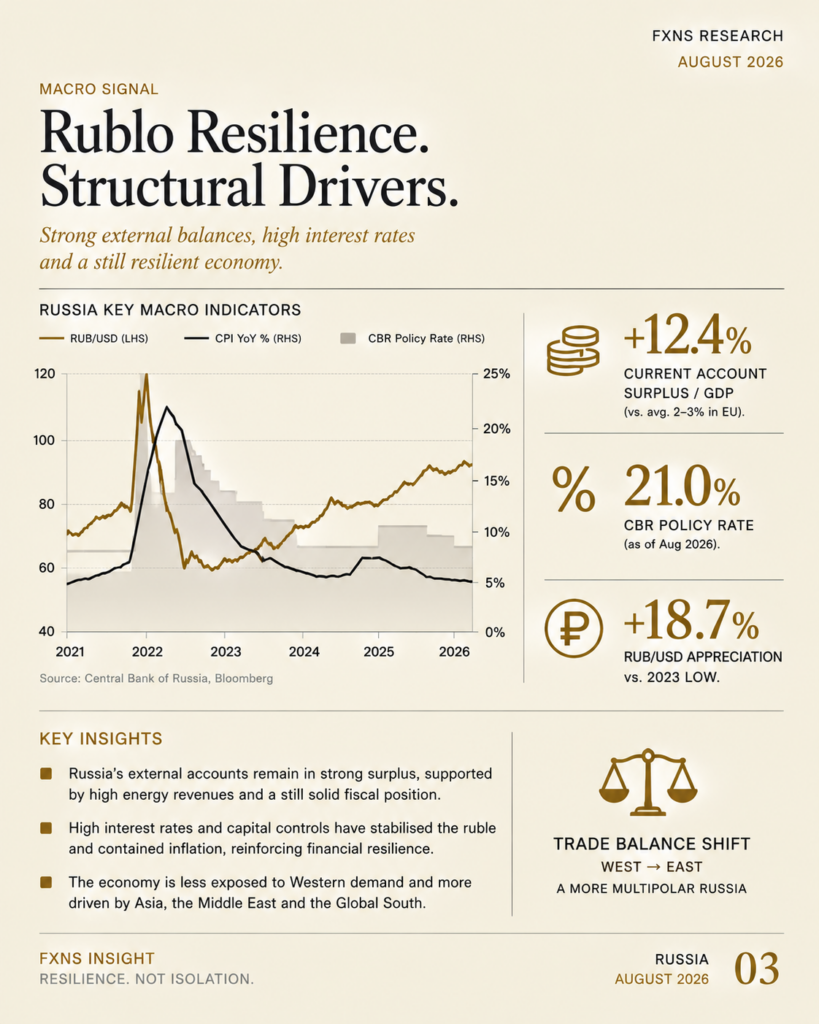
Russia’s recent economic performance illustrates why headline GDP can become an incomplete measure of economic health when the structure of demand changes dramatically. Large-scale government expenditure, particularly on defence, security and associated industrial production, can generate substantial measured output. Factories operate at higher utilisation rates, procurement orders expand, wages rise in strategically important sectors and fiscal transfers support household incomes. In conventional national accounting, a tank, an artillery shell and a piece of productive machinery all contribute to current output when they are produced. Yet their implications for future productive capacity are fundamentally different. Russia can therefore record strong activity while simultaneously reallocating labour, capital and industrial resources toward sectors whose contribution to long-term civilian productivity is far less certain.
This distinction matters because the Russian economy is operating increasingly close to its capacity constraints. Mobilisation, emigration and adverse demographic trends have tightened an already limited labour market, while defence manufacturers and civilian companies compete for engineers, technicians and skilled workers. Rising wages can support consumption, but when wage growth exceeds improvements in productivity it also creates inflationary pressure. The same dynamic applies to industrial capacity. Government orders can keep factories exceptionally busy, yet high utilisation does not necessarily indicate that the underlying productive frontier is expanding. When an economy cannot easily increase the supply of labour, technology or capital equipment, additional demand increasingly translates into higher prices rather than additional real output.
Monetary policy consequently faces an unusual challenge. Fiscal policy is pushing demand into the economy at precisely the moment when supply constraints are becoming more binding. The central bank can respond with restrictive interest rates in an attempt to contain inflation and stabilise expectations, but higher borrowing costs then place pressure on the civilian economy, particularly businesses dependent on private credit and households considering large purchases. This creates a growing divergence between sectors. Defence-related industries supported directly or indirectly by government spending can remain highly active even as interest-sensitive private investment becomes more difficult to finance. Aggregate GDP may therefore conceal a significant redistribution of resources from market-driven activity toward state-directed production.
There is also an important temporal dimension. Military expenditure can stimulate current output quickly, but its economic legacy depends on what remains once the spending impulse eventually moderates. Infrastructure, education, technological diffusion and productive capital can raise an economy’s future capacity to generate income. A large proportion of wartime production, by contrast, is consumed rather than accumulated: equipment is deployed, ammunition is expended and resources are absorbed without necessarily creating assets capable of producing future civilian cash flows. At the same time, sustained defence spending can generate technological spillovers, industrial learning and investment in selected manufacturing capabilities. The relevant question is therefore not whether military expenditure produces economic activity — it clearly does — but how much of that activity ultimately increases the economy’s long-run productive potential.
This is why the mathematics of a war economy requires a different analytical lens. Strong GDP growth, low unemployment and rising industrial output can coexist with inflation, labour scarcity, elevated interest rates, reduced private-sector optionality and an increasingly distorted allocation of capital. None of these observations imply that the Russian economy is on the verge of collapse; its ability to mobilise resources and maintain activity has repeatedly proved more resilient than many external forecasts anticipated. But resilience should not be confused with efficiency. The central issue is whether today’s extraordinary mobilisation strengthens tomorrow’s productive economy or merely brings future resources forward to sustain current activity. For Russia, the longer the present configuration persists, the more important that distinction becomes.
Russia has shown that economic isolation is rarely absolute. Trade can be rerouted, capital can adapt and new markets can replace old ones. But resilience should not be mistaken for efficiency: every alternative route carries a cost, and strategic autonomy ultimately depends on how much productivity a nation is willing to exchange for freedom of action.
FXNS RESEARCH Tweet
The Price of Strategic Autonomy
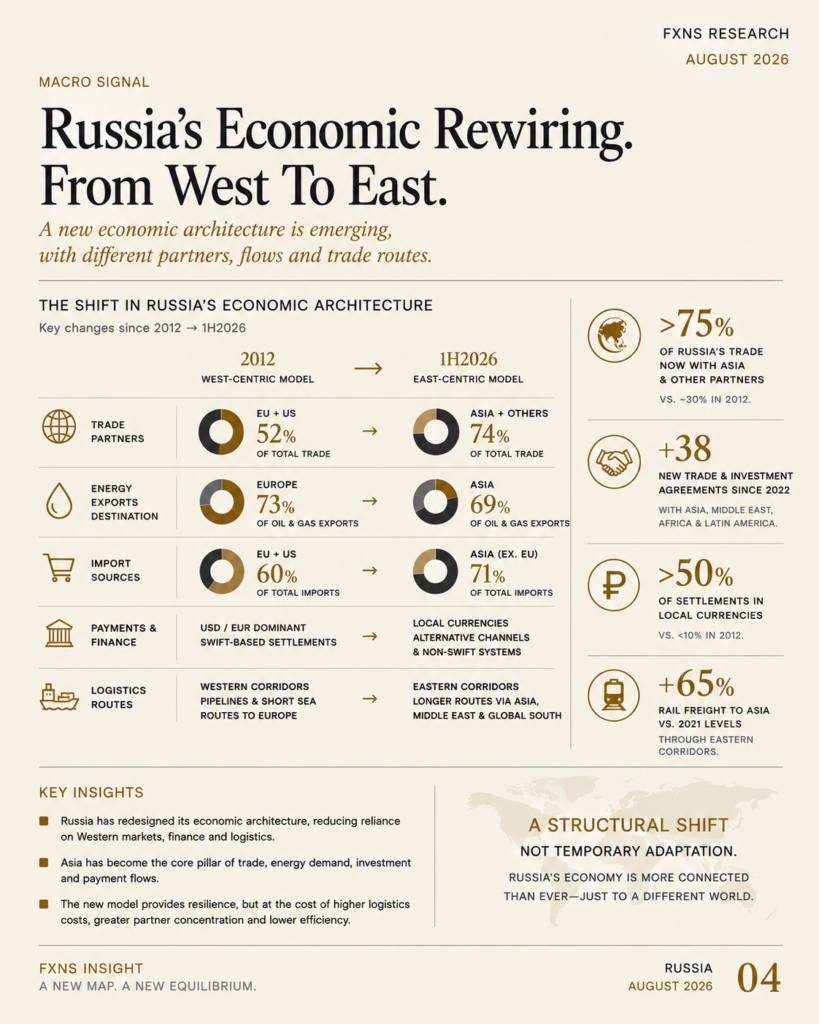
Russia’s economic transformation is ultimately a trade-off between resilience and efficiency. Since the rupture with the West, the country has demonstrated a greater capacity to absorb financial restrictions, redirect trade and sustain domestic activity than many early forecasts anticipated. Alternative payment channels have developed, imports have been rerouted, domestic production has replaced selected foreign goods and new commercial relationships have expanded across Asia, the Middle East and the Global South. From Moscow’s perspective, these adjustments represent more than emergency responses to sanctions. They form part of a broader attempt to reduce exposure to Western financial infrastructure, currencies, technology and political leverage. Strategic autonomy has therefore become an economic objective in its own right — even when achieving it requires accepting higher costs.
Import substitution is one of the clearest examples. Replacing foreign suppliers can strengthen domestic industrial capacity and reduce vulnerability to future external restrictions, particularly in sectors considered strategically important. But substitution does not automatically mean equivalence. Modern economies depend on extraordinarily specialised networks of machinery, software, semiconductors, engineering expertise and intermediate components that cannot always be reproduced domestically at comparable cost or quality. Parallel imports and third-country intermediaries can preserve access to many products, but longer supply chains introduce additional margins, logistical complexity and uncertainty. Russia can therefore become less dependent on Western suppliers while simultaneously operating with a higher structural cost base. What appears politically as greater sovereignty may economically resemble a permanent efficiency premium.
Technology represents the deeper constraint. Russia retains substantial scientific expertise, a sophisticated defence-industrial base and significant capabilities in engineering, nuclear energy and aerospace. Yet the technological frontier increasingly depends on globally integrated ecosystems in advanced semiconductors, computing infrastructure, industrial software and precision manufacturing. Restricted access to parts of those ecosystems may not cause an immediate collapse in productive capacity; existing equipment can be maintained, inventories can be accumulated and alternative suppliers can emerge. The effects are more likely to compound gradually. Investment decisions become harder, replacement cycles lengthen and the technological gap can widen incrementally as competitors continue to adopt newer systems. The most consequential costs of economic fragmentation may therefore appear not in current GDP, but in productivity several years into the future.
Demographics reinforce this challenge. Russia entered the current period with an ageing population and an already constrained labour supply. Emigration among some younger and highly skilled workers, mobilisation and rising demand from defence-related industries have intensified competition for human capital. Companies can respond through higher wages, automation and productivity investment, but each solution carries costs of its own. An economy attempting simultaneously to expand military production, replace foreign technology, develop domestic industries and construct new trade infrastructure requires considerable amounts of capital and skilled labour. Strategic autonomy is therefore not merely a question of whether Russia can produce more domestically; it is a question of how efficiently scarce resources can be allocated across competing national priorities.
The other side of the equation is Russia’s growing relationship with China. Beijing provides markets for Russian commodities, manufactured goods that can substitute for Western imports and a financial-commercial ecosystem capable of supporting bilateral trade outside many Western channels. This relationship materially increases Russia’s ability to withstand economic separation from Europe and the United States. But it also creates a new asymmetry. China’s economy is substantially larger, its industrial base far broader and its network of global trading relationships more diversified. Russia may therefore reduce one form of external dependence only to become increasingly reliant on a partner with greater negotiating leverage. Strategic autonomy, paradoxically, can coexist with strategic concentration.
This is the central paradox of Russia’s economic rewiring. The country has shown that a large, resource-rich economy cannot easily be isolated from a multipolar global system. Commodities find buyers, goods find alternative routes and capital adapts when incentives are sufficiently strong. But adaptability does not eliminate cost. Russia’s new economic architecture may prove durable, yet it is likely to be more state-directed, more dependent on non-Western intermediaries and potentially less efficient than the system it replaces. The relevant question is therefore not whether Russia can survive economic fragmentation — it has already demonstrated considerable capacity to do so. The question is how much productivity, technological optionality and future growth it must exchange for greater geopolitical freedom of action. Strategic autonomy has value, but it also has a price.



I look forward to seeing how these developments will improve service levels and customer satisfaction in the freight industry!