Location
ASSET CLASS
STRUCTURE
RESEARCH FOCUS


The global economy is entering a new era of capital intensity. As growth becomes increasingly dependent on physical assets, long-term financing and sustained capital expenditure, the defining challenge of the 2027–2031 cycle will be transforming massive investment commitments into productivity, sustainable cash flows and returns that justify the cost of capital.
The brief
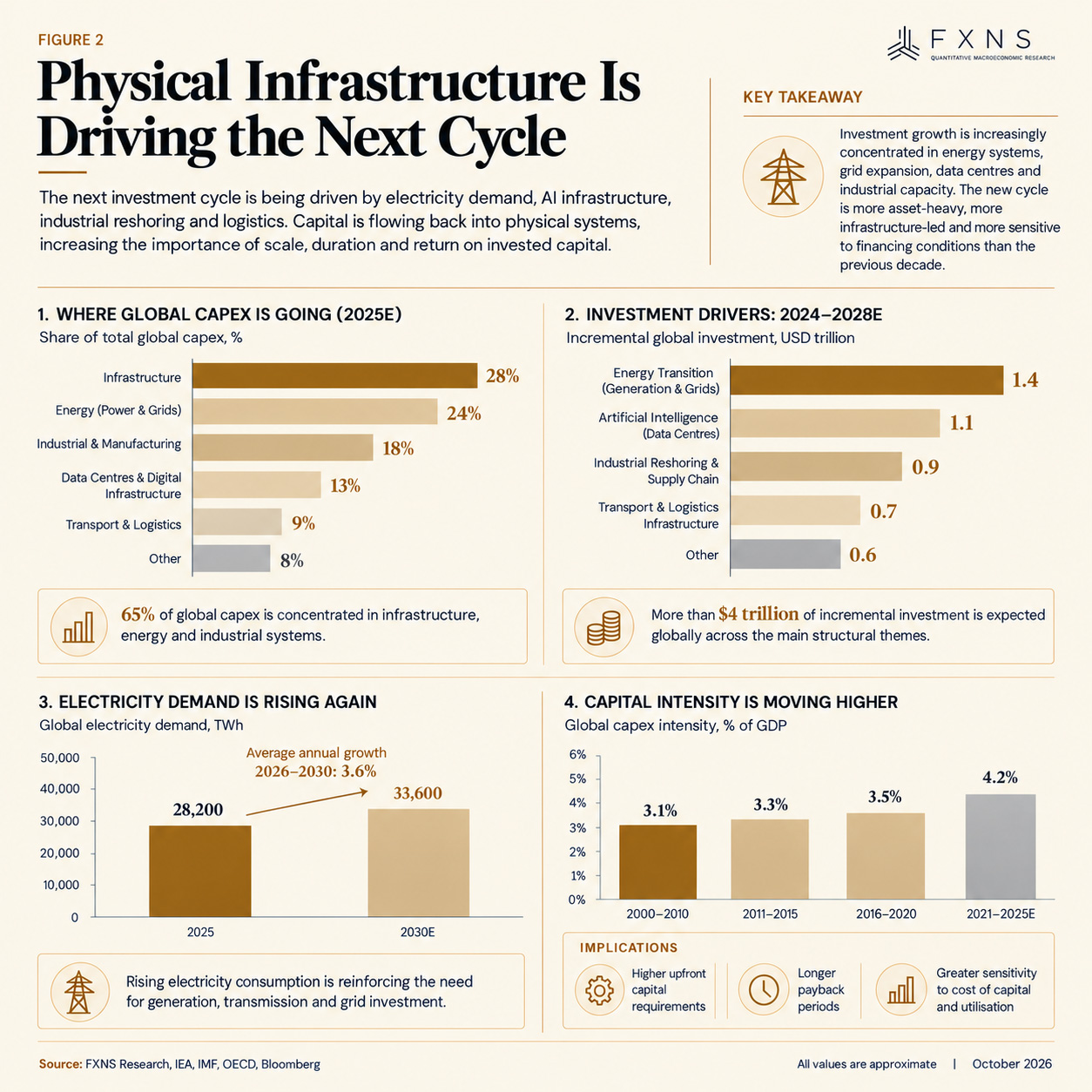
The global economy is entering a new investment cycle in which physical infrastructure, industrial capacity and energy systems are becoming increasingly important drivers of economic expansion. Artificial intelligence, electrification and advanced manufacturing are accelerating demand for data centres, power generation, transmission networks and capital-intensive production facilities. According to the International Energy Agency, global electricity demand is projected to grow by approximately 3.6% annually through 2030, underscoring the scale of infrastructure investment required to support the next phase of economic growth.
This transformation represents more than an acceleration in capital expenditure. For decades, asset-light business models allowed companies to expand revenues with comparatively limited incremental investment in physical infrastructure. The emerging cycle introduces higher upfront capital requirements, longer development horizons and greater exposure to financing costs, depreciation and capacity utilisation. The relationship between economic growth and shareholder value is therefore becoming increasingly dependent on capital efficiency rather than expansion alone.
Over the 2027–2031 horizon, the fundamental challenge will be converting unprecedented investment commitments into sustainable productivity gains, operating cash flows and attractive returns on invested capital. Infrastructure development and technological adoption may support aggregate economic growth while producing highly uneven financial outcomes across companies and sectors. The defining question of the next investment cycle is not how much capital the global economy can mobilise, but whether that capital can generate returns exceeding its cost.
RESEARCH FOCUS
Structural increase in global capital expenditure and investment intensity
Artificial intelligence, electrification and infrastructure investment requirements
Capital allocation, financing costs and investment-cycle sustainability
Return on invested capital, free cash flow and productivity transmission
Valuation discipline and capital efficiency across the 2027–2031 horizon
KEY QUESTION
Can the global economy convert rising capital intensity into sustainable productivity and financial returns, or will the next investment cycle expose a widening gap between capital expenditure and economic value creation?
The Capital-Intensive Cycle Takes Shape
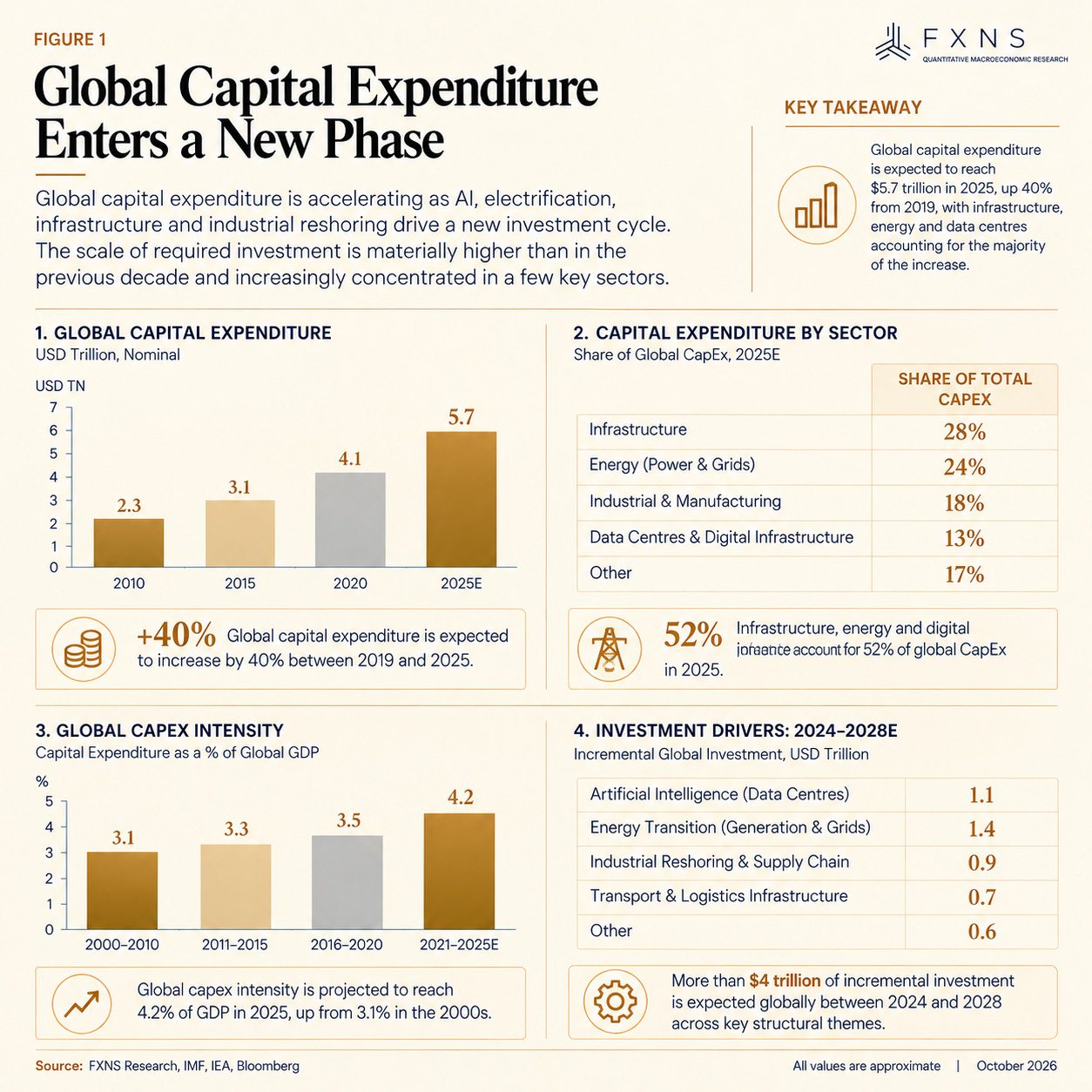
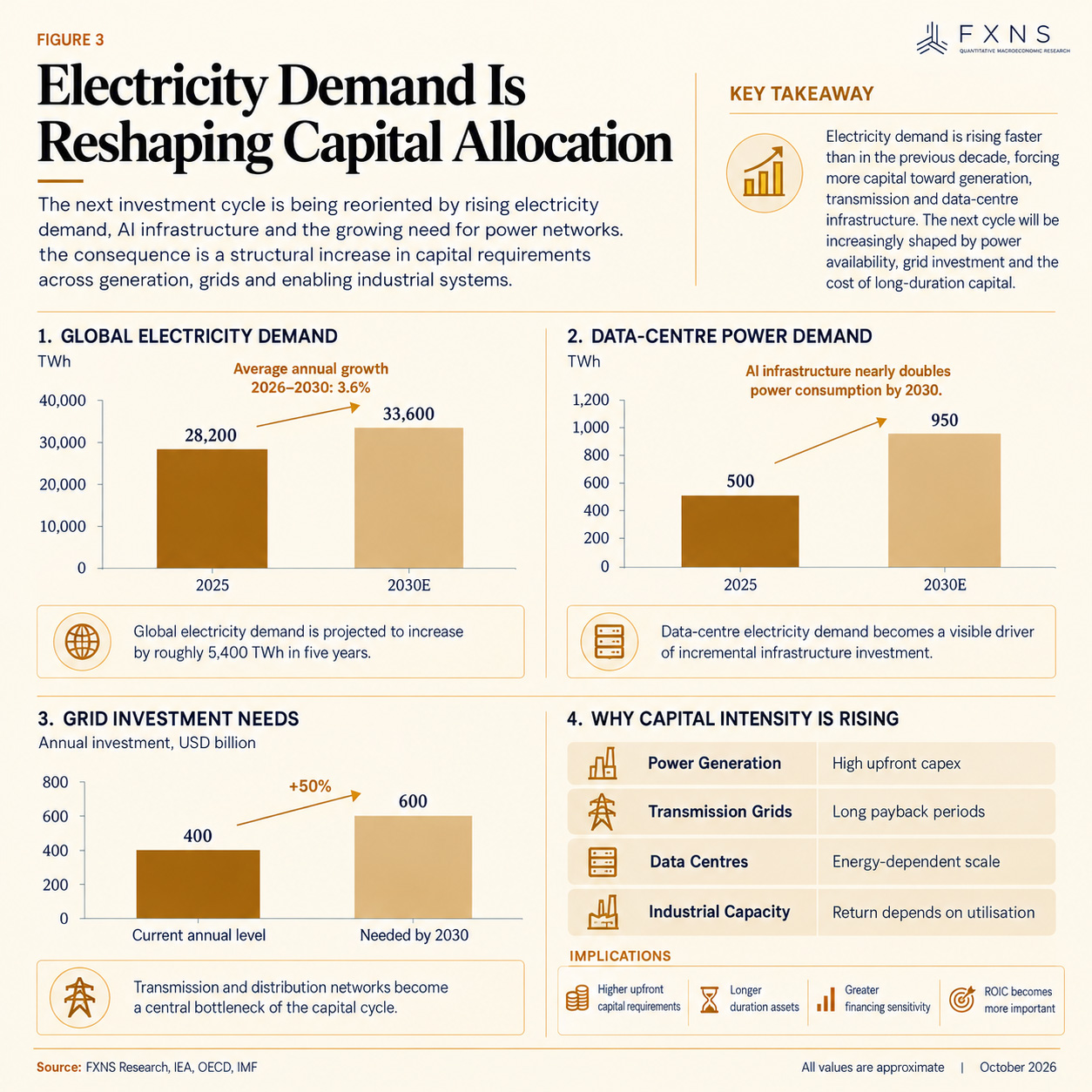
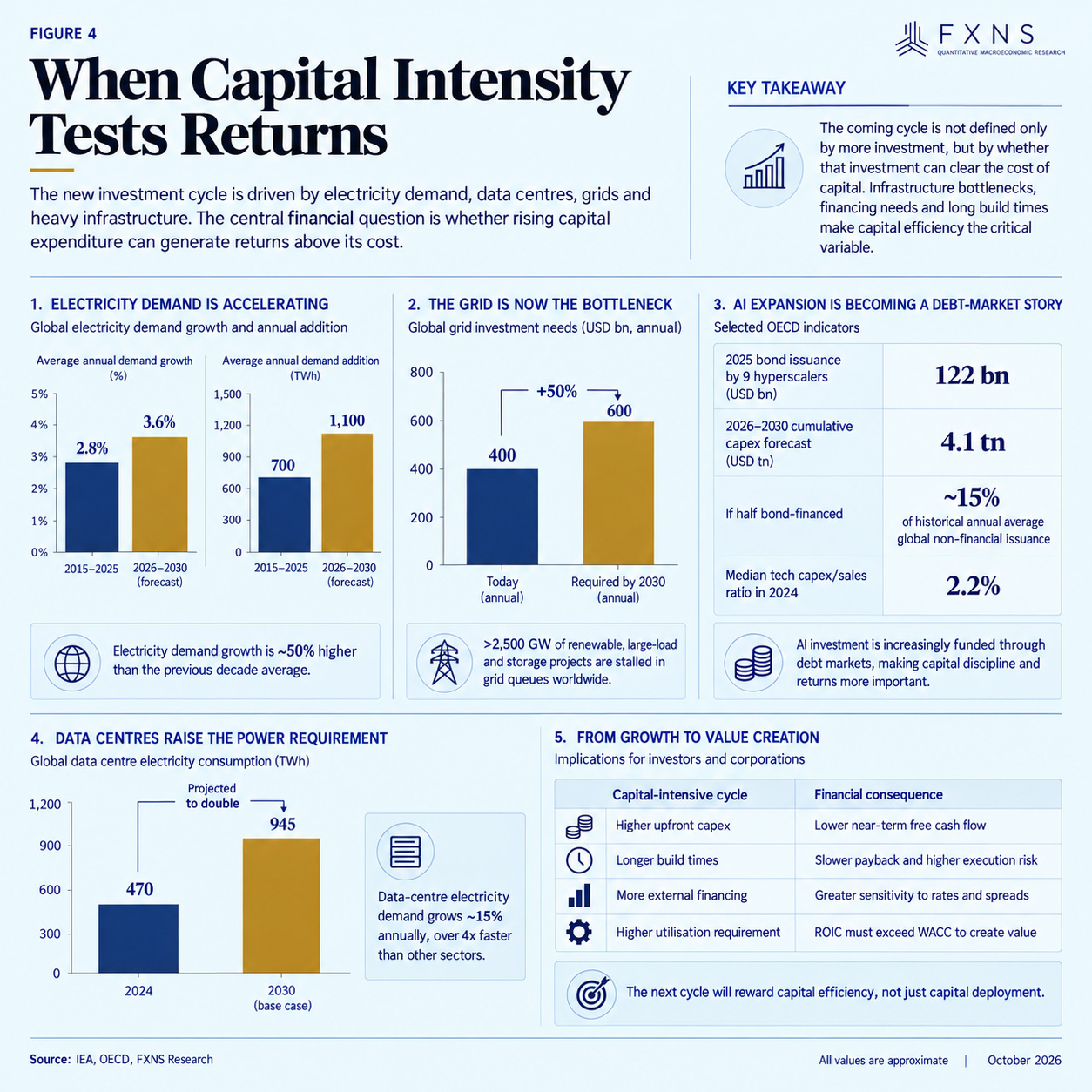
The defining feature of the emerging global investment cycle is not simply the acceleration of capital expenditure, but the structural increase in physical capital required to generate economic growth. Artificial intelligence, electrification, advanced manufacturing and infrastructure modernisation are creating demand for data centres, power generation, transmission networks and increasingly sophisticated industrial facilities. According to the International Energy Agency, global electricity demand is projected to increase by approximately 3.6% annually through 2030, while investment in electricity networks must expand substantially to accommodate rising consumption and new generating capacity. What was once predominantly a technology-driven expansion is increasingly becoming a capital-intensive infrastructure cycle.
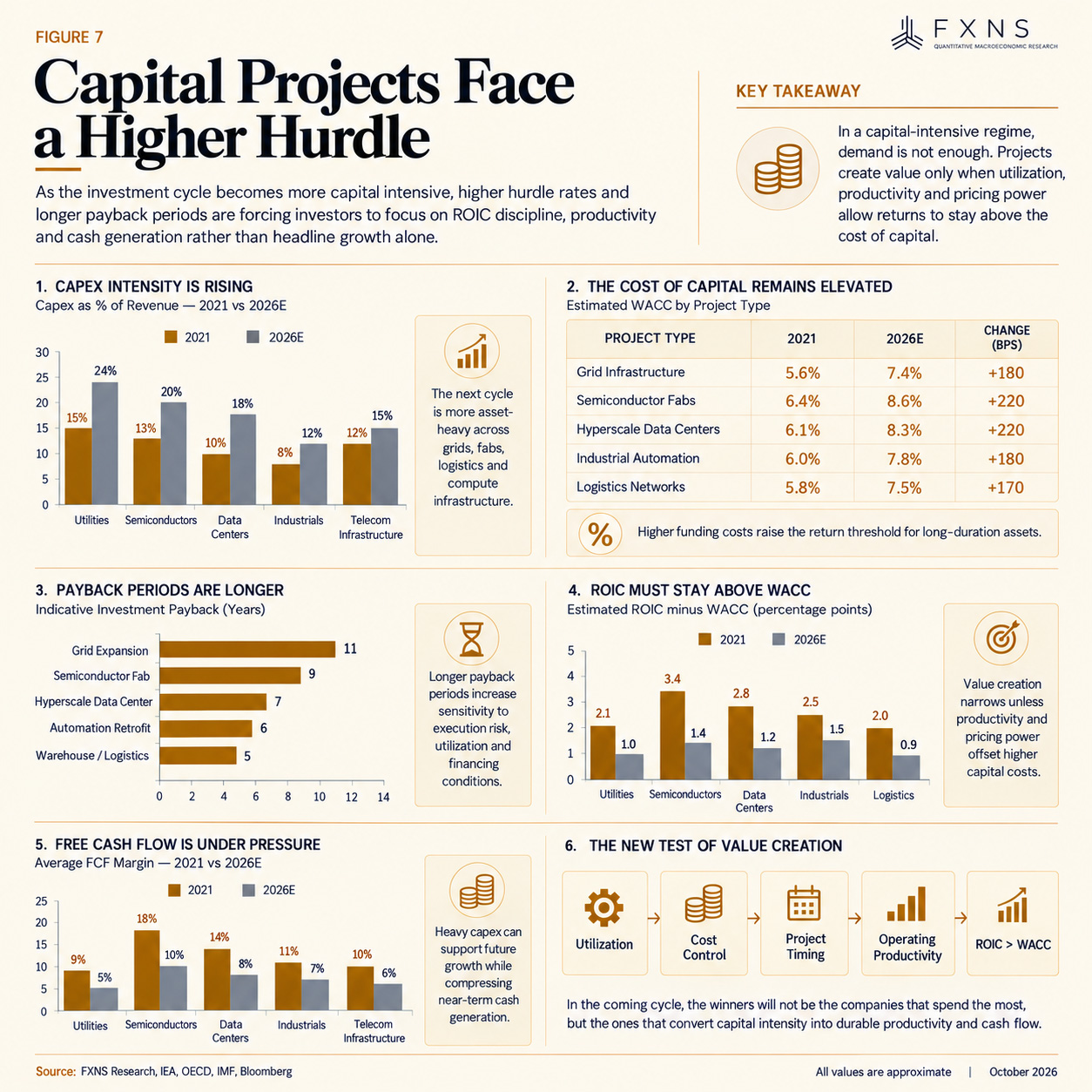
The financial implications extend beyond the immediate scale of investment. Asset-light business models historically allowed companies to expand revenues while maintaining comparatively low incremental requirements for physical capital. The emerging investment cycle introduces a different economic structure, characterised by higher upfront expenditure, longer construction periods, growing depreciation charges and increased sensitivity to financing conditions. As capital intensity rises, the relationship between revenue growth and free cash flow becomes less direct, making capital productivity a more important determinant of financial performance. Companies may report strong operating growth while simultaneously experiencing pressure on cash generation as infrastructure investment absorbs an increasing share of available resources.
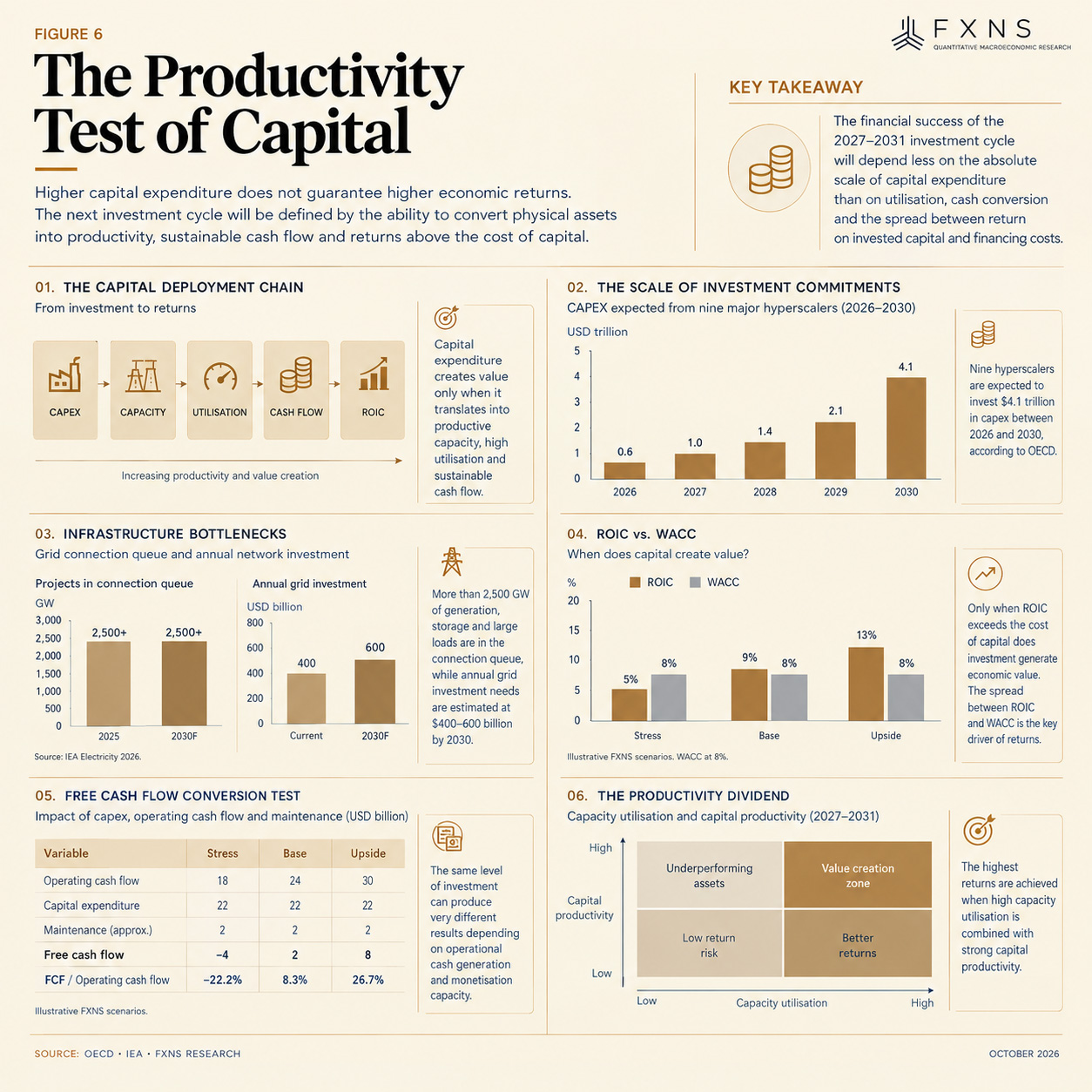
For investors, the critical variable is therefore shifting from the absolute pace of capital expenditure toward the capacity of invested capital to generate sustainable returns above its weighted average cost of capital. Two companies exposed to the same structural growth opportunities may produce materially different financial outcomes depending on construction efficiency, capacity utilisation, operating margins and the timing of investment recovery. Over the 2027–2031 horizon, these differences could become increasingly important in determining valuations and capital allocation across global markets. The next investment cycle will be defined not merely by how much capital is deployed, but by how efficiently that capital is converted into productivity, free cash flow and enduring economic value.
When Capital Expenditure Redefines Financial Returns
The expansion of capital-intensive investment is becoming increasingly consequential because the economic relationship between growth, financing requirements and shareholder returns is fundamentally changing. During the previous technology cycle, many leading companies benefited from scalable business models in which incremental revenues required relatively limited additional investment in physical assets. The emerging cycle is different. Artificial intelligence infrastructure, electricity generation, transmission networks and advanced manufacturing require substantial upfront capital commitments, often years before their full economic benefits materialise. The ability to generate revenue growth is therefore becoming increasingly dependent on the capacity to finance, construct and efficiently utilise long-duration productive assets.
This transformation changes the financial characteristics of the investment cycle. Large infrastructure programmes require sustained expenditure on equipment, construction, energy supply and technological capacity, while depreciation and financing obligations continue regardless of whether projected demand materialises. Companies must therefore balance expansion against the risk of committing excessive capital before future cash flows become sufficiently predictable. Capital expenditure becomes economically productive only when the additional operating returns generated by investment exceed the full cost of deploying and financing that capital. Rising investment volumes can consequently coexist with declining free cash flow, weaker capital efficiency and pressure on valuations, particularly where utilisation rates or operating margins fall short of expectations.
The result is an increasingly important distinction between economic expansion and financial value creation. Strong demand for infrastructure does not automatically guarantee attractive returns for the institutions and companies providing it. The duration of construction projects, the availability of electricity and industrial inputs, technological obsolescence and changes in financing costs can materially influence investment profitability. Over the 2027–2031 horizon, return on invested capital, cash conversion, capacity utilisation and the spread between ROIC and weighted average cost of capital will become critical variables in assessing the sustainability of the new investment cycle. The central challenge will be determining whether unprecedented capital deployment produces a lasting improvement in productivity or merely increases the quantity of assets competing for insufficient economic returns.
The Productivity Test of Global Capital
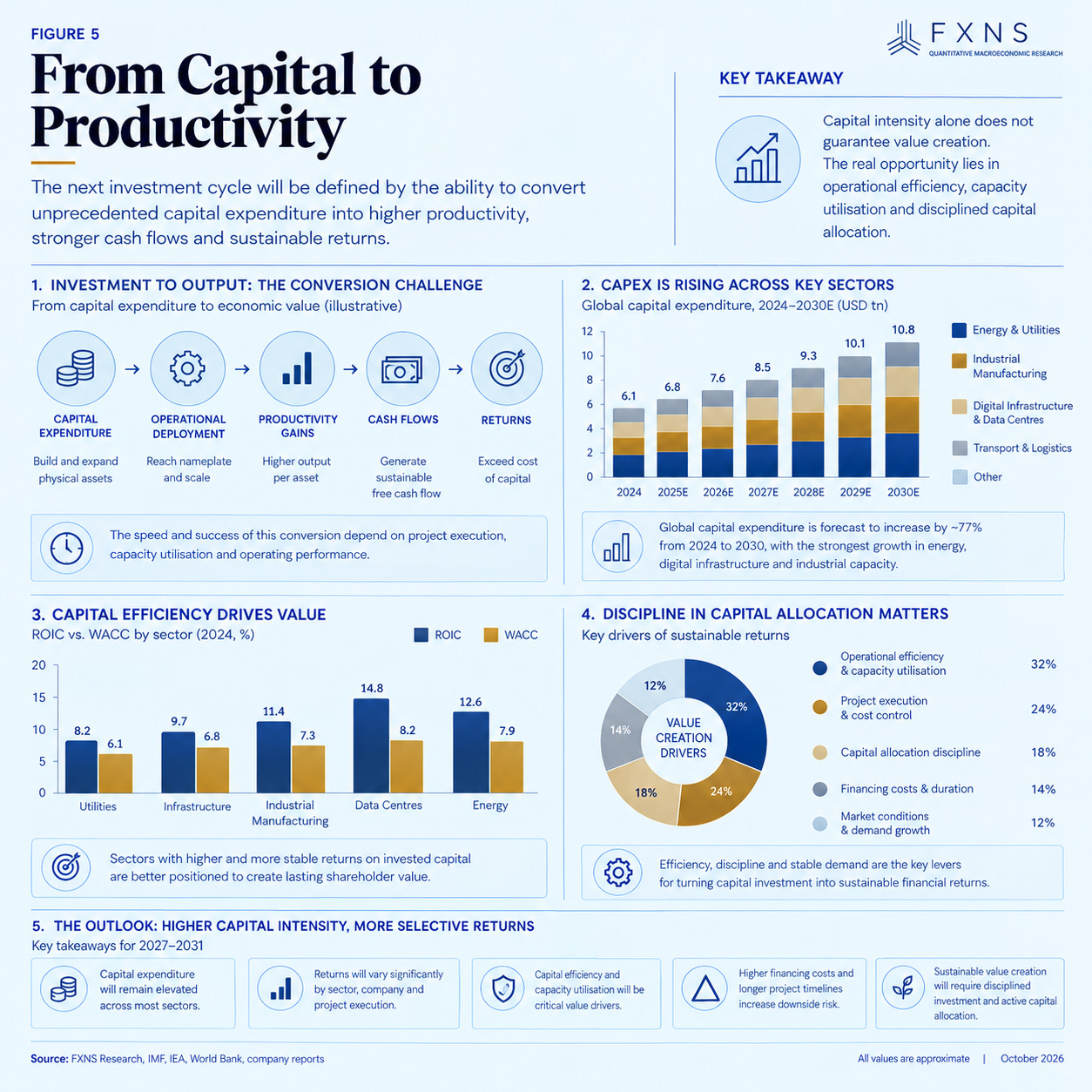
The consequences of the emerging capital-intensive investment cycle extend far beyond the immediate expansion of infrastructure and industrial capacity. As artificial intelligence, electrification and advanced manufacturing require increasingly substantial financial commitments, the central economic challenge is shifting from mobilising investment toward generating sufficient productivity to justify its cost. Capital expenditure can support employment, industrial output and aggregate demand during the construction phase, but these benefits do not automatically translate into sustainable financial returns. Once new facilities become operational, their profitability depends on utilisation rates, operating efficiency, pricing power and the durability of underlying demand. The distinction between building productive capacity and creating lasting economic value will become increasingly important for global capital markets.
This creates a structural challenge for companies, lenders and institutional investors allocating capital across the 2027–2031 horizon. Infrastructure projects and advanced production facilities often require lengthy development periods, substantial external financing and significant expenditure before generating meaningful operating cash flows. Meanwhile, depreciation, maintenance requirements and financing obligations continue even when revenues develop more slowly than anticipated. The risk is not necessarily that the global economy invests too much in aggregate, but that capital is deployed into assets whose realised returns fail to compensate investors for their cost and risk. Where return on invested capital falls below the weighted average cost of capital, additional investment can destroy economic value despite contributing positively to reported revenue growth and productive capacity.
For financial markets, the defining variable will therefore become the transmission of capital expenditure into measurable productivity improvements and sustainable free cash flow. Investment volumes, financing costs, capacity utilisation and capital efficiency must be evaluated as components of the same economic equation. Companies capable of converting new infrastructure into higher output per unit of capital may strengthen profitability and justify premium valuations, while those facing construction delays, technological obsolescence or disappointing demand could experience deteriorating returns and greater refinancing pressure. The next phase of global growth may consequently produce significant divergence between businesses participating in the same investment cycle. The ultimate measure of the return of capital intensity will not be the unprecedented scale of investment itself, but whether that investment generates productivity gains, resilient cash flows and returns sustainably above the cost of capital.