
Location
ASSET CLASS
STRUCTURE
RESEARCH FOCUS


The global financial system is undergoing a quiet transfer of power. As non-bank institutions gain control over capital allocation, market liquidity and credit creation, traditional banks are losing their central role. The next financial cycle will be shaped less by who creates money than by who controls its flow.
The brief
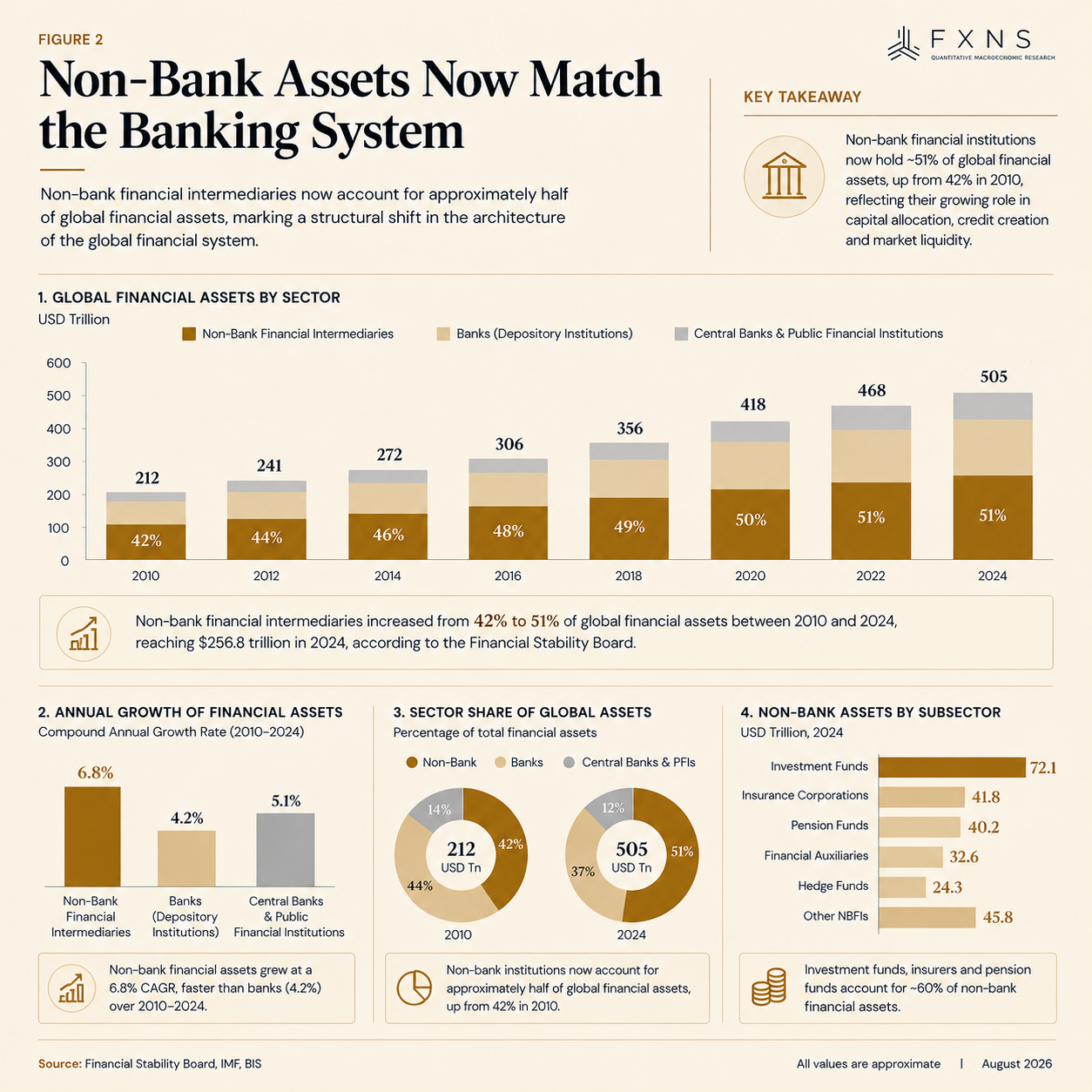
The global financial system is undergoing a structural transformation in the way capital is allocated, credit is supplied and liquidity is distributed. Non-bank financial intermediaries—including investment funds, pension funds, insurers, hedge funds and private credit providers—now account for approximately half of global financial assets. According to the Financial Stability Board, their assets reached $256.8 trillion in 2024, reflecting a growing role in the architecture of global finance.
The shift extends well beyond institutional market share. As financial intermediation increasingly takes place through securities markets, investment vehicles and collateralized funding structures, traditional banks are becoming part of a more complex network of interconnected capital providers. The resilience of financial markets is therefore becoming increasingly dependent on non-bank liquidity, leverage and the capacity of institutional investors to absorb financial shocks.
Over the 2027–2031 horizon, this transformation could fundamentally alter the transmission of monetary policy, the pricing of risk and the distribution of financial vulnerabilities. The central question is no longer simply whether non-bank finance will continue expanding, but whether the global financial system can accommodate this redistribution of capital without creating new concentrations of systemic risk.
RESEARCH FOCUS
Structural growth of non-bank financial intermediation
Institutional capital allocation and market-based credit creation
Liquidity provision, leverage and collateral dependencies
Monetary transmission and interconnected financial markets
Systemic risk migration and financial resilience through 2031
KEY QUESTION
Can the global financial system sustain the growing influence of non-bank capital without compromising market liquidity, financial stability and the effective transmission of monetary policy?
The Balance of Financial Power Shifts
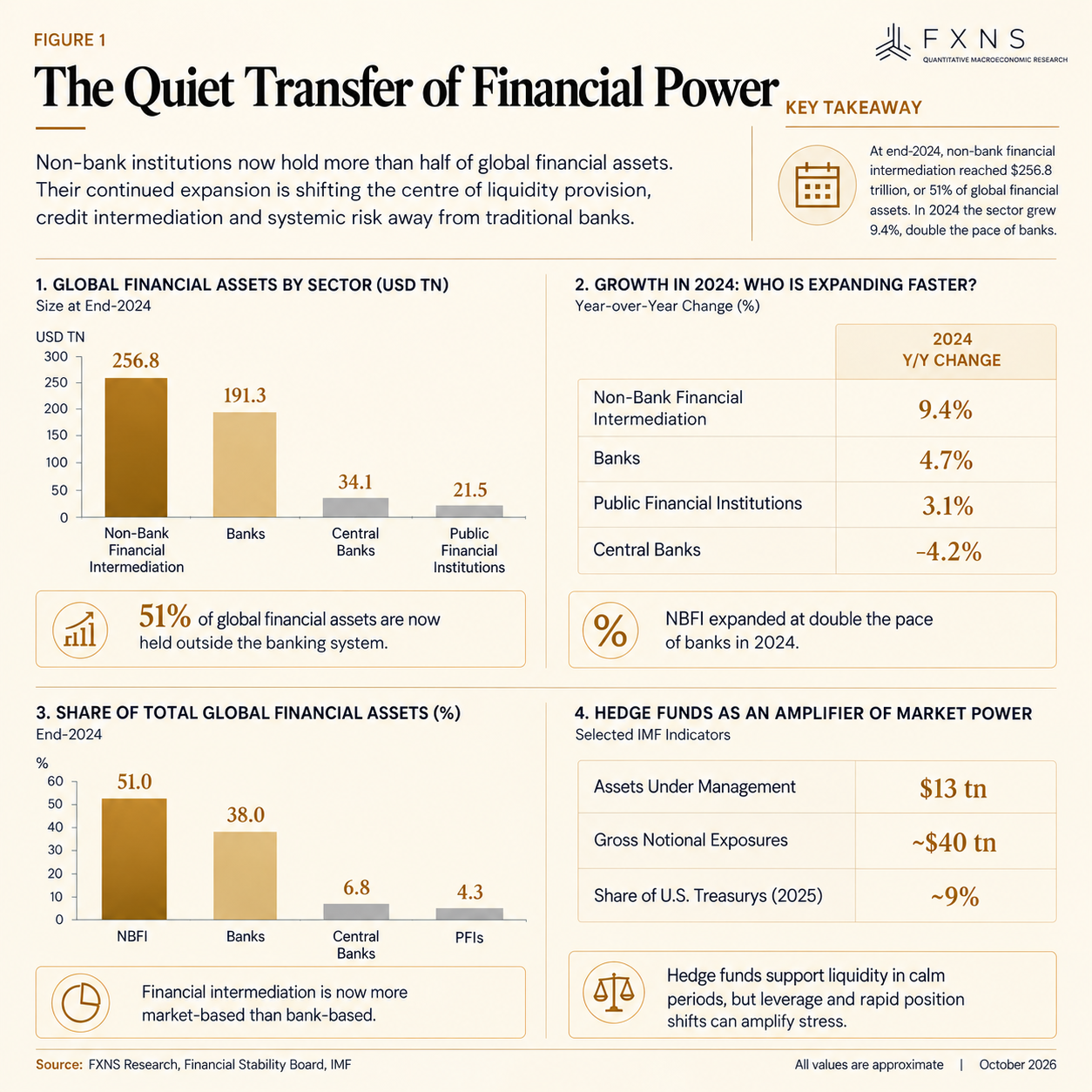
The defining transformation in global finance is no longer simply the expansion of capital markets, but the growing concentration of financial intermediation outside the traditional banking system. According to the Financial Stability Board, non-bank financial intermediaries controlled approximately $256.8 trillion in assets at the end of 2024, representing around 51% of global financial assets. Investment funds, insurers, pension funds, hedge funds and other market-based institutions now occupy a central position in the allocation of capital. What was once a predominantly bank-centered financial architecture is becoming an increasingly market-dependent system.
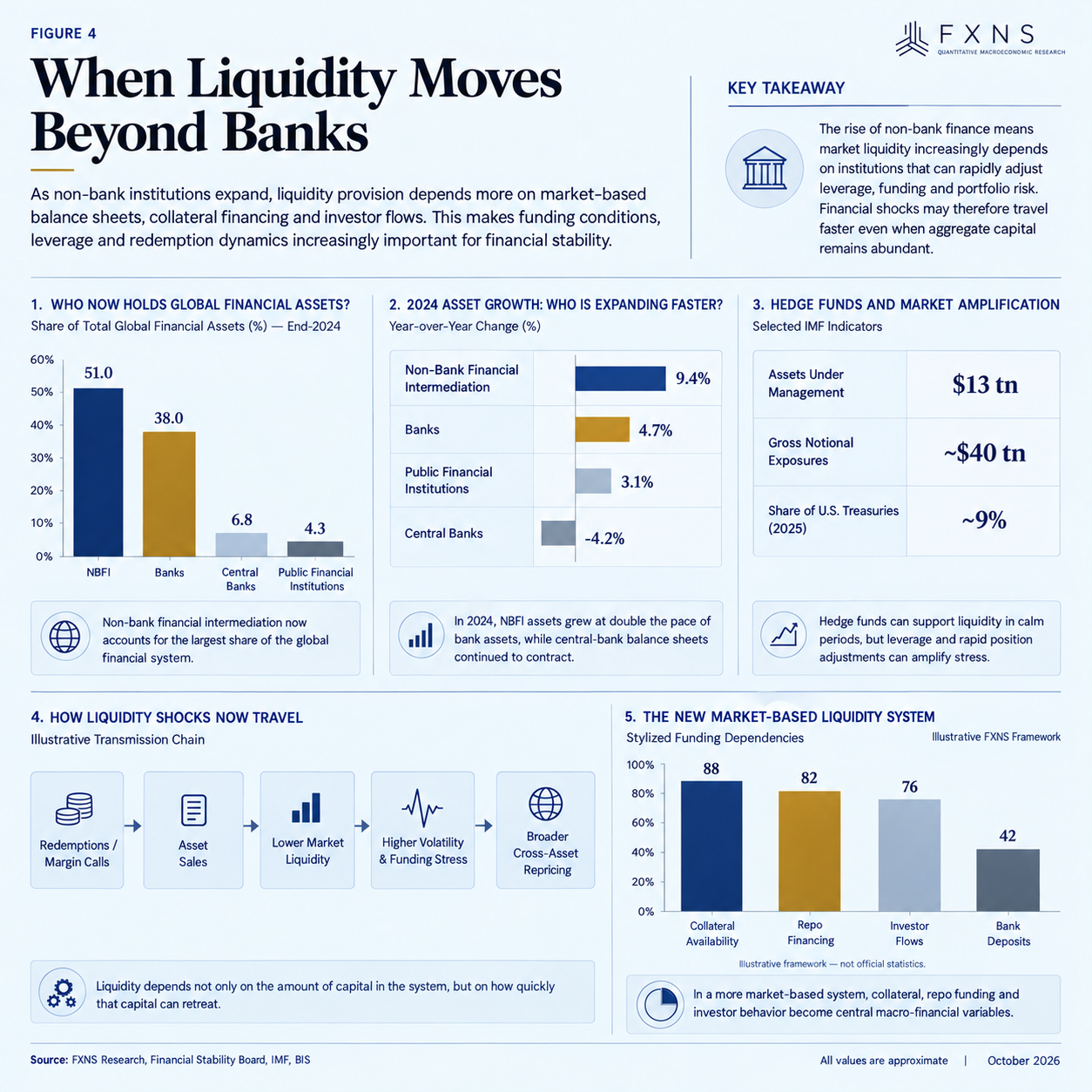
The shift is accelerating through the interaction of institutional savings, regulatory constraints and the expansion of market-based financing. In 2024, non-bank financial assets increased by 9.4%, compared with 4.7% for banking institutions, although part of this divergence reflected asset-price appreciation rather than new capital formation. The significance extends beyond relative growth rates. As financial intermediation migrates toward investment vehicles and securities markets, the mechanisms governing credit availability, liquidity provision and risk distribution are changing. Banks remain essential, but their influence increasingly operates alongside institutional investors whose balance-sheet constraints and investment mandates respond differently to financial stress.
For global markets, the critical variable is therefore shifting from the size of the banking system toward the composition, leverage and interconnectedness of the institutions controlling financial assets. Two financial systems with similar aggregate capital resources may exhibit very different resilience depending on whether those resources are intermediated through stable deposits, redeemable investment funds or leveraged market positions. Over the 2027–2031 horizon, this distinction could become increasingly important for monetary transmission and financial stability. The question is no longer only how much capital the system possesses, but who controls it, how it is financed and how rapidly it can move.
When Liquidity Moves Beyond Banks
The growing influence of non-bank institutions is transforming financial markets because the mechanisms through which liquidity is created, distributed and withdrawn are fundamentally different from those of traditional banking. Banks typically intermediate credit through deposits, lending relationships and regulated balance sheets, while investment funds, hedge funds and other market-based intermediaries rely more heavily on securities transactions, collateralized financing and investor capital. As these institutions expand, a greater share of financial activity becomes exposed to market valuations, redemption pressures and changes in funding conditions. The stability of liquidity increasingly depends not only on the availability of capital, but on the willingness of market participants to keep it deployed.
This distinction becomes particularly important during periods of financial stress. Open-ended investment funds may face redemption requests precisely when underlying assets become difficult to sell, while leveraged hedge funds can be forced to reduce positions as margins increase or financing conditions tighten. Banks remain deeply interconnected with these activities through repo markets, derivatives, prime brokerage and credit facilities. Risk is therefore not necessarily disappearing from the banking system; it is being redistributed across a wider network of institutions whose exposures can become highly correlated during market disruptions. The same mechanisms that improve market efficiency under normal conditions may amplify price movements when multiple investors attempt to reduce risk simultaneously.
The consequence is a structural change in how financial shocks propagate across asset classes. Market liquidity can deteriorate even when aggregate financial assets remain substantial, because asset ownership does not guarantee immediate financing capacity or a willingness to absorb losses. Government bonds, corporate credit, equities and funding markets are increasingly connected through common investors, collateral requirements and leveraged strategies. Over the 2027–2031 period, monitoring financial stability may therefore require greater attention to redemption dynamics, repo financing, portfolio concentration and liquidity mismatches. The defining vulnerability of the emerging financial architecture may be less a shortage of capital than the speed at which capital can retreat when confidence weakens.
The New Architecture of Systemic Risk
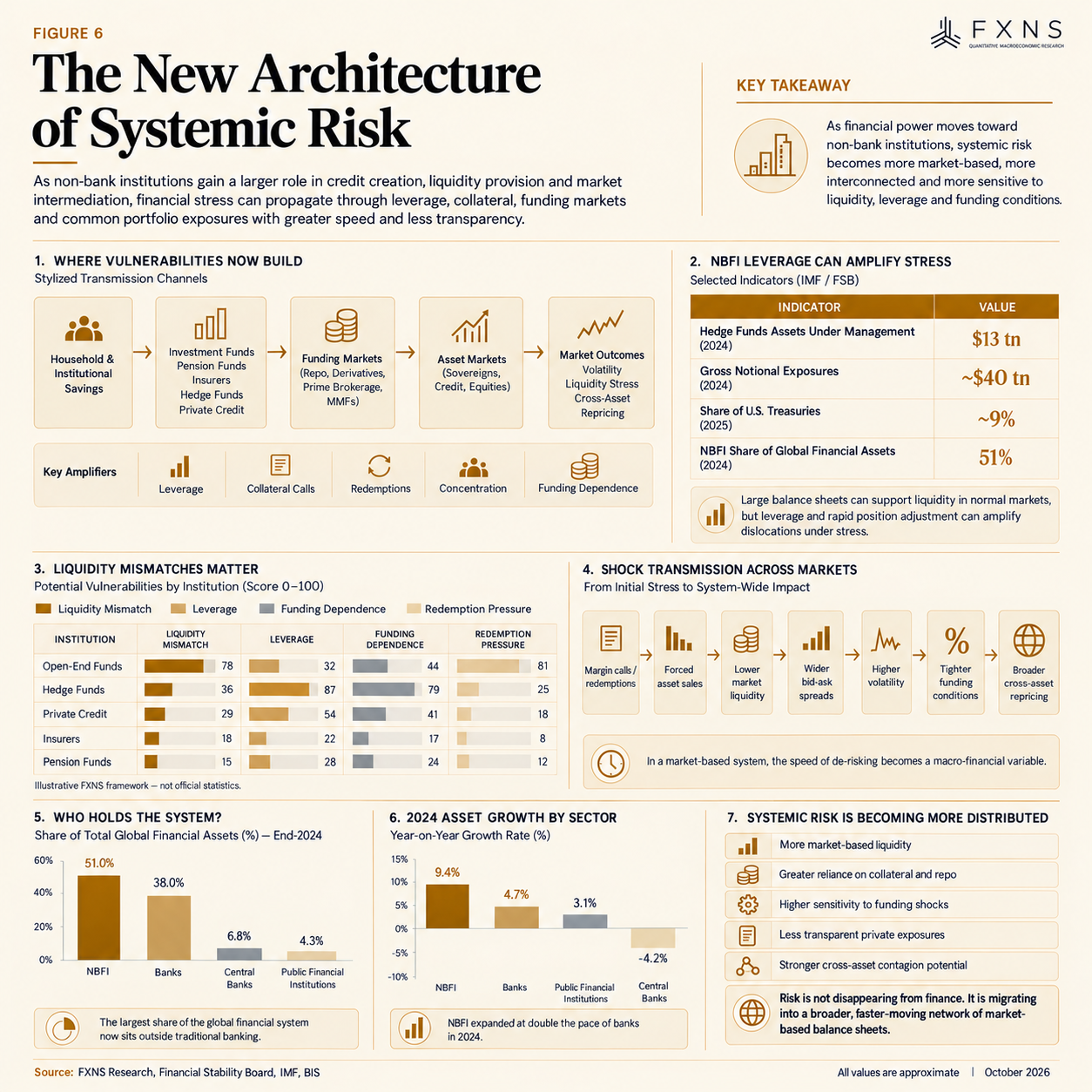
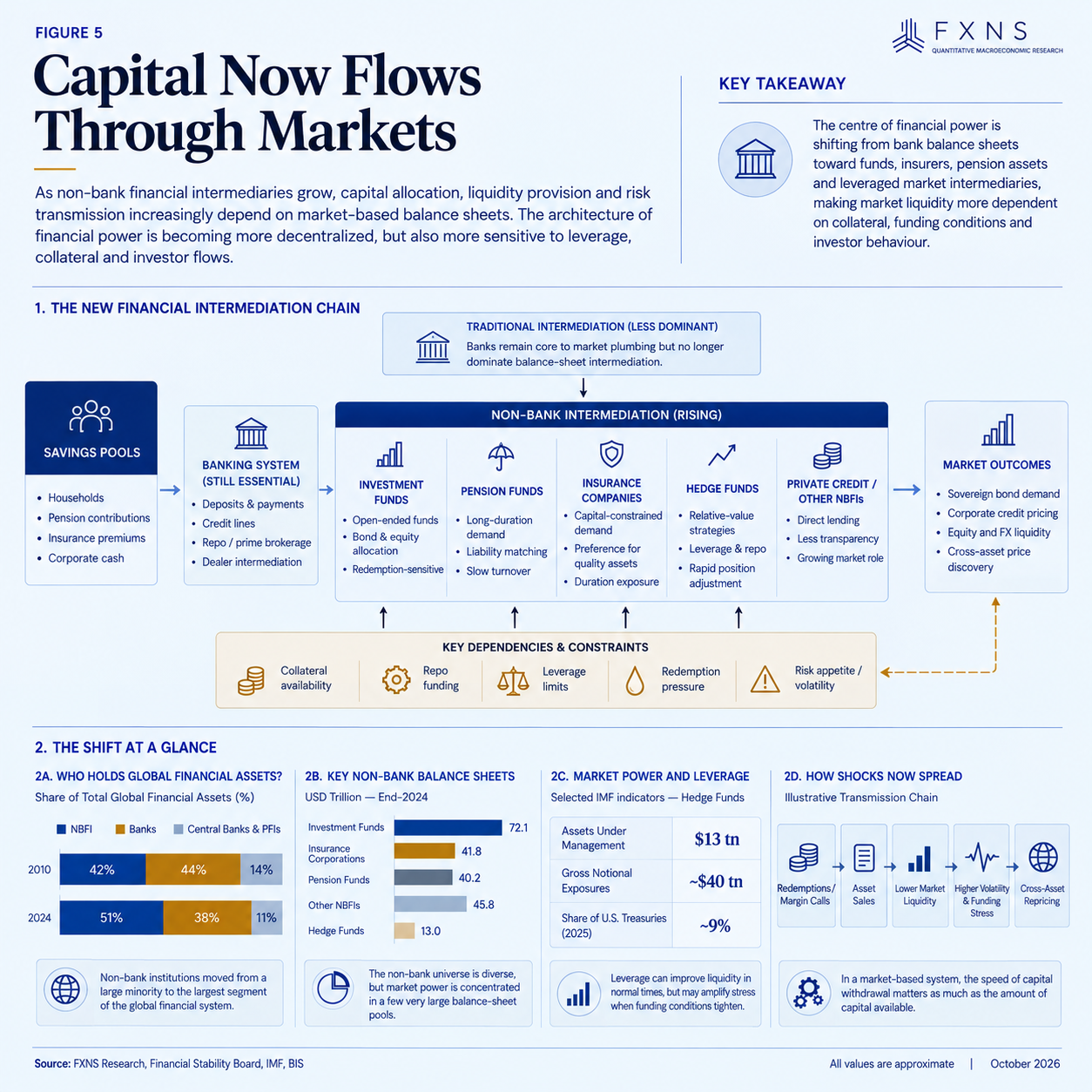
The consequences of the shift toward non-bank financial intermediation extend far beyond the redistribution of assets between institutions. As investment funds, insurers, pension funds and leveraged intermediaries assume a larger role in credit markets, financial stability increasingly depends on the interaction between market liquidity, institutional leverage and interconnected balance sheets. Unlike traditional bank lending, market-based finance can transmit changes in investor sentiment directly into asset prices and financing conditions. This creates a financial architecture in which risks may accumulate across multiple institutions without becoming immediately visible in conventional banking indicators. The migration of financial activity does not eliminate systemic risk; it changes where that risk resides and how rapidly it can spread.
This transformation is particularly consequential for private credit, sovereign bond markets and institutional investment portfolios. Non-bank lenders can diversify financing sources and improve access to capital, but their growing connections with banks, insurers and investment vehicles introduce additional channels of contagion. Liquidity mismatches, concentrated exposures and collateral requirements can reinforce one another when financial conditions deteriorate. A shock originating in a relatively narrow segment of market-based finance can therefore propagate through funding relationships, asset sales and common portfolio exposures. As documented by the IMF and Financial Stability Board, leverage and interconnectedness are becoming increasingly important determinants of financial resilience, particularly where transparency and consistent regulatory reporting remain limited.
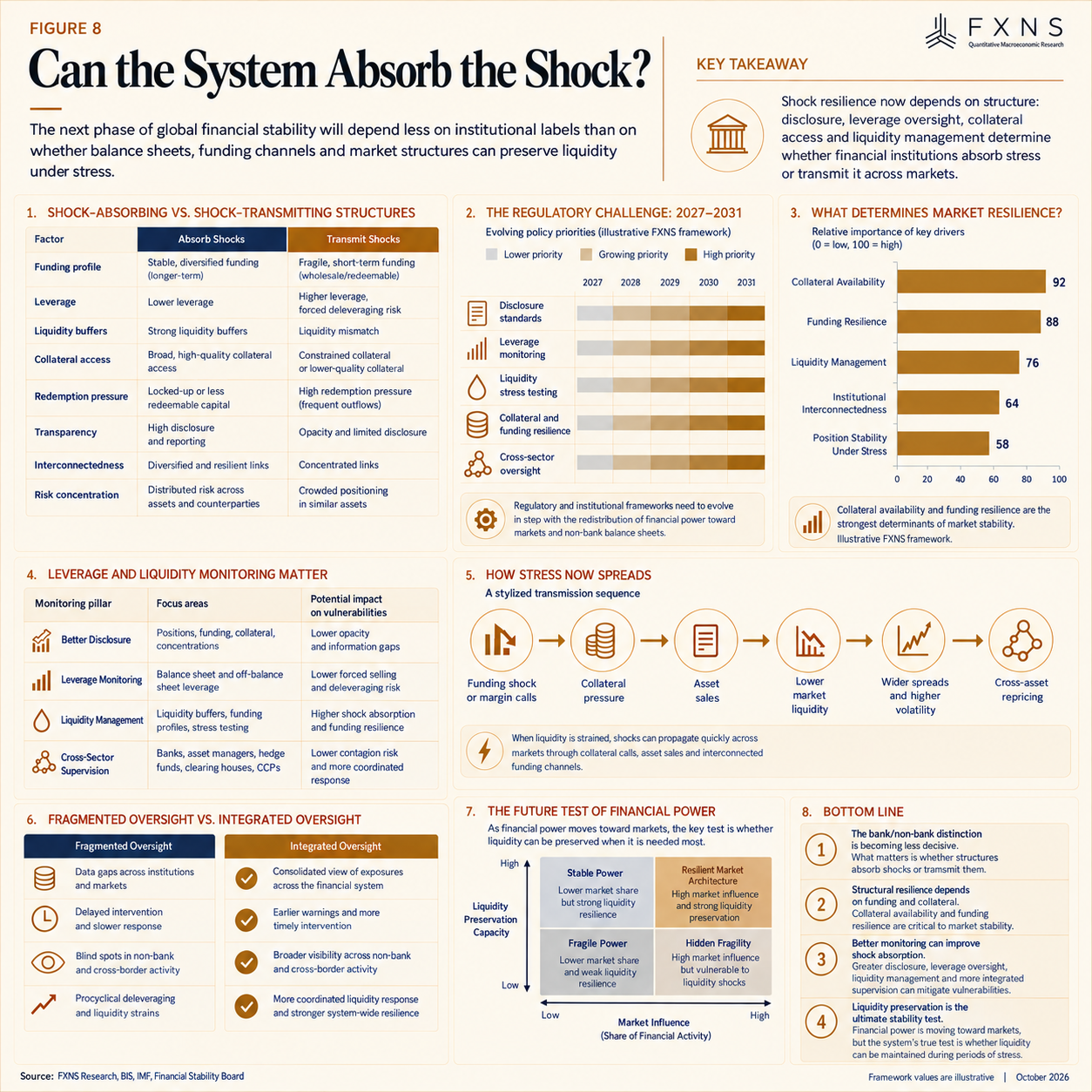
Over the 2027–2031 horizon, the central challenge will be determining whether the regulatory and institutional architecture can evolve alongside this redistribution of financial influence. Greater disclosure, improved monitoring of leverage and stronger liquidity management could mitigate vulnerabilities, while fragmented oversight may allow risks to accumulate beyond traditional supervisory boundaries. The decisive distinction will not be between banks and non-banks, but between financial structures capable of absorbing shocks and those forced to transmit them. The future stability of global markets will depend increasingly on collateral availability, funding resilience, institutional interconnectedness and the capacity of investors to maintain positions during periods of stress. Financial power is moving toward markets, but the ultimate measure of that power will be the system’s ability to preserve liquidity when it is needed most.