

The AI infrastructure boom is often described through GPUs, model scale and data-center investment. Yet one of its most consequential bottlenecks sits deeper in the stack. High-Bandwidth Memory has become essential to the performance of advanced AI accelerators, turning what was once a specialized segment of the semiconductor industry into a strategic constraint on the entire AI build-out. As demand accelerated, the economics of memory began to change with it.
During the first half of 2026, that shift became increasingly visible in public markets. SK hynix emerged as one of the clearest beneficiaries, combining technological leadership in HBM with manufacturing execution and privileged exposure to the world’s leading AI accelerator platforms. Its extraordinary equity performance was not simply a reflection of enthusiasm around artificial intelligence. It represented the market repricing a company whose position had moved from cyclical memory supplier to critical infrastructure provider.
The Challenge: When AI Demand Meets Physical Supply
The central question is therefore not why memory demand increased. It is why this particular cycle has produced such an asymmetric outcome. Traditional memory markets have historically been defined by powerful supply cycles, commoditization and recurring periods of excess capacity. HBM changes part of that equation. Its production is technically demanding, capacity intensive and closely tied to the performance requirements of increasingly sophisticated AI systems.
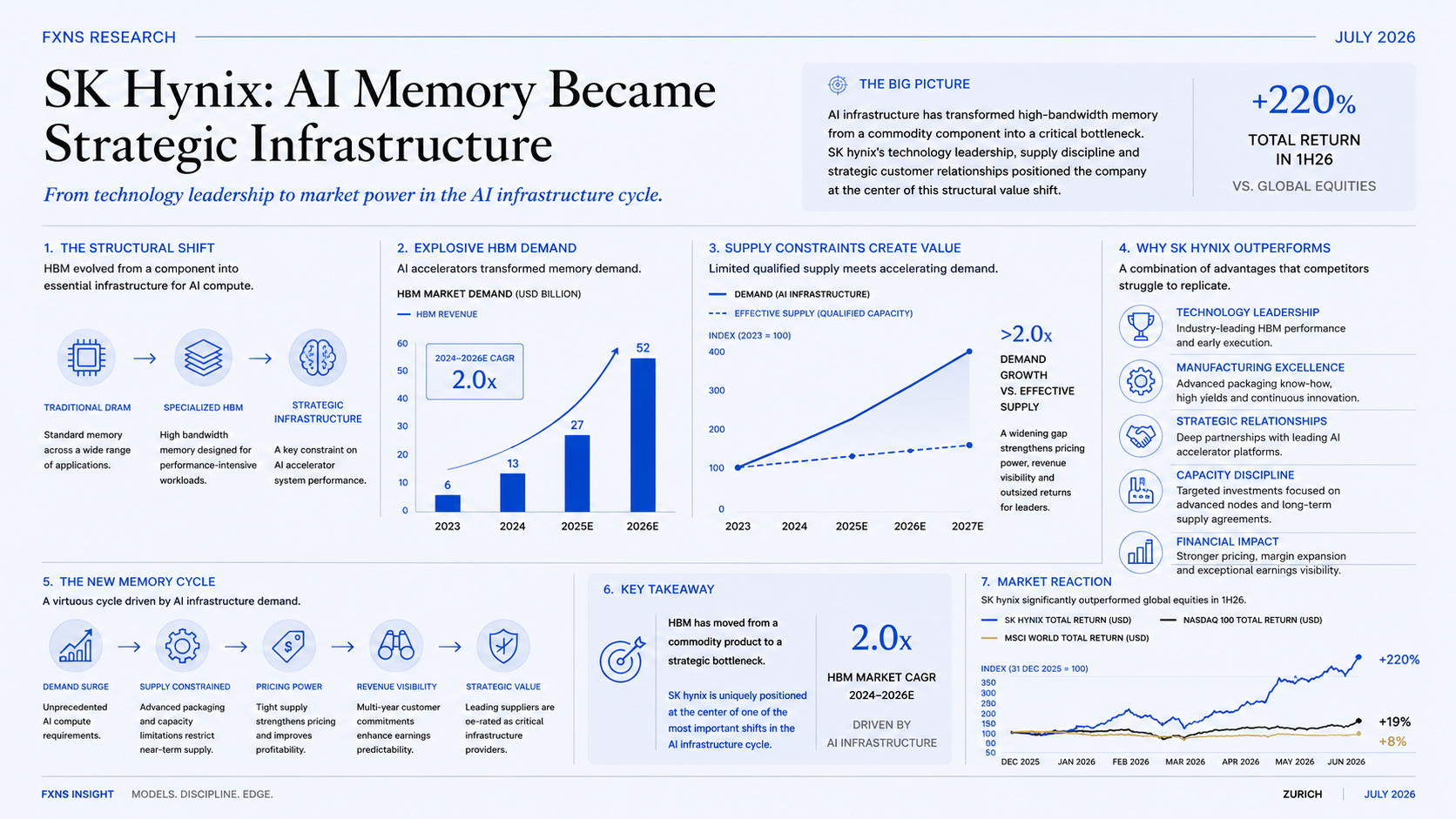
As accelerator architectures consume more memory bandwidth, suppliers must simultaneously advance product generations, expand production capacity and maintain demanding yields. Capacity cannot be added instantaneously, while qualification with major customers creates another layer of constraint. The result is a market in which demand can move considerably faster than effective supply — creating pricing power, stronger revenue visibility and unusually favorable economics for the companies capable of executing at scale.
For investors, this makes the SK hynix case more than a story about a stock that rose sharply. It provides a useful lens through which to examine how structural bottlenecks redistribute value inside a technological investment cycle — and why some of the strongest beneficiaries of AI may sit several layers beneath the products most visible to the end user.
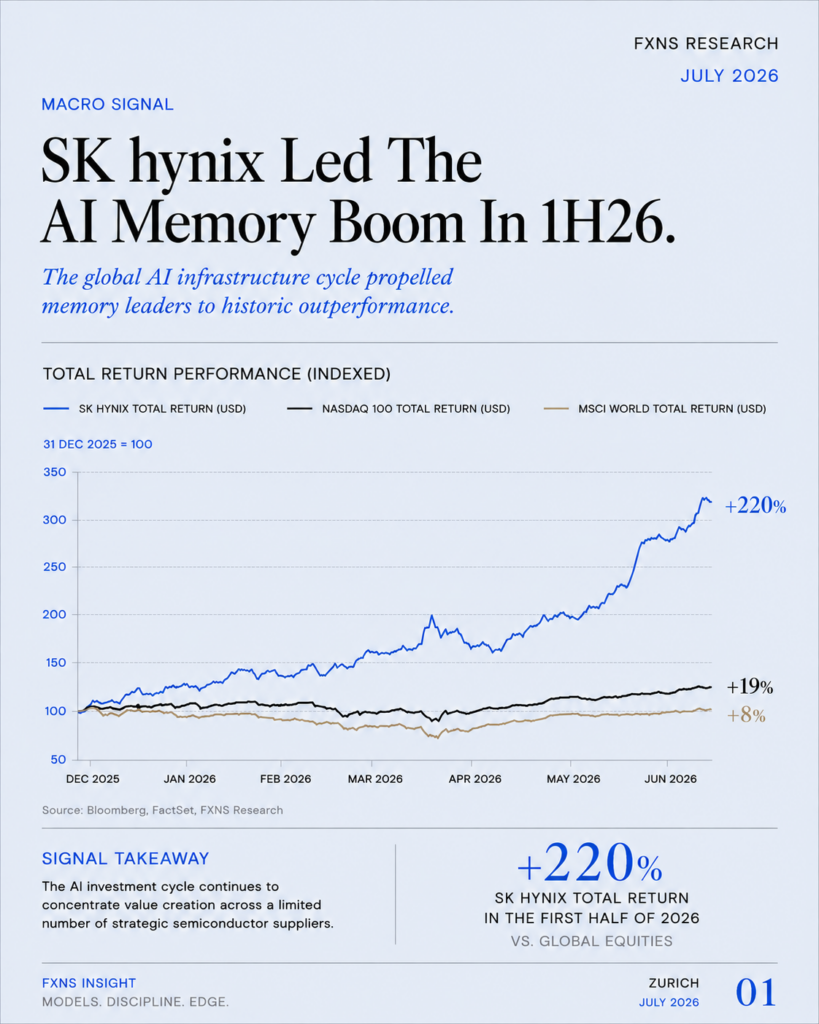
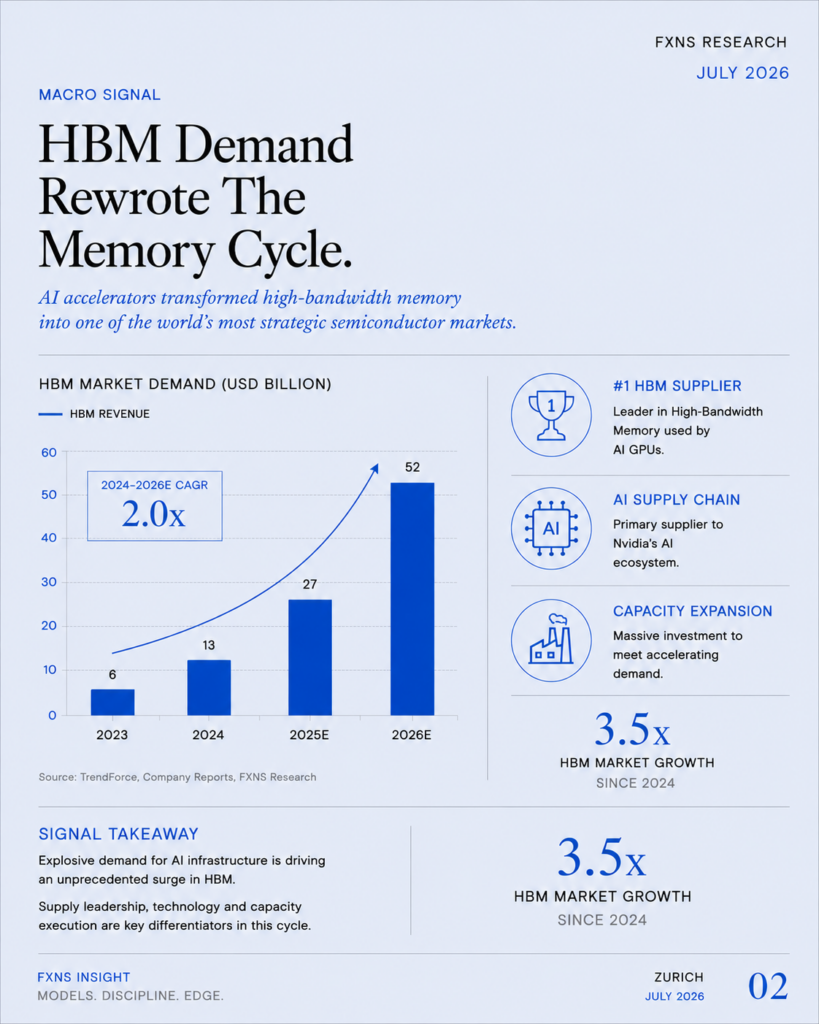
The extraordinary performance of SK hynix was not simply the result of another semiconductor upcycle. The underlying structure of the memory market changed as artificial-intelligence infrastructure moved from experimentation to large-scale deployment. High-bandwidth memory, once a relatively specialized product category, became a critical component of advanced AI accelerators. Each new generation of GPUs required substantially greater memory bandwidth and increasingly sophisticated HBM architectures, turning memory performance into a constraint on the computational capacity of the entire system. For suppliers capable of delivering at scale, this created something unusually powerful in the historically cyclical memory industry: rapidly expanding demand combined with limited qualified supply.
SK hynix entered this transition from a position of technological leadership. Its early execution in HBM, manufacturing capability and close integration with major AI accelerator platforms allowed the company to capture a disproportionate share of the fastest-growing segment of the memory market. Capacity could not be expanded instantly. Advanced packaging, production yields and qualification requirements created physical constraints precisely as hyperscalers accelerated investment in AI infrastructure. The result was a market in which leading-edge memory was no longer treated primarily as a commoditized component. Scarcity increased pricing power, improved revenue visibility and supported a significant expansion in the economic value attributed to the companies controlling the bottleneck.
The equity market recognized that shift quickly. SK hynix’s exceptional first-half performance therefore reflected more than enthusiasm surrounding artificial intelligence. Investors were repricing the strategic importance of a company positioned at one of the most difficult-to-replicate layers of the AI supply chain. The broader implication extends beyond memory: when a technological cycle creates a new infrastructure bottleneck, value creation can concentrate dramatically around the relatively small number of suppliers capable of removing it.
AI Memory Became Strategic Infrastructure
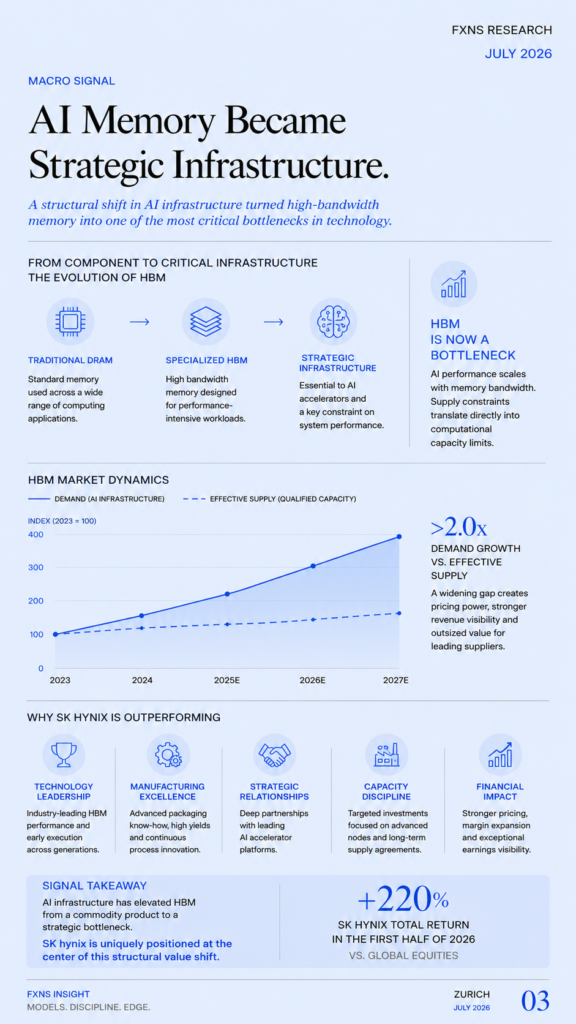
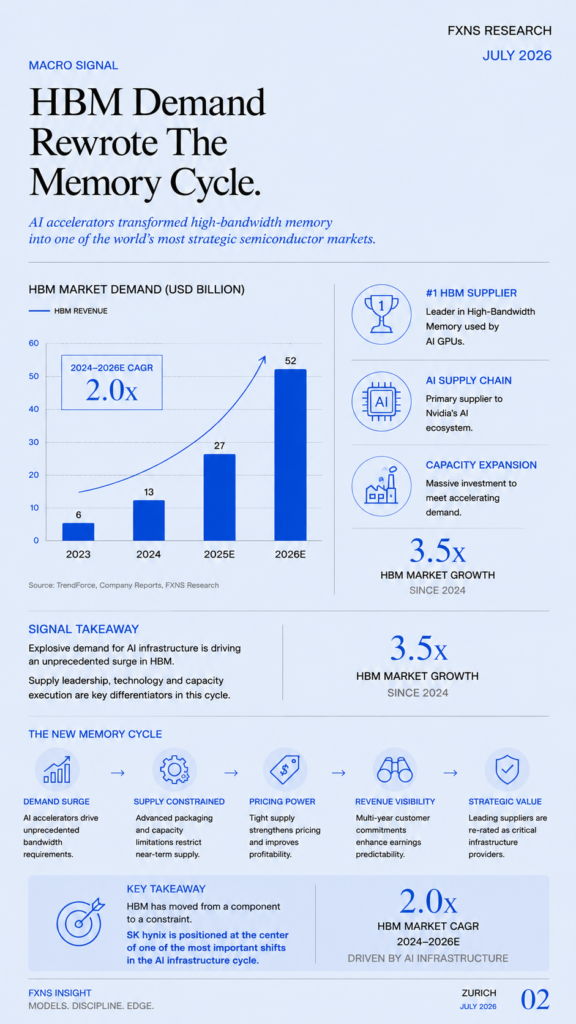
The equity market recognized this structural change quickly. SK hynix’s exceptional performance was therefore not simply a reflection of enthusiasm surrounding artificial intelligence, but a repricing of its strategic position within the AI infrastructure stack. As HBM became increasingly critical to accelerator performance, technological leadership translated directly into stronger economics, greater earnings visibility and a more defensible competitive position. What had historically been treated as a cyclical memory business was beginning to be valued as a strategic supplier to one of the most capital-intensive technology build-outs of the decade.
Structural Leadership: From Technology Edge to Market Power
SK hynix’s outperformance was not simply the result of rising semiconductor demand. The more important shift occurred inside the structure of the AI supply chain itself. As high-bandwidth memory became essential to the performance of advanced accelerators, technological capability, manufacturing yields and access to leading customers began to matter more than sheer production scale. SK hynix entered this phase with an unusually strong combination of all three, allowing the company to capture a disproportionate share of the value created by the AI infrastructure cycle.
That advantage became increasingly difficult for competitors to replicate. Advanced HBM requires complex stacking, packaging and thermal management, while qualification cycles with major accelerator manufacturers create additional barriers to entry. Supply therefore remained constrained even as demand accelerated, strengthening pricing power and improving revenue visibility. What initially appeared to be another cyclical recovery in memory increasingly revealed a structural change: the most advanced memory suppliers were no longer selling an interchangeable component, but controlling one of the critical bottlenecks of the AI compute stack.
The AI memory cycle is no longer about selling more memory. It is about controlling the scarce infrastructure that determines how much AI compute can actually be deployed.
FXNS RESEARCH
From Cyclical Recovery to Structural Advantage
The most important conclusion is that SK hynix’s performance cannot be understood simply as another upswing in the memory cycle. Traditional memory markets have historically been defined by recurring periods of excess capacity, falling prices and subsequent supply discipline. HBM changes that equation. The product is technologically more complex, qualification cycles are longer, manufacturing yields matter more, and the relationship between memory suppliers and accelerator designers is considerably deeper. As AI infrastructure expands, these characteristics make advanced memory less interchangeable and increase the strategic value of the companies capable of producing it reliably at scale.
For SK hynix, this has created a reinforcing combination of technology leadership, manufacturing execution and customer positioning. Early leadership in HBM allowed the company to establish relationships with the most important participants in the AI accelerator ecosystem before demand reached its current scale. Those relationships provide more than immediate revenue: they improve visibility into future product requirements, support capacity planning and make it possible to align capital expenditure with demand several generations ahead. In an industry where advanced packaging capacity and production yields can constrain effective supply, that visibility becomes a meaningful competitive advantage.
The economics of the business change with it. When demand grows faster than qualified supply, pricing power strengthens and the traditional commodity characteristics of memory become less dominant. Higher utilization, stronger product mix and greater revenue visibility can translate technological leadership into operating leverage and margin expansion. At the same time, profitability provides the capital required to fund the next generation of HBM technology and manufacturing capacity. The result is a feedback loop in which leadership generates cash flow, cash flow finances innovation, and innovation reinforces leadership.
This is also why the extraordinary equity performance matters beyond the headline return. The market has not merely rewarded higher near-term earnings; it has begun to assign greater value to SK hynix’s position inside the architecture of AI infrastructure. The distinction is important. A supplier of a broadly available component competes primarily on cost, capacity and cycle timing. A supplier controlling a scarce, performance-critical layer of the compute stack occupies a fundamentally different strategic position. HBM increasingly resembles the latter.
None of this eliminates cyclicality. Capacity will expand, competitors will invest aggressively, technological transitions will continue and pricing conditions will eventually normalize. The relevant question is therefore not whether the memory cycle has disappeared, but whether its most valuable segment has structurally changed. The evidence increasingly suggests that it has. AI has transformed high-bandwidth memory from a specialized product into a constraint on compute deployment, and that shift has altered where value accumulates across the semiconductor supply chain.
For investors, the implication extends beyond SK hynix itself. The AI infrastructure cycle is likely to remain highly selective: extraordinary demand does not automatically produce extraordinary economics for every participant. Value tends to concentrate where technological complexity, constrained supply, customer integration and capital intensity create durable barriers to entry. In the first half of 2026, SK hynix provided one of the clearest examples of that mechanism at work. Its performance was not simply the consequence of participating in AI growth; it reflected ownership of a critical bottleneck at precisely the moment that bottleneck became strategically indispensable.



I look forward to seeing how these developments will improve service levels and customer satisfaction in the freight industry!