

Electricity was once treated as a background input to economic growth—abundant, predictable, and available wherever capital chose to build. That assumption is beginning to break. The rapid expansion of data centers, AI infrastructure, advanced manufacturing and electrification is pushing power demand into territories that existing grids were never designed to absorb at this speed.
The constraint is no longer simply how much electricity an economy can generate. Increasingly, it is whether that power can reach the right place, at the right time, through networks constrained by transmission capacity, transformer shortages and years-long interconnection queues. As digital infrastructure expands, access to reliable power is becoming a strategic variable in capital allocation—and the grid itself is moving from background infrastructure to the center of the investment equation.
Power Demand Is Moving Faster Than the Grid
The new electricity cycle is being shaped by a mismatch in speed. Data centers can be planned and constructed in a matter of years, industrial facilities can be expanded rapidly, and capital can migrate toward regions offering better economics. Transmission networks cannot respond on the same timetable. New high-voltage lines often require lengthy permitting processes, complex rights-of-way negotiations and substantial upgrades across multiple parts of the system. Transformers, substations and interconnection capacity have consequently become critical bottlenecks precisely as electricity-intensive investment accelerates.
This changes the geography of growth. A location may offer inexpensive land, tax incentives, skilled labor and attractive renewable resources, yet still be unsuitable for a major AI campus or advanced manufacturing facility because sufficient power cannot be delivered when it is needed. Developers are increasingly forced to evaluate available megawatts, grid congestion and connection timelines alongside traditional measures of economic attractiveness. In that environment, electricity infrastructure stops being a passive utility and becomes a scarce productive asset. The regions capable of expanding generation and moving that electricity efficiently may ultimately determine where the next wave of digital and industrial capital is deployed.
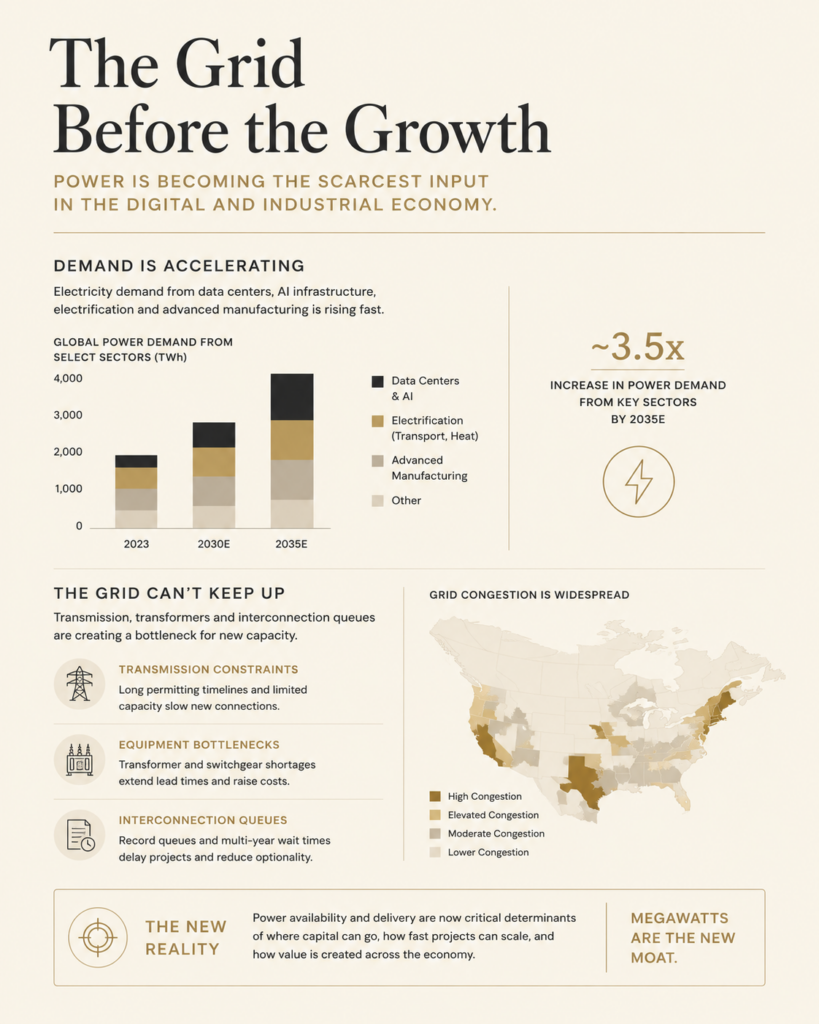
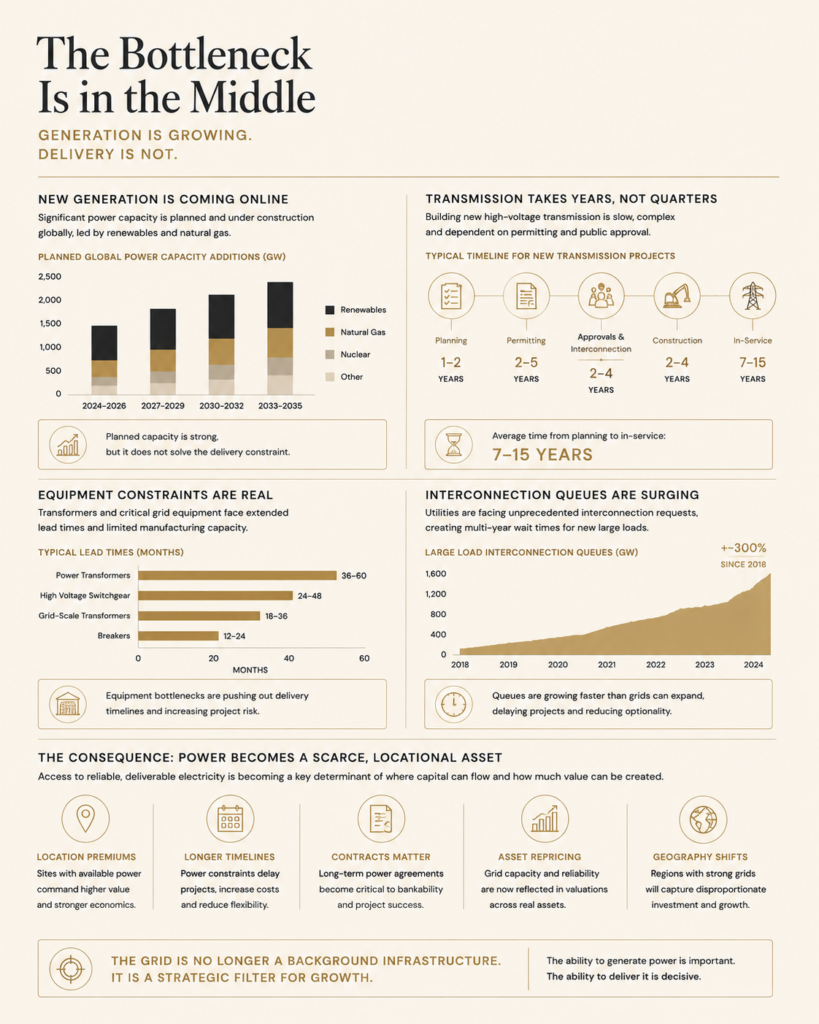
The pressure is becoming most visible where electricity-intensive investment is accelerating fastest. Data centers, semiconductor facilities and advanced manufacturing projects are competing for access to the same constrained grid infrastructure. In these markets, available power is no longer assumed—it has become something developers must secure, contract and increasingly compete for before capital can be deployed.
The Geography of Growth Is Being Rewritten
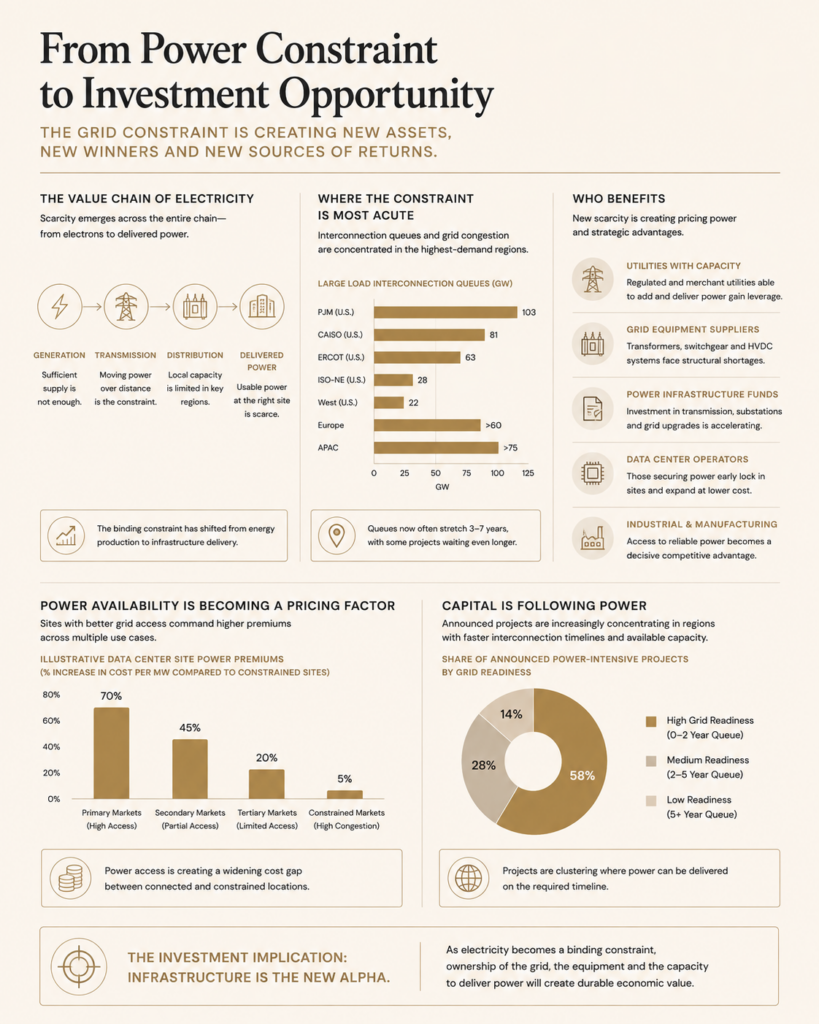
The consequence is a fundamental change in how locations are valued. For decades, investment decisions were dominated by labor costs, taxation, logistics, land availability and proximity to customers. Those variables remain important, but electricity is moving rapidly up the hierarchy. A site with attractive economics can lose its advantage if the grid cannot provide sufficient capacity within the required development window. Conversely, regions with reliable generation, available transmission capacity and shorter interconnection queues can command a growing premium. For data centers in particular, the ability to secure hundreds of megawatts is becoming a prerequisite rather than a secondary consideration. Capital is therefore beginning to follow power availability, shifting development toward markets where infrastructure can support expansion immediately rather than theoretically at some point in the future.
This creates a new layer of scarcity with consequences far beyond utilities. Land located near substations and uncongested transmission corridors becomes strategically more valuable; long-term power agreements become embedded in project economics; grid equipment manufacturers gain leverage as replacement and expansion cycles accelerate; and utilities capable of delivering incremental capacity acquire a more important role in regional competitiveness. The investment map is being redrawn around a deceptively simple constraint: growth can only occur where electricity can actually be delivered. In the next infrastructure cycle, the winning regions may not necessarily be those capable of generating the cheapest power, but those capable of connecting new demand to it faster than everyone else.
Execution Is Becoming the Differentiator
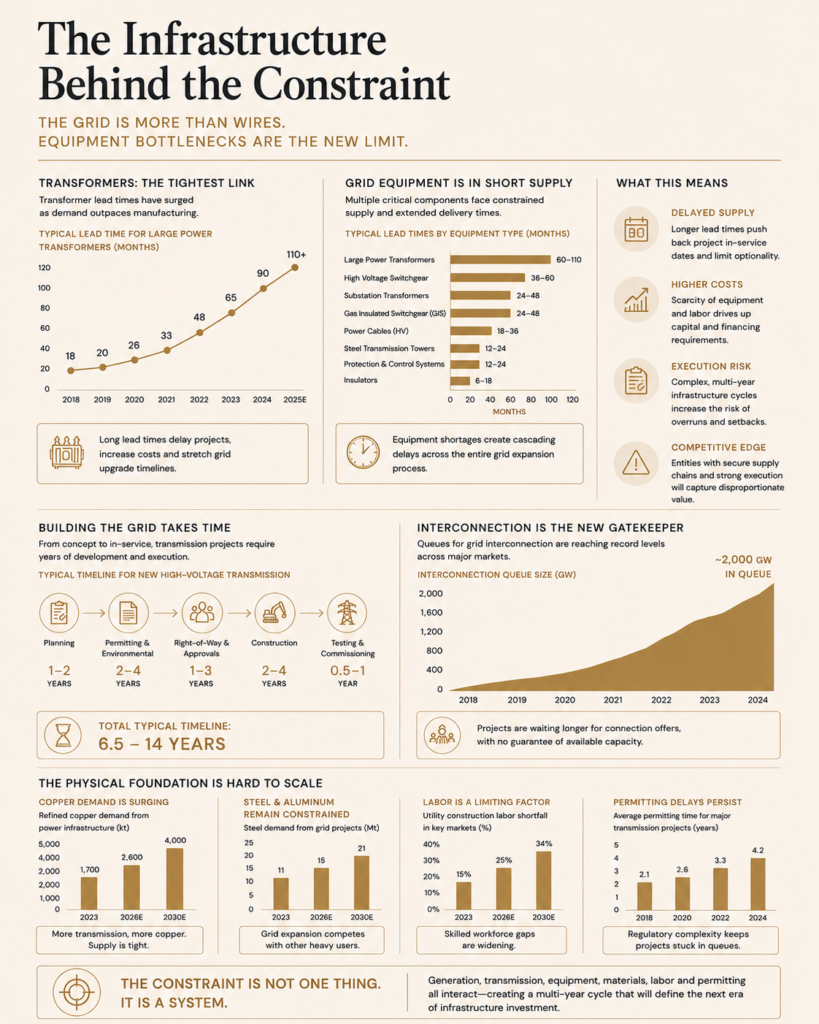
The next phase of the infrastructure cycle will not be defined simply by who wants to build. Capital is available, demand is visible, and the strategic case for expanding power generation, transmission and grid capacity has rarely been stronger. The harder question is which projects can actually move from announcement to operation. Equipment availability, interconnection capacity, permitting, specialized labor and access to critical materials are increasingly determining the pace at which investment can be converted into productive infrastructure.
This changes the economics of the opportunity. As physical constraints tighten, value begins to migrate toward the companies and assets positioned to control them. Utilities with secured transformer supply, developers holding advanced interconnection positions, manufacturers with expandable capacity and operators capable of navigating complex permitting processes gain an advantage that cannot easily be replicated with additional capital alone. In this environment, execution capacity becomes a scarce asset in its own right—and the ability to deliver infrastructure on time may ultimately matter more than the size of the investment pipeline.
The next infrastructure cycle will not be won by those with the largest ambitions, but by those who can turn capital into physical capacity. In a world of constrained grids, scarce equipment and longer development timelines, execution itself becomes a source of economic value.
FXNS RESEARCH Tweet
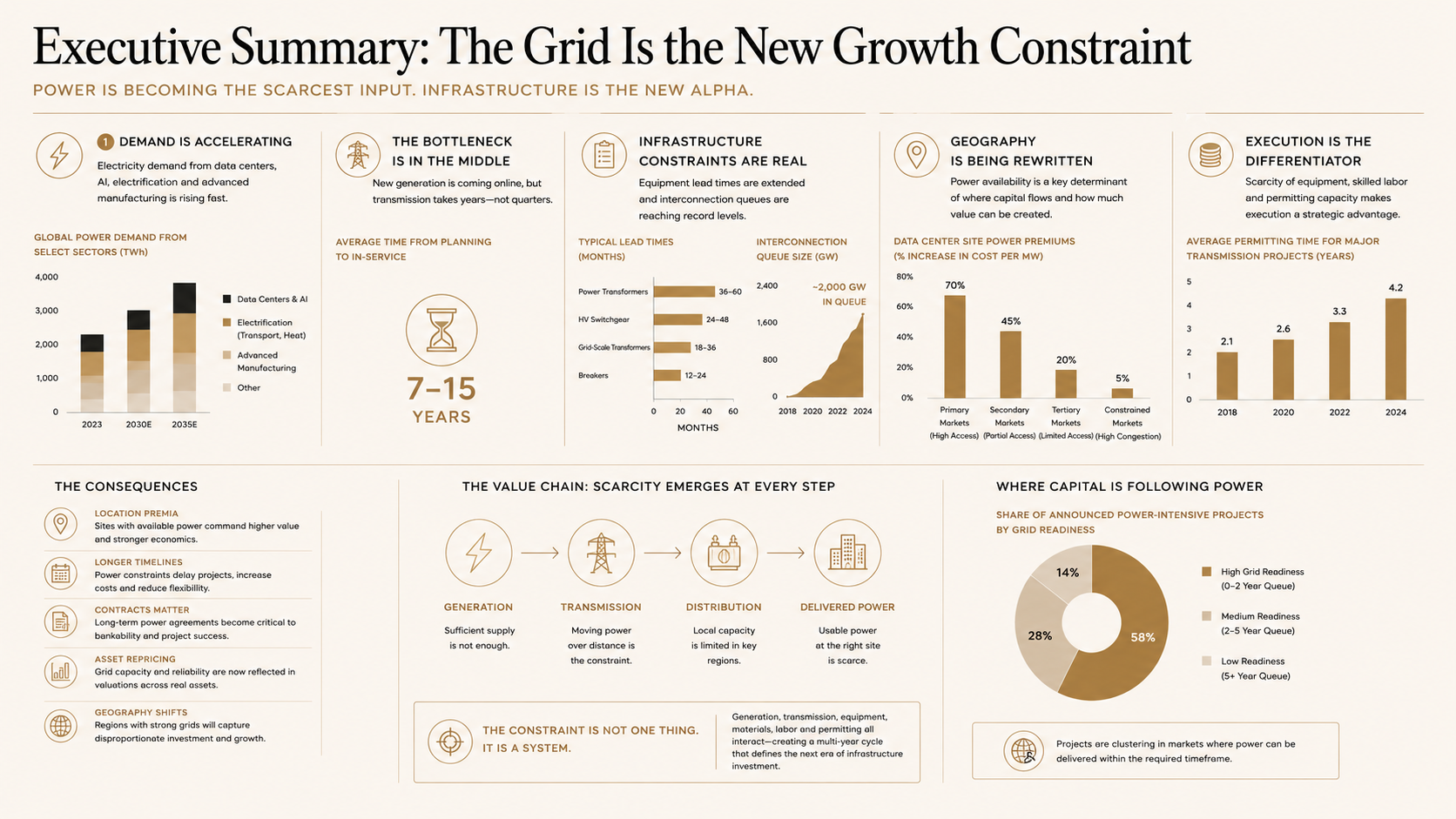
Power Becomes the New Location Premium
The infrastructure bottleneck is beginning to reshape the geography of investment. For decades, companies selected locations primarily around labor availability, logistics, taxation, land costs and proximity to customers. Those variables still matter, but for power-intensive industries a new filter is moving rapidly toward the top of the hierarchy: can the required electricity actually be delivered, at scale, within the investment horizon? A theoretically attractive site loses much of its value when grid connection requires years of waiting, transmission capacity is constrained or the local utility cannot guarantee the additional load. Power availability is therefore becoming embedded directly into the economics of location.
This is particularly visible across data centers, AI infrastructure, semiconductor manufacturing, advanced industrial facilities and other electricity-intensive projects. Developers are increasingly competing not simply for land, but for energized land—sites where generation, transmission, substations and interconnection rights are already aligned. That distinction creates a new form of scarcity premium. Regions capable of delivering reliable incremental megawatts quickly can attract disproportionate capital, while areas with congested grids may see otherwise viable projects delayed, resized or redirected elsewhere. The competitive map can therefore change even without meaningful differences in underlying demand.
The same logic extends through the infrastructure value chain. Grid equipment manufacturers, engineering contractors, utilities, transmission developers and owners of strategically located power assets increasingly occupy positions that determine how quickly new economic capacity can be created. Long-term contracts, secured transformer supply, available interconnection capacity and permitting expertise become strategic advantages rather than operational details. As bottlenecks persist, these advantages can translate into stronger pricing power, greater revenue visibility and higher asset values.
For investors, this requires looking beyond headline electricity demand. The more important question is where that demand can actually become physical consumption. Capital expenditure announcements alone do not create economic output; generation must connect to transmission, transmission must reach distribution networks, equipment must arrive, permits must clear and power must ultimately reach the facility. The investment opportunity therefore lies not only in rising demand, but in identifying the scarce infrastructure that enables that demand to materialize. In the next phase of the cycle, the grid will increasingly determine where growth can happen, how quickly it can happen—and who captures the value created along the way.



I look forward to seeing how these developments will improve service levels and customer satisfaction in the freight industry!