
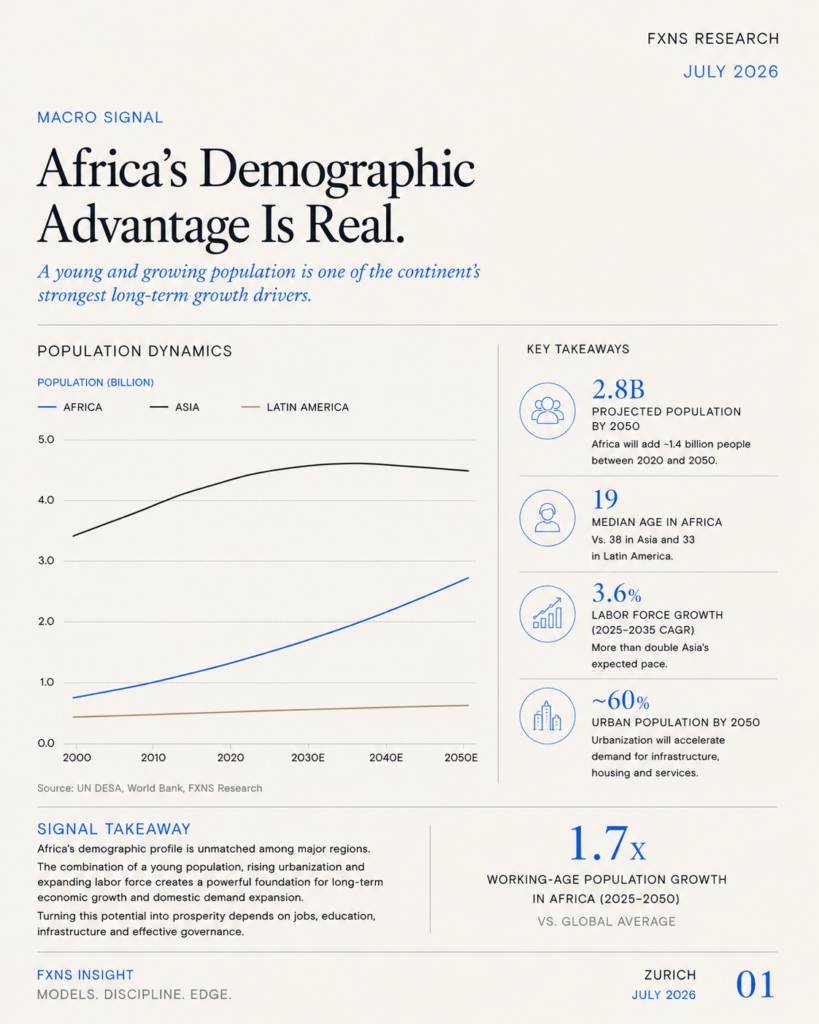
For decades, Africa has occupied a relatively narrow position in global investment portfolios: a source of commodities, a frontier market allocation, or a high-beta expression of global growth. Oil, copper, cobalt, gold and agricultural exports dominated the narrative, while weak infrastructure, fragmented markets, currency instability and political risk kept much of the continent outside mainstream capital allocation. That framework is becoming increasingly incomplete. Africa is entering a period in which several structural forces are beginning to overlap: rapid urbanisation, a young and expanding workforce, rising electricity demand, accelerating digital adoption and, critically, a global competition for the minerals, energy systems and trade routes required by the next industrial cycle.
The result is not simply renewed interest in African resources. It is a gradual repricing of the infrastructure and productive capacity surrounding them. Mining projects increasingly require power generation, transmission networks, railways, ports, processing facilities and reliable logistics; expanding cities require housing, mobility, telecommunications and financial infrastructure; digital economies require fibre networks, data centres and increasingly sophisticated payment systems. Capital is therefore being drawn into a much broader ecosystem than extraction alone. In selected markets, the economic value of a resource is beginning to extend beyond the mine or well and into the physical and financial architecture required to bring that resource into global supply chains.
The Challenge: The Repricing of Africa
This shift also arrives at a moment when the geopolitical value of diversification has increased. Governments and corporations are seeking alternatives to concentrated supply chains, while competition among China, the United States, Europe and Gulf economies is creating new sources of financing and strategic investment. African governments, meanwhile, are increasingly attempting to capture a larger share of the value created by their natural resources through local processing, industrial policy and infrastructure development. Execution remains uneven, and ambition frequently exceeds institutional capacity, but the direction of travel matters: the relationship between resources, foreign capital and domestic development is becoming more complex than the traditional extract-and-export model.
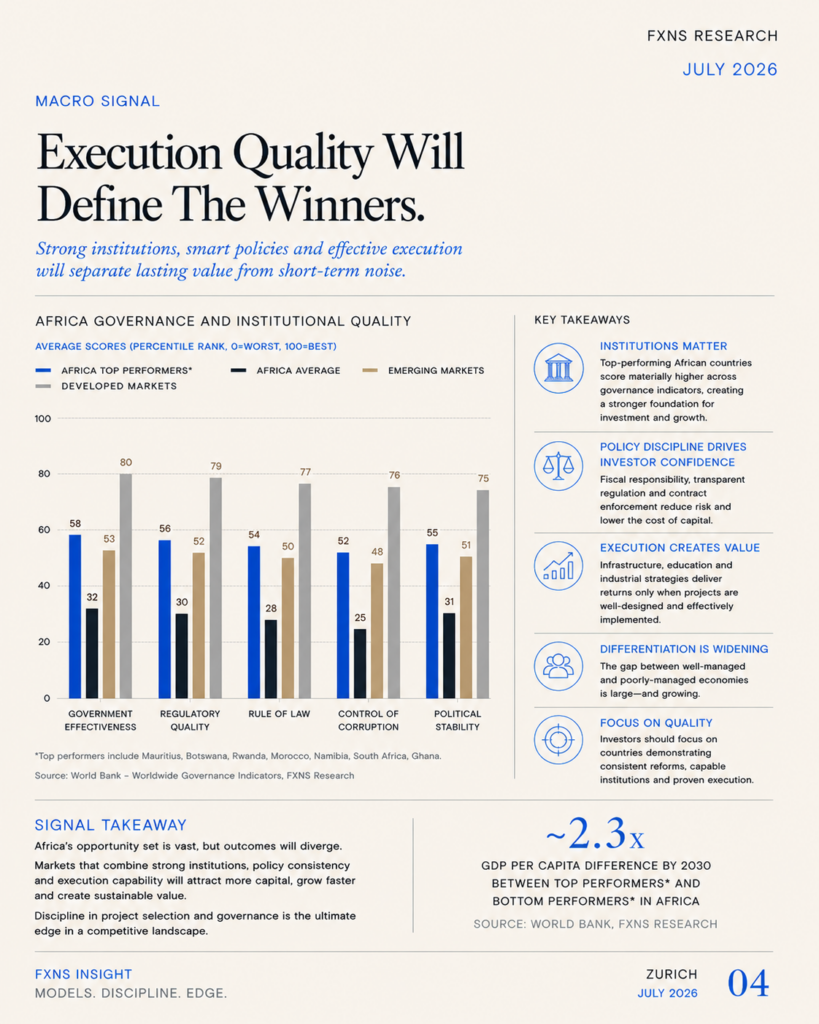
For investors, however, “Africa” remains a dangerously broad abstraction. The continent contains more than fifty economies with profoundly different fiscal positions, political institutions, currencies, demographic structures and access to capital. The opportunity is therefore not a generalized bet on African growth. It lies in identifying the specific markets where capital formation, infrastructure investment and institutional improvement are beginning to reinforce one another. The repricing of Africa will not occur uniformly, and it will not happen without setbacks. But where resource endowment is increasingly matched by connectivity, power, financing and credible execution, the investment case can evolve from one based primarily on scarcity beneath the ground to one built around productive capacity above it.
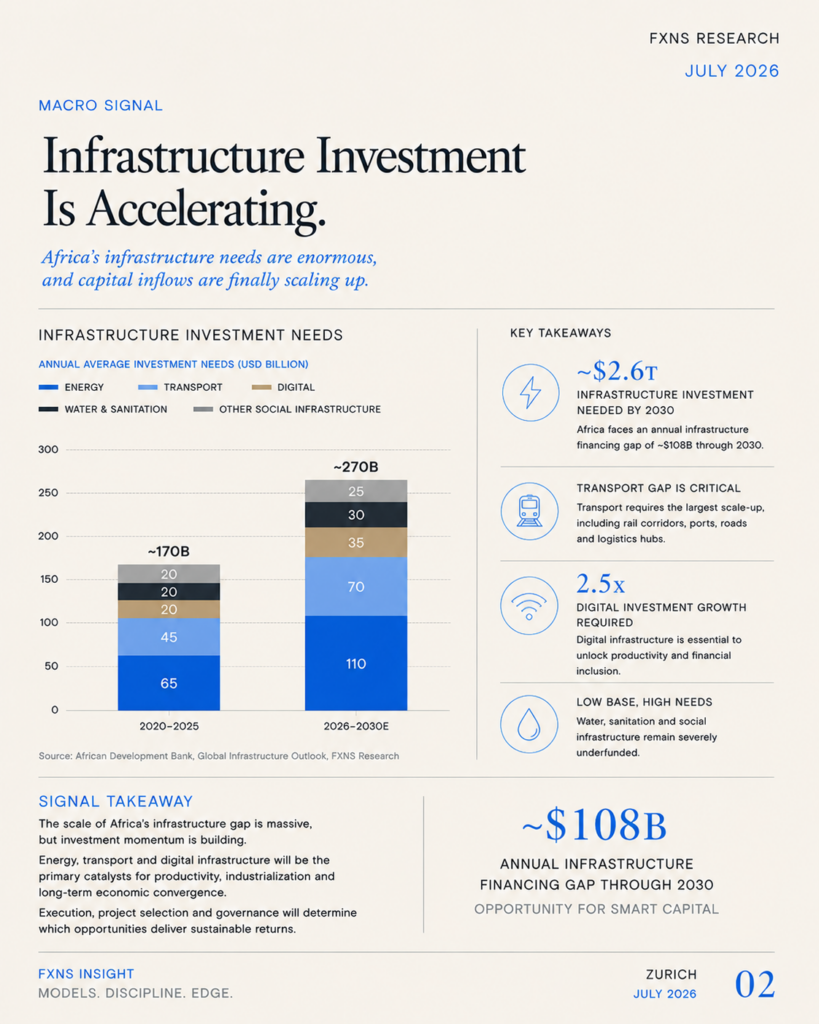
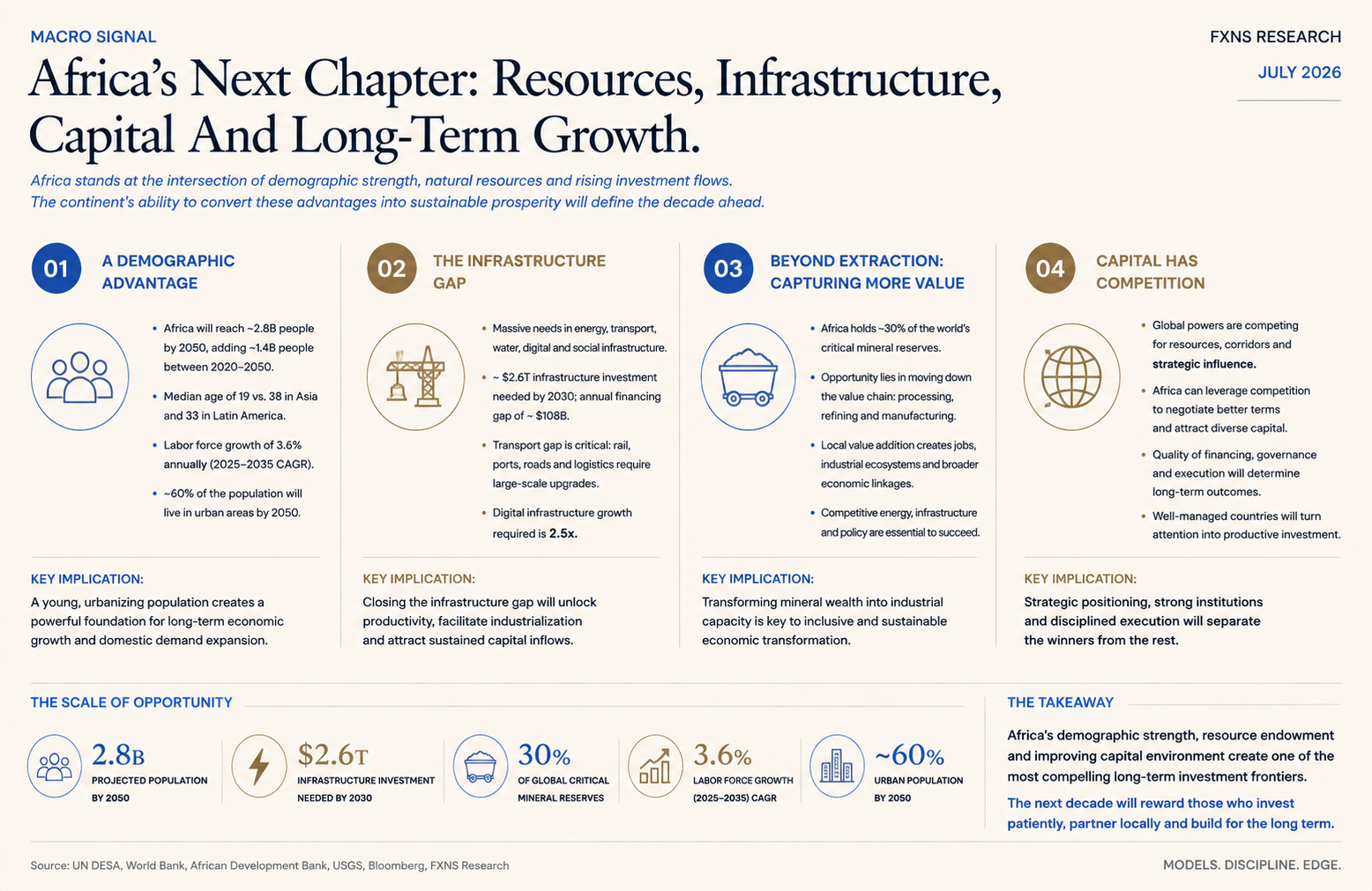
Africa’s growth potential has never been constrained by a lack of economic activity alone. More often, the binding constraint has been the infrastructure required to convert that activity into scale. Electricity remains unreliable or insufficient across large parts of the continent, transport networks are fragmented, logistics costs are high and cross-border connectivity is frequently weaker than the underlying trade opportunity would justify. A mine without reliable power, an industrial zone without efficient access to a port, or a rapidly expanding city without adequate transport and digital infrastructure cannot fully translate demand into productivity. This is why the infrastructure gap should not be viewed simply as a development deficit. Increasingly, it represents one of the central variables determining where African capital formation can accelerate — and where it will continue to stall.
Results Revealed: The Infrastructure Gap
Energy sits at the centre of this equation. Population growth, industrialisation, urban expansion and digitalisation are all increasing electricity demand, yet generation and transmission capacity remain inadequate in many markets. The challenge is not merely to add megawatts. New generation must be connected to functioning grids, financed at sustainable costs and supported by utilities capable of collecting revenues and maintaining infrastructure over decades. At the same time, Africa possesses exceptional renewable resources, from solar irradiation across the Sahel and Southern Africa to hydroelectric potential in Central and Eastern Africa. This creates an unusual combination: some of the world’s largest unmet energy needs coexist with some of its most attractive potential sources of low-cost generation. Where regulatory frameworks and financing structures become credible, that imbalance can become investable.
Transport infrastructure is equally decisive. Much of Africa’s existing rail and port architecture was historically designed to move raw materials from inland production areas toward the coast rather than to integrate domestic and regional economies. The next investment cycle is beginning to challenge that model. New railways, upgraded ports, highways and logistics hubs can connect mineral regions not only to export terminals but also to processing centres, industrial clusters and neighbouring markets. Projects such as the Lobito Corridor illustrate the strategic significance of this transition: infrastructure that once might have been considered primarily a transport asset is increasingly viewed as part of a wider competition over supply chains, critical minerals and geopolitical influence. Connectivity itself is becoming a strategic asset.
The same logic extends beyond physical infrastructure. Mobile payments demonstrated that African markets can sometimes leapfrog legacy systems rather than reproduce them, and the next phase is expanding into fibre networks, cloud infrastructure and data centres. As businesses digitise and financial systems deepen, digital infrastructure can reduce transaction costs across economies where physical distance and fragmented banking networks have historically limited scale. Yet the investment opportunity remains inseparable from execution risk. Large infrastructure projects require long-duration capital, regulatory continuity and often some combination of public financing, development institutions and private investors. Currency depreciation can destroy otherwise attractive local returns, while weak governance can transform productive assets into stranded capital. The infrastructure gap is therefore both Africa’s greatest constraint and one of its largest potential investment opportunities. The markets capable of closing it credibly will be the ones best positioned to convert demographic and resource potential into sustained economic productivity.
Beyond Extraction
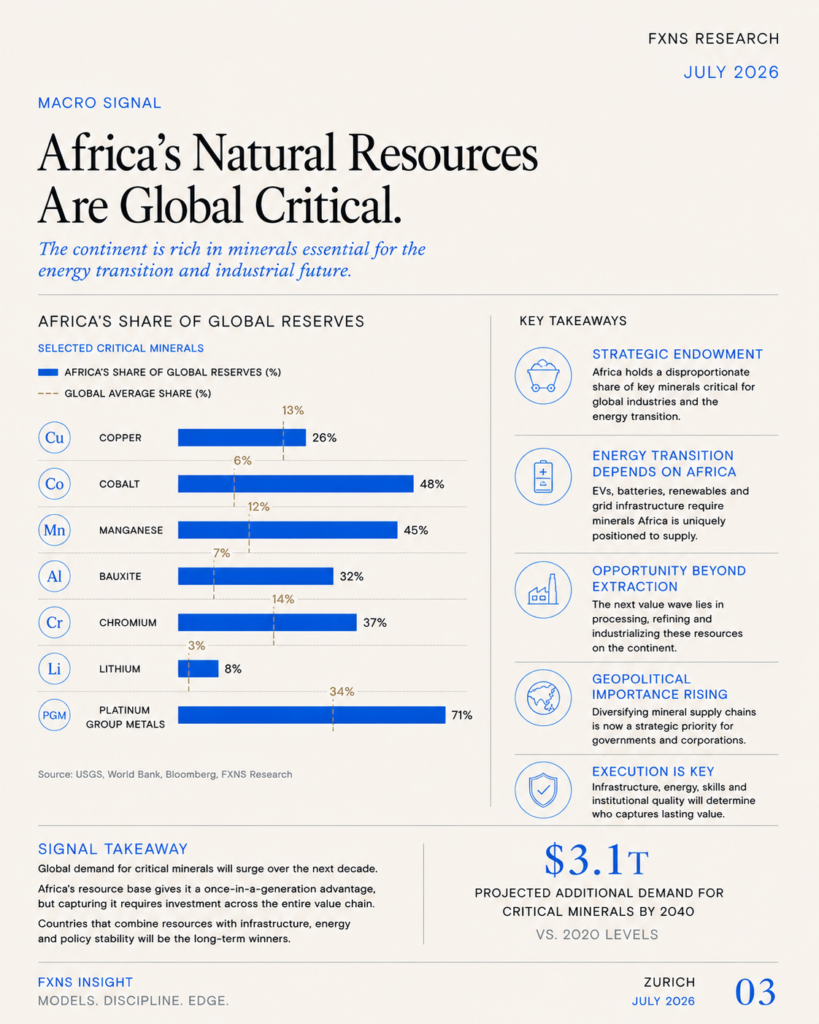
Africa’s mineral wealth has long been central to its relationship with the global economy, but the distribution of value created by those resources has historically been highly asymmetric. Copper, cobalt, manganese, bauxite, gold and other raw materials have often left the continent with limited processing, refining or manufacturing taking place near the point of extraction. The result has been a familiar economic structure: African economies absorb much of the operational, environmental and commodity-price risk associated with resource production, while a significant share of the higher-margin activity occurs elsewhere in the value chain. As demand for critical minerals accelerates, however, governments across the continent are increasingly questioning whether this model remains economically or politically sustainable.
The energy transition has made that debate considerably more important. Electric vehicles, battery storage, renewable power systems and expanding electricity grids require enormous quantities of copper, cobalt, lithium, graphite, manganese and other strategically important materials. Africa holds significant reserves of several of these resources, placing countries such as the Democratic Republic of Congo, Zambia, Zimbabwe, Guinea and South Africa in increasingly important positions within global supply chains. Yet mineral abundance alone does not guarantee economic transformation. The strategic question is whether these countries can capture a greater proportion of the value between extraction and the finished product — through refining, processing, component manufacturing and the industrial ecosystems that develop around them.
Africa’s next chapter will not be defined simply by the resources that lie beneath its soil, but by the infrastructure, industries and productive capacity it builds above them — and by its ability to transform strategic wealth into enduring economic power.”
FXNS RESEARCH
Capital Has Competition
For much of the past two decades, the expansion of foreign capital across Africa was closely associated with China. Chinese policy banks, state-owned enterprises and construction groups financed and delivered roads, railways, ports, power plants and telecommunications infrastructure at a scale that few other external actors were willing or able to match. In exchange, Beijing secured commercial relationships, access to resources and a strategic presence across some of the world’s fastest-growing economies. That model fundamentally altered Africa’s infrastructure landscape. But the environment is now changing. China remains a major economic force across the continent, yet it increasingly operates within a far more competitive field as the United States, Europe, Gulf states and other emerging powers seek deeper positions in African resources, logistics, energy and consumer markets.
Critical minerals have accelerated this competition. The transition toward electrification and renewable energy has exposed the strategic vulnerability created by concentrated supply chains, particularly where extraction, refining or processing is dominated by a small number of countries. Africa therefore matters not simply because it possesses valuable resources, but because it offers the possibility of diversifying the physical architecture through which those resources reach global markets. Copper from Zambia and the Democratic Republic of Congo, cobalt from Central Africa, bauxite from Guinea and a broader range of battery and industrial minerals are increasingly being viewed through the lens of economic security. Infrastructure financing is consequently becoming intertwined with industrial policy: a railway, port or processing facility can simultaneously be a commercial investment, a development project and a geopolitical instrument.
This is producing a more complex map of capital flows. The United States and Europe are attempting to support alternative trade corridors and supply chains, while Gulf states are deploying substantial capital into ports, logistics, renewable energy, agriculture and digital infrastructure. China, meanwhile, is adapting its own approach, becoming more selective in sovereign lending while retaining deep commercial relationships and extensive operational experience across the continent. African governments therefore find themselves with something they have not always possessed: greater competition among potential partners. Rather than relying on a single dominant source of external financing, they can increasingly negotiate across multiple pools of capital, each bringing different combinations of funding, technology, political alignment and strategic objectives.
Greater competition, however, does not automatically produce better outcomes. Infrastructure financed for geopolitical reasons can still become economically unproductive; opaque contracts can create long-term fiscal liabilities; and projects designed around resource access may generate limited domestic spillovers if they remain disconnected from local economies. Sovereign debt constraints also matter. Many African governments have far less balance-sheet capacity than they did during earlier infrastructure cycles, making private capital, multilateral institutions and blended-finance structures increasingly important. The quality of financing may therefore become as significant as its quantity. Countries capable of maintaining credible institutions, predictable regulation and disciplined project selection should be better positioned to turn geopolitical competition into productive investment rather than another cycle of external dependency.
This is ultimately where Africa’s new capital cycle becomes most consequential. The continent is no longer simply the passive arena in which major powers compete for resources; in selected markets, it has an opportunity to use that competition to finance infrastructure, deepen domestic value chains and improve its position within the global economy. The outcome will differ dramatically from country to country, and geopolitical attention should never be confused with investability. But the strategic balance has shifted. As access to minerals, energy and trade routes becomes increasingly valuable, capital has more reasons to enter Africa — and African governments have more potential partners competing for the right to deploy it.



I look forward to seeing how these developments will improve service levels and customer satisfaction in the freight industry!