

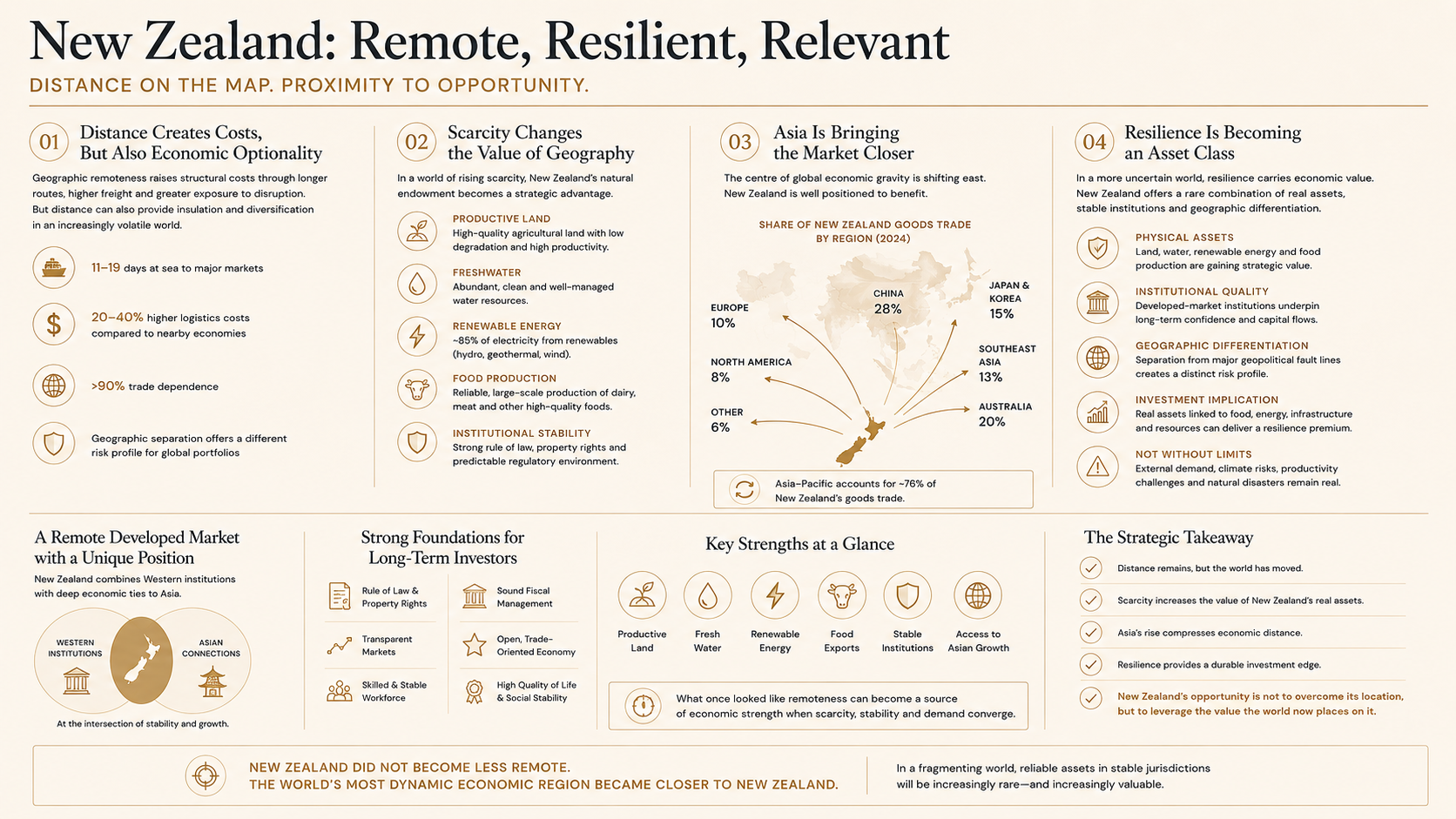
New Zealand’s economic geography begins with an unavoidable fact: distance is expensive. The country sits thousands of kilometres from the world’s largest consumer markets, operates with a relatively small domestic population and depends heavily on international trade to achieve the scale that its internal economy cannot provide. For decades, this combination has imposed a structural premium on transportation, inventory management, market access and capital allocation. New Zealand firms exporting physical goods must absorb longer shipping routes and more complex logistics than competitors located inside the dense commercial networks of Europe, North America or East Asia. Imported machinery, industrial components and intermediate goods face the same constraint in reverse. Geography therefore enters the economy almost like an invisible tax: it raises the cost of moving goods, limits economies of scale and makes external connectivity disproportionately important.
The consequences extend well beyond freight. A small domestic market changes the economics of almost every investment decision. Infrastructure must often be built for relatively limited volumes; specialized labour pools are thinner; companies seeking meaningful expansion frequently need to internationalize earlier than businesses in larger economies. Productivity becomes particularly important because New Zealand cannot rely indefinitely on population scale or proximity to enormous neighboring markets to compensate for inefficiencies. Even capital formation is influenced by this structure. Projects that would benefit from dense industrial ecosystems elsewhere may encounter higher procurement costs, fewer specialized suppliers and longer replacement cycles when equipment or components have to cross the Pacific before reaching their destination. The result is an economy in which resilience has historically required maintaining connections across extraordinary distances.
Yet New Zealand has repeatedly demonstrated that remoteness does not prevent integration. Instead, it has forced the country to specialize in activities capable of overcoming geography. Agriculture, dairy, meat, forestry and other resource-based industries developed precisely because New Zealand could produce products valuable enough to justify transporting them across the world. Services, technology and knowledge-intensive businesses offer a different solution: reducing the importance of physical distance altogether. Trade agreements and deep economic relationships across the Asia-Pacific have progressively compressed economic distance even when physical distance remained unchanged. The country’s economic model can therefore be understood as a continuous attempt to overcome one fundamental constraint—how to extract global value from an economy located far from most of the global population.
The Challenge: Distance Has Always Had a Price
For investors, that constraint matters because it explains both New Zealand’s vulnerabilities and its strengths. Distance increases exposure to disruptions in shipping, imported inflation and changes in external demand, but it has also created an economy accustomed to operating without the advantages of geographic convenience. Supply chains have to be deliberate. Export industries have to remain internationally competitive. Institutions and infrastructure carry greater importance because mistakes cannot always be compensated for by proximity to another major market. For most of modern economic history, this geography represented a discount that New Zealand had to overcome. But as the global system becomes more fragmented, security-conscious and sensitive to concentration risk, the more interesting question is no longer simply how much distance costs. It is whether some of the characteristics once treated as liabilities are beginning to acquire a strategic premium.
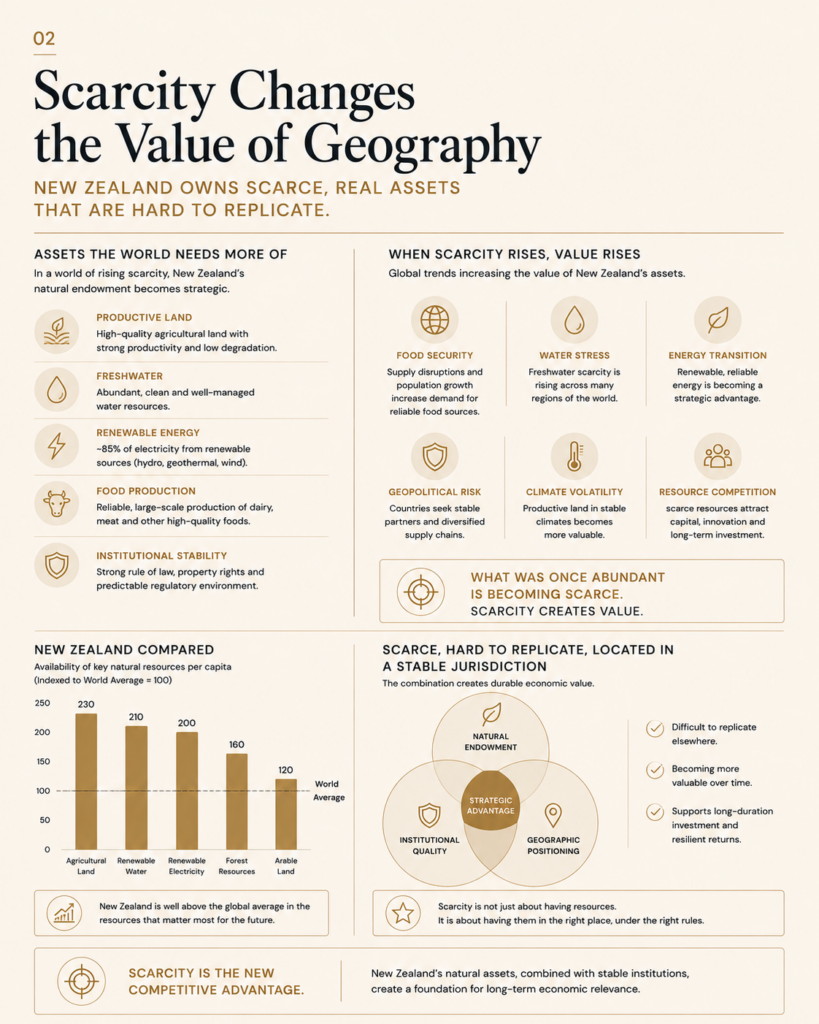
For most of the modern economic era, globalization rewarded proximity, density and efficiency. Production migrated toward enormous industrial clusters, supply chains were optimized around just-in-time delivery, and capital gravitated toward locations capable of connecting labour, infrastructure and consumers at the lowest possible cost. In that framework, New Zealand’s geography appeared structurally disadvantaged. But the variables determining economic value are changing. A world increasingly concerned with geopolitical fragmentation, food security, energy independence, water availability and supply-chain resilience assigns a different price to resources that were once considered abundant. When scarcity increases, the value of geography changes with it. New Zealand possesses an unusual combination of productive land, freshwater resources, renewable electricity, agricultural expertise and institutional stability. None eliminates the cost of distance, but together they transform what distance represents.
Food is perhaps the clearest example. New Zealand produces far more agricultural output than its domestic population consumes, making the country an important exporter of dairy products, meat and other food commodities despite its modest economic size. This capacity rests on something increasingly difficult to manufacture through capital alone: a combination of land, climate, water, biological productivity and decades of agricultural know-how. As climate volatility, geopolitical tensions and changing consumption patterns increase uncertainty around global food systems, reliable agricultural production becomes strategically relevant rather than merely commercially valuable. The distinction matters. An efficient producer operating in a world of abundant supply competes primarily on price and quality; a reliable producer operating in a world where supply itself becomes less predictable acquires an additional attribute—security. New Zealand’s agricultural base therefore represents more than export revenue. It provides exposure to a category of real assets whose strategic importance can rise precisely when the global system becomes more fragile.
Scarcity Changes the Value of Geography
Energy reinforces the same argument. New Zealand benefits from an electricity system in which renewable generation already plays a dominant role, supported by hydroelectric, geothermal and wind resources. This does not make the country completely energy independent, nor does it remove the need for investment in generation, transmission, storage and grid resilience. But it creates a fundamentally different starting position from economies attempting to reconstruct their energy systems while remaining heavily dependent on imported fossil fuels. Abundant renewable resources can eventually support more than domestic decarbonization: they can influence where energy-intensive industries locate, how infrastructure is valued and which forms of production remain competitive as carbon constraints become more economically significant. The strategic asset is therefore not simply renewable electricity itself. It is the possibility of combining clean power, natural resources and political stability within the same jurisdiction.
This is where New Zealand’s apparent isolation begins to acquire another interpretation. Geographic remoteness still creates logistical costs, but it also reduces certain forms of physical and geopolitical concentration risk. Productive land cannot be relocated. Hydroelectric catchments and geothermal resources cannot be replicated through financial engineering. Institutional credibility takes decades to construct. In a global portfolio increasingly dominated by intangible assets and highly interconnected supply chains, these characteristics offer something different: scarce, geographically anchored productive capacity inside a stable developed-market framework. That does not justify treating every New Zealand asset as inherently defensive or strategically valuable. It means that the country owns a collection of attributes whose marginal value may rise as resilience itself becomes scarce. The investment question is therefore shifting from what does isolation cost? toward something more consequential: what is reliable access to food, water, energy and stable institutions worth in a less reliable world?
Asia Is Bringing the Market Closer
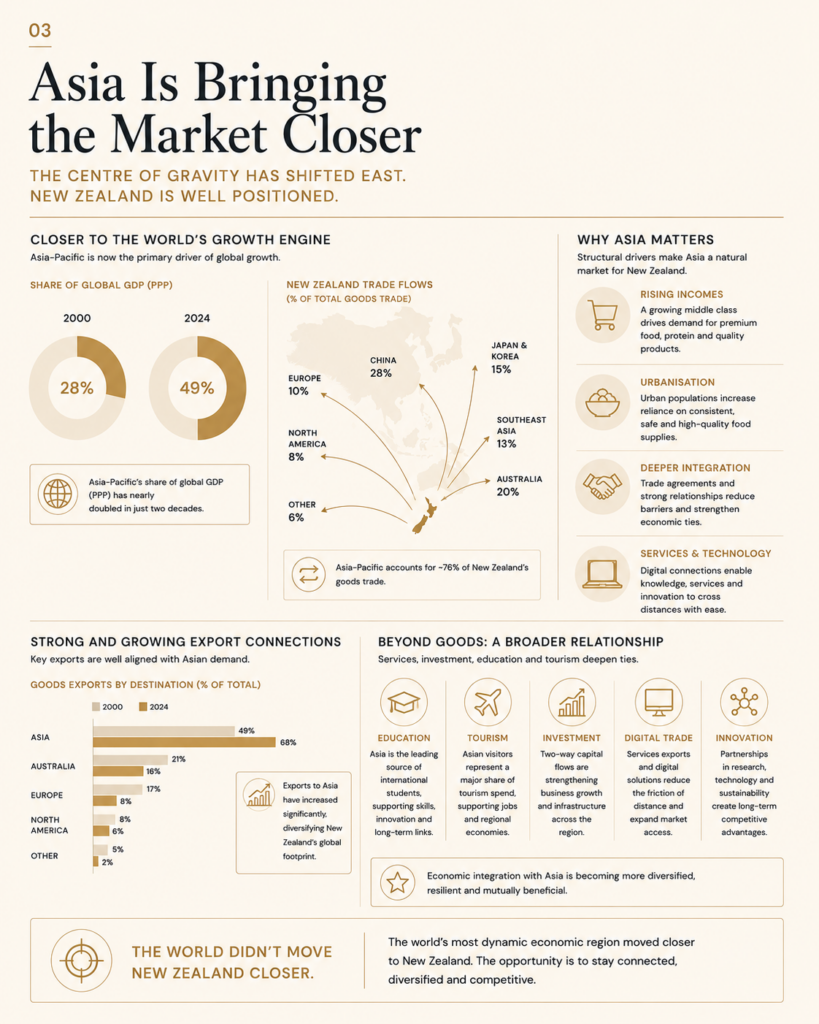
New Zealand has not moved, but the centre of gravity of the global economy has. For much of the country’s modern history, economic distance was measured against Britain, Europe and North America—the markets, capital centres and institutional relationships around which New Zealand’s commercial system had originally developed. That geography made the country appear exceptionally remote. The rise of Asia changes the map. China, Australia, Japan, South Korea and the broader Indo-Pacific now represent a far larger share of global consumption, manufacturing and capital formation than they did a generation ago. As economic activity has shifted eastward, New Zealand’s position in the South Pacific has become less peripheral. Physical distance remains unchanged, but economic distance is being compressed by the relocation of demand itself.
China illustrates the transformation most clearly. Its emergence as a major consumer of food, agricultural commodities and premium proteins created a natural complementarity with New Zealand’s productive base. Dairy, meat, forestry and other primary exports found enormous markets across Asia, while successive trade agreements reduced barriers and strengthened commercial integration. Australia remains deeply embedded in New Zealand’s economic architecture, but the broader Asian relationship has diversified the country away from its historical dependence on distant Western markets. The important point is not simply that New Zealand sells more products to Asia. It is that the structure of global demand has moved closer to the structure of New Zealand’s comparative advantage. Rising Asian incomes, urbanization and the expansion of middle-class consumption increase demand for precisely the categories in which New Zealand has established international credibility: food quality, agricultural products, natural resources and increasingly specialized services.
This integration is also becoming more sophisticated than a simple commodity relationship. The next phase of New Zealand’s connection with Asia will depend increasingly on services, technology, intellectual property, tourism, education, financial flows and high-value specialized production. Digitalization changes the economics of remoteness because knowledge can cross the Pacific without occupying a container ship. A software company, specialist engineering business or digital service provider can address customers thousands of kilometres away without carrying the same transportation penalty faced by physical exporters. At the same time, improvements in logistics, aviation, communications infrastructure and regional trade architecture continue to reduce the effective friction of distance for the traditional economy. New Zealand does not need to reproduce the industrial scale of East Asia. Its opportunity lies in connecting scarce domestic capabilities to enormous external markets.
But deeper integration creates a new form of vulnerability. When distance falls economically, concentration can rise strategically. Greater exposure to Asian demand—particularly to a small number of major trading partners—means that changes in Chinese growth, consumer demand, regulation or geopolitical relationships can transmit quickly into New Zealand’s export economy. What solved one problem can therefore create another. The strategic objective is not simply to maximize trade with the nearest sources of growth, but to preserve access while maintaining diversification across markets, products and partners. India and Southeast Asia could become increasingly important within that equation, providing additional sources of demand within the same broad Indo-Pacific economic system.
For investors, this produces a more interesting interpretation of New Zealand’s geography. The country should no longer be viewed exclusively as a remote developed economy sitting at the edge of the traditional Western commercial system. It increasingly occupies the intersection between Western institutions and Asian economic growth. Its legal framework, governance standards and capital markets remain firmly associated with advanced Western economies, while its trade geography points increasingly toward the Indo-Pacific. That combination is unusual. New Zealand’s strategic value may therefore lie not in overcoming its location, but in recognizing that the economic map around it has changed. The country did not become closer to the world. The world’s most dynamic economic region became closer to New Zealand.
New Zealand’s advantage is not that it escaped the constraints of distance, but that the value of those constraints is changing. In a world where food, energy, natural resources and institutional stability are becoming increasingly strategic, resilience itself carries a premium — and what once looked like isolation can become a source of economic optionality.
FXNS RESEARCH
Resilience Is Becoming an Asset Class
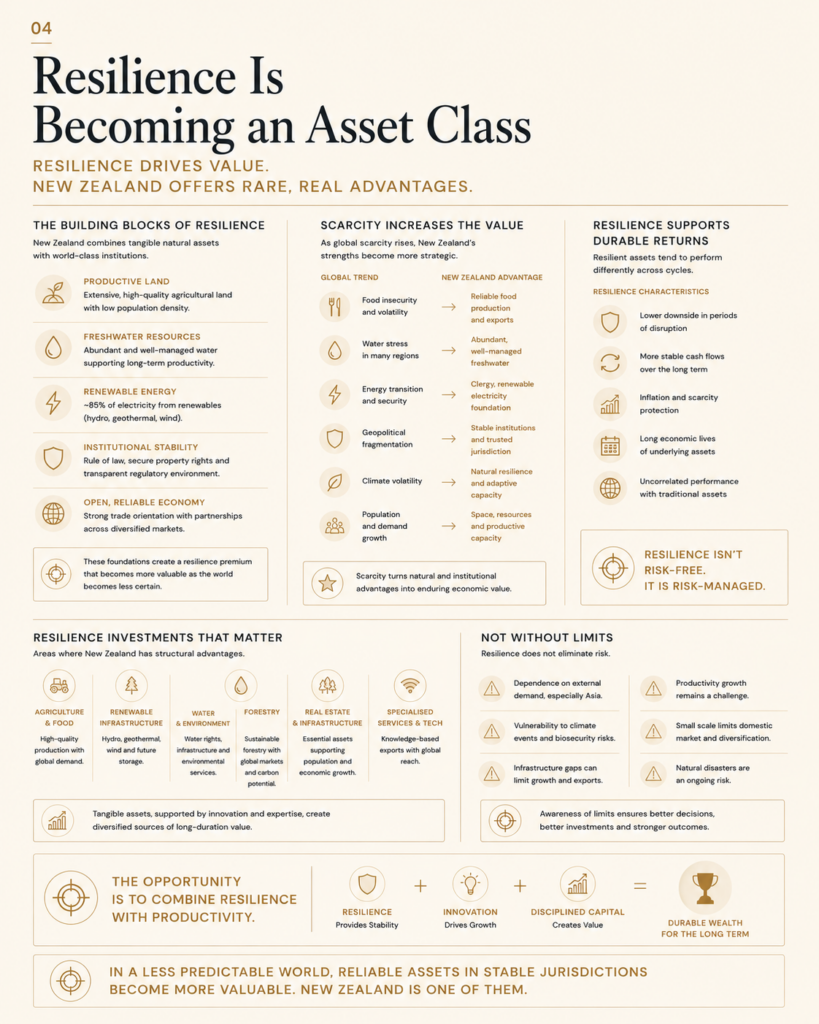
For most of the past four decades, financial markets rewarded efficiency above almost everything else. Capital moved toward the lowest-cost producer, inventories were minimized, supply chains were concentrated and redundancy was treated as an unnecessary expense. The underlying assumption was that the global system itself would remain sufficiently stable for optimization to dominate resilience. That assumption has weakened. Pandemic disruption, geopolitical fragmentation, energy shocks, climate volatility and increasingly strategic competition over critical resources have exposed the cost of systems designed with little spare capacity. Investors are beginning to recognize that reliability has economic value. Supply security, political stability, energy availability and institutional credibility may not appear as conventional assets on a balance sheet, but they influence the durability of the cash flows that ultimately determine asset values. In this environment, New Zealand possesses a collection of characteristics that can increasingly be understood through the concept of a resilience premium.
The foundation of that premium is unusually tangible. New Zealand combines productive agricultural land, substantial freshwater resources, high levels of renewable electricity generation and an export-oriented food system capable of producing considerably more than its domestic population requires. These are not speculative advantages dependent on the success of a single technology or business model. They are forms of physical productive capacity whose strategic value can increase when global systems become less predictable. Food security becomes more valuable when agricultural supply is disrupted. Renewable generation becomes more valuable when imported energy becomes expensive or politically vulnerable. Water becomes more valuable as climate stress increases scarcity elsewhere. Productive land becomes more valuable when populations continue to grow while the quantity of high-quality agricultural land remains inherently finite. Scarcity does not create New Zealand’s resources; it changes the price the world is willing to assign to their reliability.
Institutions provide the second layer. Natural resources alone do not create investable resilience. Many resource-rich economies struggle to convert geological or agricultural advantages into durable wealth because property rights, governance, capital markets or political stability remain uncertain. New Zealand combines its physical endowment with a developed-market institutional framework: established rule of law, relatively predictable regulation, transparent markets and a long history of protecting private ownership. For long-duration investors, this combination matters enormously. A productive asset expected to generate cash flows for thirty or fifty years depends not only on what it produces, but on confidence that contracts, taxation, ownership and regulation will remain sufficiently predictable over that horizon. Resilience therefore emerges from the interaction between physical assets and institutional credibility, not from either characteristic in isolation.
Geographic isolation adds a third dimension. The same distance that raises transportation costs can provide a degree of insulation from certain forms of geopolitical disruption. New Zealand remains dependent on global shipping, imported technology, liquid fuels and international capital, so remoteness should never be confused with self-sufficiency. A serious disruption to maritime trade would expose rather than eliminate many of the country’s vulnerabilities. Yet physical separation from the major geopolitical fault lines of Europe, the Middle East and continental Asia creates a different risk profile from economies located directly beside them. In portfolio terms, this matters because diversification is valuable when exposures are genuinely different. An asset does not need to be risk-free to improve resilience; it needs to respond differently to the risks already concentrated elsewhere.
This logic extends into infrastructure and capital allocation. If resilience carries economic value, investments that once appeared inefficient can acquire an option premium. Additional electricity generation, grid capacity, water infrastructure, domestic storage, diversified supply chains and stronger transport connections may generate returns that conventional models underestimate because their greatest value emerges during periods of stress. The same principle applies at the national level. Maintaining redundant capabilities can appear expensive during normal conditions, just as insurance appears expensive when nothing goes wrong. But the economic cost of redundancy must be compared with the potential cost of interruption. New Zealand’s challenge is therefore not merely to possess resilient characteristics, but to invest sufficiently in the systems that preserve and monetize them.
There is also an important financial implication. Global portfolios remain heavily concentrated in large economies, major technology platforms and financial assets whose valuations often depend on similar underlying variables: abundant liquidity, functioning global supply chains and stable geopolitical relationships. Real assets linked to food, energy, infrastructure and water behave differently because their value derives from physical scarcity and productive utility. New Zealand cannot become a major global capital market simply through these exposures; its scale is far too small. But precisely because it is small, stable and unusually endowed with certain scarce resources, it can offer investors access to economic characteristics that are difficult to reproduce synthetically. Agriculture, renewable infrastructure, forestry, selected real estate and resource-linked businesses can therefore represent more than conventional sector exposures. They can become expressions of a broader thesis around security of supply and durability of productive capacity.
The resilience thesis nevertheless has limits. New Zealand remains highly exposed to external demand, particularly across Asia, and its agricultural economy is vulnerable to climate conditions, biological risks and changing environmental regulation. Housing affordability and infrastructure constraints can reduce competitiveness and make it more difficult to attract skilled labour. Productivity growth has remained an important structural challenge, while the country’s small domestic market limits the scale available to many businesses. Natural disasters represent another unavoidable risk in a geologically active country. And even abundant renewable electricity does not eliminate dependence on imported fuels across transportation and parts of the industrial system. Resilience is not the absence of vulnerability. It is the capacity to absorb disruption without allowing one vulnerability to become systemic.
That distinction is essential because the investment case for New Zealand should not become a romantic narrative about a remote safe haven. Its strategic attributes have economic value only if they are accompanied by productivity, infrastructure investment and disciplined capital allocation. Productive land that cannot access export markets loses value. Renewable generation without sufficient transmission cannot support new industry. Institutional stability without innovation can preserve wealth without creating enough new wealth. The opportunity is therefore to combine the defensive characteristics of scarcity and stability with the offensive characteristics of technology, trade and productive investment.
This is ultimately why the economics of distance are changing. New Zealand spent much of its modern history paying a premium for being far from the world. Globalization reduced that penalty by improving transportation, communications and trade integration. A more fragmented global system could now produce a second transformation: some of the distance that once represented inefficiency may begin to represent optionality. The country remains remote, small and dependent on external markets. None of those facts has disappeared. What has changed is the value investors may assign to reliable food production, renewable energy, natural resources, institutional stability and geographic diversification when those characteristics become less abundant elsewhere. New Zealand did not become less remote. The world made remoteness more valuable.



I look forward to seeing how these developments will improve service levels and customer satisfaction in the freight industry!