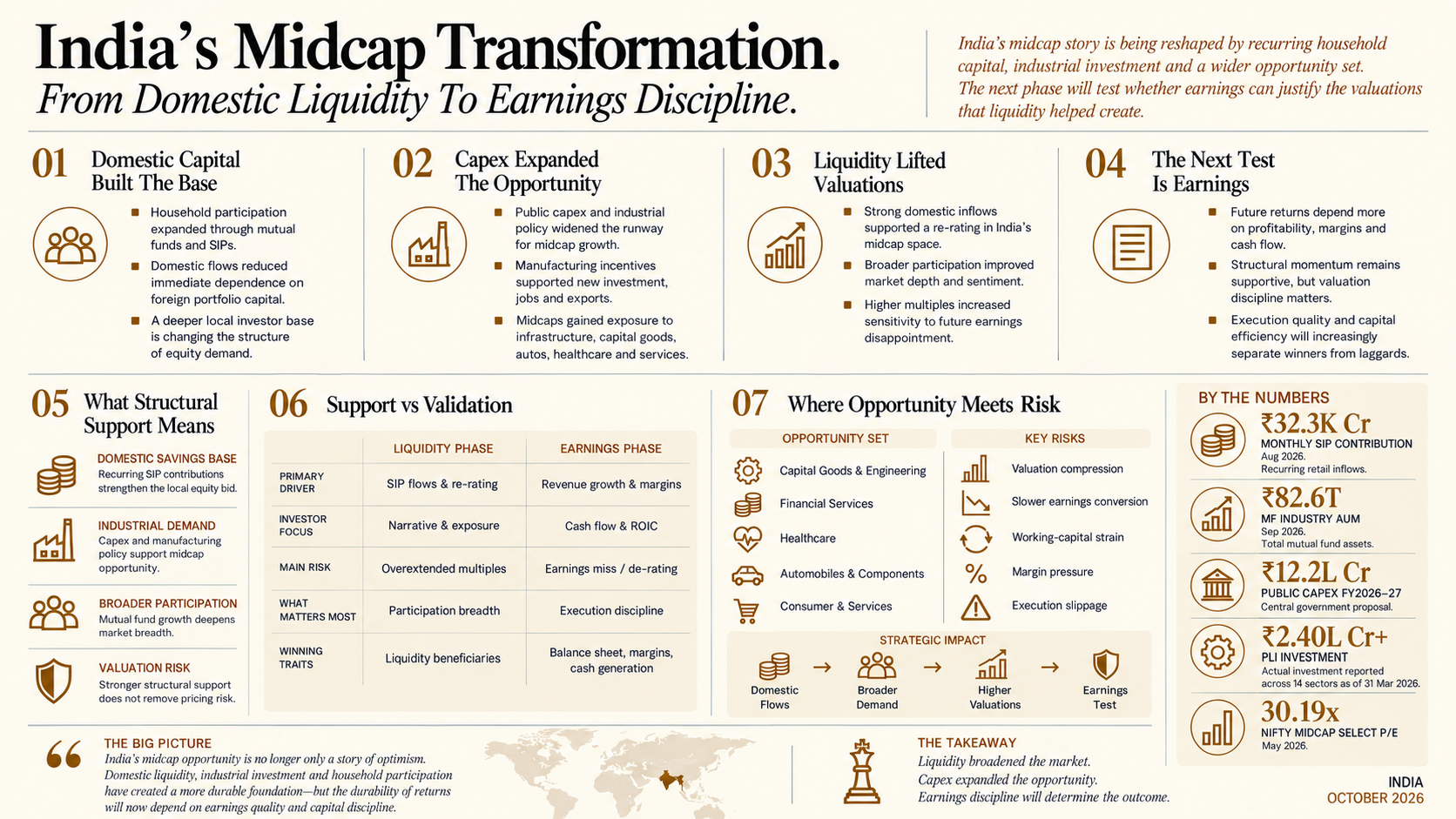

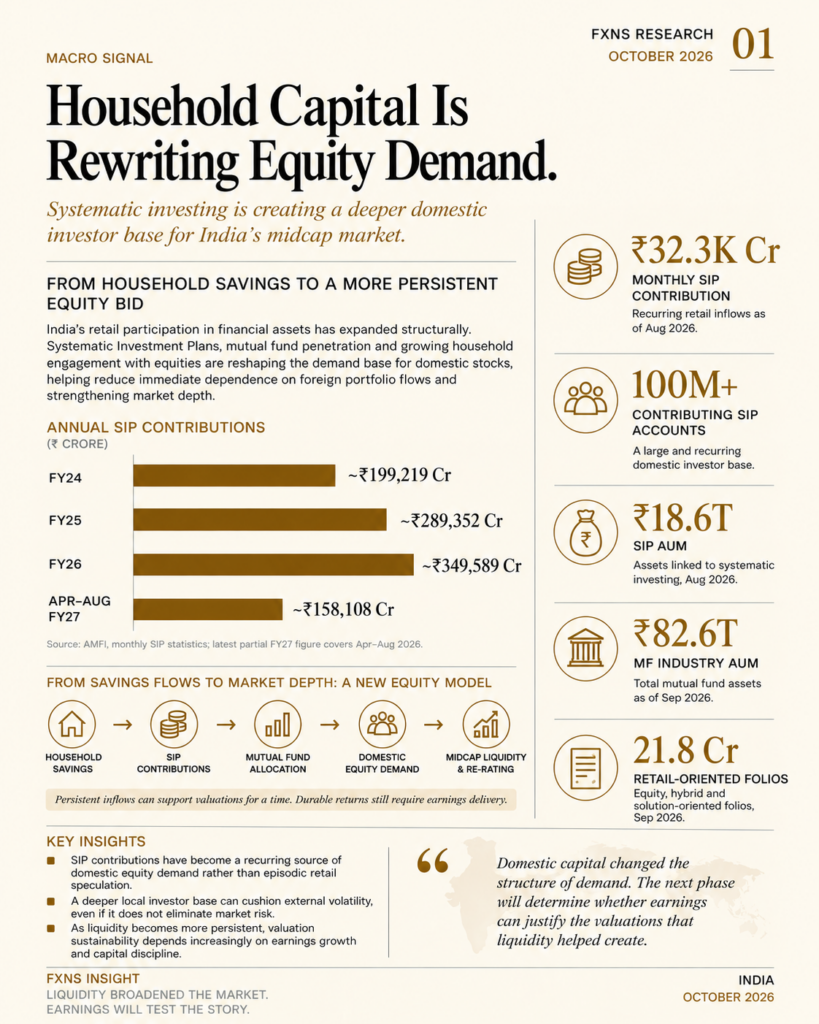
Since 2023, India’s midcap equity market has become an increasingly revealing expression of the country’s economic transformation, reflecting the interaction between expanding domestic savings, sustained investment in productive capacity and a broader industrial opportunity set. The Nifty Midcap Select, a concentrated benchmark comprising 25 liquid companies drawn from the Nifty Midcap 150 universe, offers a distinctive perspective on this evolution, capturing businesses exposed to different segments of India’s corporate growth cycle. The forces shaping this market extend well beyond traditional expectations of economic expansion. Public infrastructure expenditure, manufacturing incentives, supply-chain diversification, financial deepening and the gradual formalisation of economic activity have created new opportunities for companies operating across industrial production, engineering, capital goods, financial services and domestic consumption. At the same time, the structure of equity demand has undergone an important transformation. Indian households are increasingly participating in capital markets through systematic investment plans, mutual funds and other domestic investment channels, creating a more established source of recurring equity allocations. In September 2026, monthly Systematic Investment Plan contributions reached a record ₹32,490 crore, equivalent to approximately ₹324.9 billion, reinforcing the scale of this shift. These contributions represent flows into the broader mutual fund industry rather than direct purchases of Nifty Midcap Select constituents, but their significance lies in the development of a domestic savings ecosystem capable of supporting equity demand through changing market conditions. The resulting transformation is not merely financial. It is gradually altering the relationship between household savings, corporate funding, market liquidity and the allocation of capital within one of the world’s largest emerging economies. Yet the combination of structural investment opportunities and persistent domestic inflows has also raised an increasingly consequential question: how much of the optimism surrounding Indian midcaps reflects improvements in future corporate earnings, and how much has already been incorporated into their valuations?
India's midcap transformation is being financed by a new generation of domestic investors. The next challenge is whether corporate earnings can grow fast enough to justify the expectations their capital has created.
The importance of this transition becomes clearer when viewed through the changing dynamics of capital formation and market pricing. Historically, emerging-market equities have often been highly sensitive to foreign portfolio investment, global dollar liquidity and shifts in international risk appetite. India remains exposed to these forces, particularly through exchange-rate movements, global interest rates, energy import costs and the behaviour of institutional investors. However, the expansion of domestic mutual fund participation has introduced a more persistent counterweight to foreign capital flows, potentially reducing the immediate impact of external selling on market liquidity without eliminating volatility or valuation risk. The distinction is particularly relevant to midcap companies, whose valuations can respond strongly to changes in marginal investor demand and expectations of future growth. Recurring domestic subscriptions may help absorb selling pressure and broaden market participation, but stable inflows do not automatically translate into stable share prices, nor do they guarantee attractive future returns. Meanwhile, India’s investment cycle is creating genuine opportunities for corporate expansion. Infrastructure development can generate demand for equipment, construction services and industrial inputs; manufacturing incentives can encourage new production capacity; and the formalisation of financial activity can support the development of more sophisticated corporate funding channels. The challenge is that these structural improvements unfold at different speeds. Government expenditure does not immediately become private-sector profitability, order-book growth does not necessarily translate into stronger margins, and capacity expansion can create competitive pressure before delivering sustainable returns on invested capital. After a period in which domestic participation and expectations of economic transformation have supported investor enthusiasm, the next phase of India’s midcap market will therefore require greater discrimination between businesses capable of converting structural demand into free cash flow and those whose valuations depend primarily on ambitious assumptions about future growth. The Nifty Midcap Select provides an important lens through which to examine this transition, although its concentrated composition means that its performance cannot be treated as a complete representation of India’s broader midcap universe. The central issue is no longer simply whether India possesses the economic foundations for long-term corporate growth. It is whether the profitability, execution capabilities and capital efficiency of individual companies can validate the valuations investors are prepared to pay. As domestic capital becomes a more permanent feature of India’s equity market, earnings delivery—not the availability of liquidity alone—will increasingly determine the durability of its midcap opportunity.
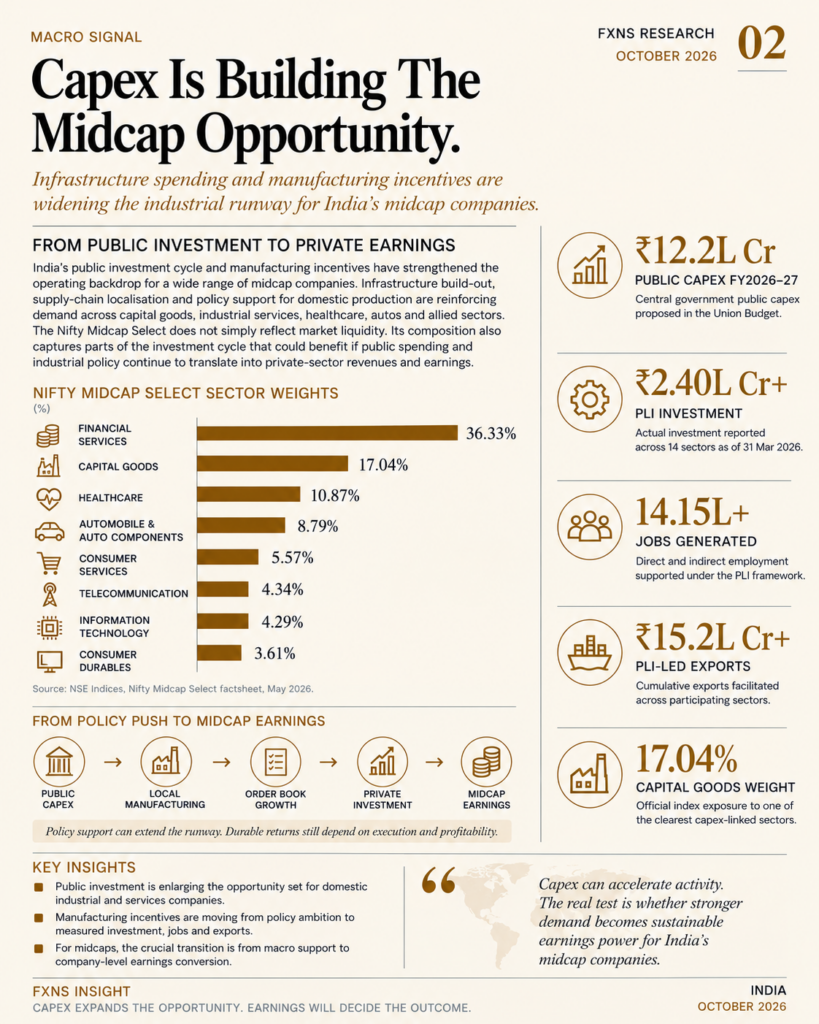
India’s expanding investment cycle is gradually redefining the opportunity set for its mid-sized listed companies, creating a transmission mechanism through which public expenditure, industrial policy and domestic capital formation can influence corporate profitability. The scale of this transformation is considerable. The Union Budget for FY2026–27 proposed approximately ₹12.2 lakh crore in central government capital expenditure, reinforcing a multi-year commitment to transport infrastructure, logistics networks, energy systems and productive capacity. Alongside this public investment programme, India’s Production Linked Incentive schemes have encouraged manufacturing expansion across 14 strategic sectors, attracting more than ₹2.40 lakh crore in cumulative investment and supporting over 1.4 million direct and indirect jobs by March 2026. These developments are significant because they extend the economic consequences of government expenditure beyond the initial construction or manufacturing activity. New infrastructure reduces logistical friction, improves market accessibility and can strengthen the economics of private investment, while expanding industrial capacity generates demand for machinery, engineering services, specialised components, financing and technological integration. For midcap businesses positioned within these supply chains, the opportunity lies not simply in securing additional orders but in converting a sustained investment cycle into higher capacity utilisation, stronger operating leverage and improved returns on capital. The Nifty Midcap Select provides a concentrated perspective on this process, although its composition is broader than a pure industrial investment theme. According to NSE Indices’ May 2026 factsheet, financial services represented approximately 36.3% of the benchmark, followed by capital goods at 17.0%, healthcare at 10.9% and automobiles and auto components at 8.8%. This sector distribution illustrates how India’s investment cycle intersects with several distinct sources of corporate earnings, from industrial production and infrastructure equipment to credit intermediation, healthcare demand and domestic mobility. It also introduces an important distinction: the benefits of structural economic growth are neither uniform nor automatic. A rising national capital expenditure budget does not imply equivalent earnings growth across listed companies, and the timing of revenue recognition, working-capital requirements, competitive intensity and project execution can produce substantial differences in financial outcomes. The structural investment thesis is strongest where expanding economic activity translates into sustainable cash generation, not merely larger order books or more ambitious revenue forecasts.
Public investment creates the opportunity. Corporate execution determines its value. India's next midcap cycle will reward the companies that turn structural demand into sustainable earnings and capital efficiency.
The critical question for investors is therefore shifting from the scale of India’s economic ambitions to the financial quality of their implementation. A prolonged expansion in infrastructure and manufacturing can support corporate revenues for several years, but the ultimate investment return depends on the relationship between earnings growth, capital requirements and the valuation paid for that growth. Businesses benefiting from government contracts and industrial incentives may experience rapid increases in order intake while simultaneously facing rising inventories, delayed receivables, labour constraints and additional financing needs. Capacity expansion can initially strengthen market expectations without immediately improving free cash flow, particularly when companies must commit substantial capital before new facilities reach efficient utilisation levels. For financial institutions, the transmission operates differently: industrial investment and household financialisation may support credit demand, fee income and broader financial intermediation, but profitability remains sensitive to funding costs, asset quality and the credit cycle. These differences matter because the Nifty Midcap Select is not a uniform collection of manufacturing beneficiaries. Its constituents operate across industries with different earnings visibility, capital intensity, competitive structures and sensitivity to economic conditions. Valuation discipline consequently becomes more important as investors move from assessing the size of the addressable market to measuring how much economic value individual businesses can retain. Companies with strong balance sheets, predictable cash conversion, disciplined capital allocation and demonstrable pricing power are better positioned to translate sustained demand into durable shareholder returns. Conversely, firms whose market valuations depend on uninterrupted order growth, permanently elevated margins or continued expansion in valuation multiples may become increasingly vulnerable to even modest disappointments. The interaction with domestic mutual fund flows adds another layer to this process. Recurring SIP contributions have broadened the pool of capital available to Indian equities, potentially supporting market depth and reducing the immediate dependence on foreign portfolio investors. Yet these flows are distributed across different investment categories, and the amount ultimately allocated to any individual midcap stock depends on portfolio mandates, active fund decisions, index composition and prevailing market prices. A persistent domestic investor base can therefore change the conditions under which equities are traded without changing the fundamental economics of the companies being valued. Indeed, when strong inflows coincide with optimistic earnings expectations, market prices may anticipate several years of future growth before that growth has materialised. This creates a second-order vulnerability: even companies delivering respectable operating results can generate disappointing equity returns if earnings fail to exceed expectations embedded in elevated valuations. The next stage of India’s midcap development is thus likely to be characterised by greater differentiation between businesses that can consistently convert investment opportunities into economic profits and those whose valuations have advanced faster than their underlying fundamentals. Rather than treating the market’s structural growth narrative as a sufficient investment argument, the more revealing indicators will be earnings revisions, operating margins, free-cash-flow generation, return on invested capital and the relationship between valuation multiples and realised growth. India’s industrial transformation can remain fundamentally intact even as individual midcap equities undergo significant repricing. The durability of the opportunity will depend less on the persistence of the narrative than on the ability of corporate earnings to substantiate it.
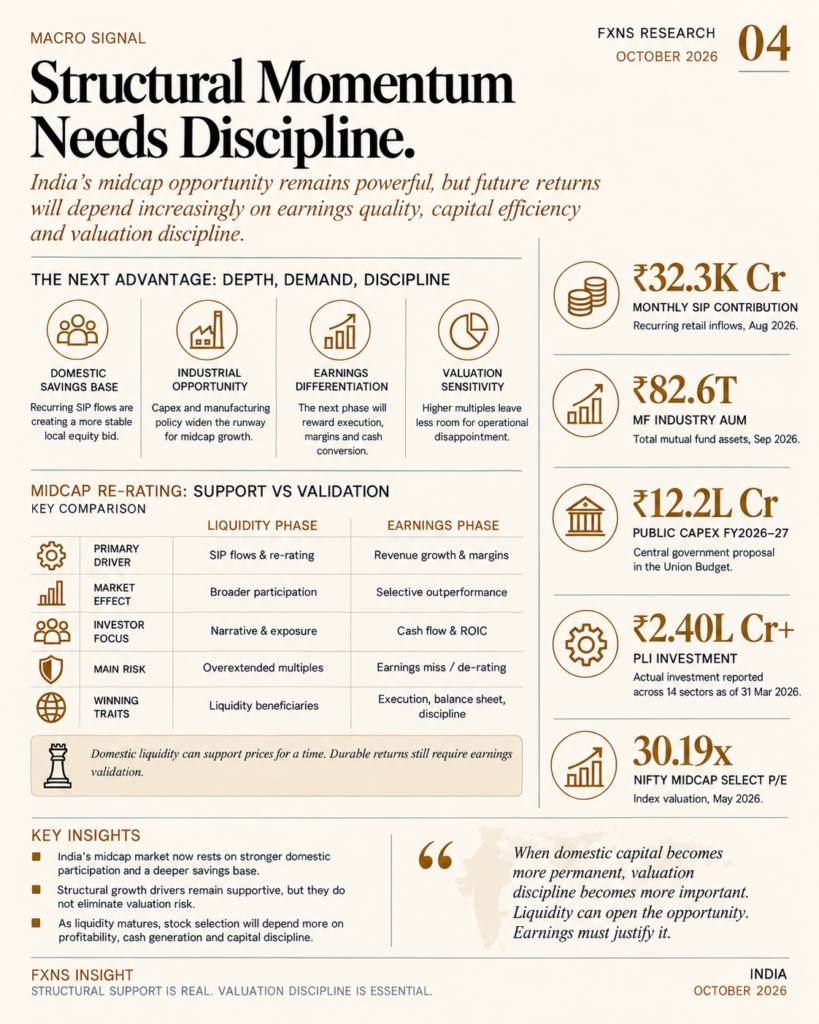
India's domestic investment revolution is changing the structure of equity demand, but it cannot change the mathematics of valuation. As liquidity becomes more persistent, the decisive variable shifts from who is buying equities to how much economic value those companies can generate.
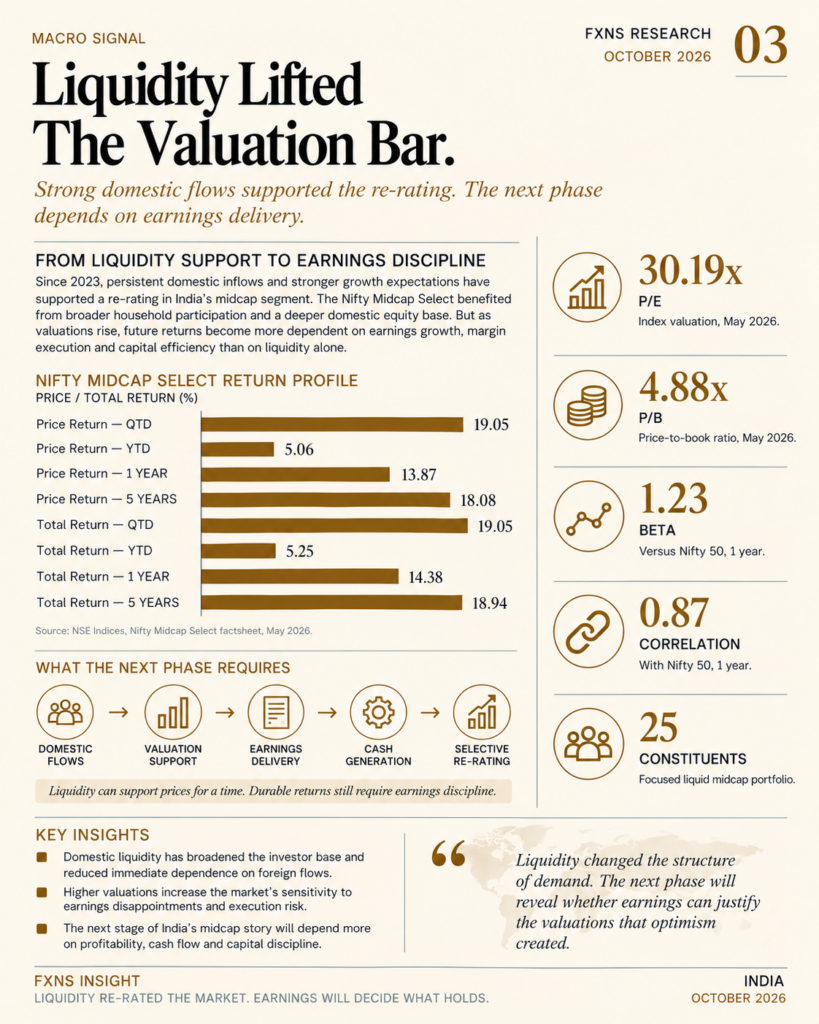
The most consequential development in India’s midcap equity market may not be the expansion of household participation itself, but the way in which persistent domestic investment flows are changing the relationship between liquidity, valuation and corporate performance. As systematic investment plans become a more established component of household financial behaviour, the market acquires a recurring source of potential demand that is less directly dependent on the allocation decisions of foreign portfolio investors. This represents an important structural improvement for India’s financial system, particularly in an emerging-market environment where international capital flows can reverse rapidly in response to changes in US interest rates, dollar liquidity, geopolitical uncertainty or global risk appetite. A broader domestic investor base can absorb part of the selling pressure generated by external withdrawals, support secondary-market activity and encourage a more diversified ownership structure across listed companies. However, the resulting stability is conditional rather than absolute. Mutual fund subscriptions do not necessarily translate into proportional purchases of midcap equities, and recurring investment contributions do not prevent investors from redeeming fund holdings during periods of financial stress. More importantly, a persistent source of capital can influence the price investors are willing to pay for future earnings without necessarily improving those earnings themselves. This creates a subtle but increasingly significant valuation challenge. When domestic liquidity expands alongside credible structural growth opportunities, higher equity prices can initially reflect both improving fundamentals and a reassessment of long-term business prospects. Yet as valuation multiples rise, a growing proportion of expected future success becomes embedded in current market prices. The margin for disappointment consequently narrows, even when the broader economic environment remains favourable. This distinction is especially important for the Nifty Midcap Select, whose concentrated 25-stock composition introduces company-specific and sector-concentration risks in addition to those associated with the wider midcap universe. The benchmark’s exposure to financial services, capital goods, healthcare and other domestically relevant industries creates multiple channels through which India’s economic expansion can influence profitability, but these channels respond to different operating conditions. Industrial companies may benefit from stronger order books while facing execution delays, rising input costs or working-capital pressures. Financial businesses may capture opportunities from credit expansion and increasing financial participation, yet remain exposed to changes in funding costs, asset quality and regulatory requirements. Healthcare and technology-oriented companies can access expanding markets while confronting competitive pressures, pricing constraints and sustained requirements for reinvestment. The result is an increasingly differentiated earnings landscape in which broad economic momentum does not guarantee uniform shareholder returns. A further second-order effect emerges through corporate financing decisions. Elevated equity valuations can reduce the effective cost of raising new capital, enabling companies to finance expansion, strengthen balance sheets or pursue strategic acquisitions on more favourable terms. When this capital is deployed productively, financial-market optimism can reinforce real economic growth, creating a constructive feedback loop between household savings, corporate investment and future earnings. But the same mechanism can become destabilising if abundant capital encourages excessive capacity expansion, acquisitions at inflated prices or projects whose expected returns fail to compensate for their risks. Higher valuations may therefore improve access to financing while simultaneously raising the probability of inefficient capital allocation. This is why the next phase of India’s midcap development should be assessed through measures of economic profitability rather than market performance alone. Revenue growth, operating margins, cash conversion, return on invested capital, balance-sheet resilience and the quality of earnings revisions will become increasingly important in distinguishing durable businesses from those primarily benefiting from favourable liquidity conditions. The transition need not imply a broad reversal in Indian midcap equities. Structural investment opportunities can remain substantial, domestic participation can continue to expand, and individual companies can still deliver exceptional long-term growth. Nevertheless, the distribution of future returns may become less uniform as valuation premiums encounter the realities of corporate execution. Even strong earnings growth can produce disappointing investment outcomes when the initial purchase price already discounts a more optimistic trajectory, while companies trading at more reasonable valuations may offer attractive returns through consistent profitability and disciplined reinvestment. The central transformation is therefore not simply the emergence of India as a deeper, more domestically financed equity market. It is the gradual movement toward a market in which persistent liquidity provides the foundation for participation, but the capacity to convert economic opportunity into sustainable free cash flow determines which valuations can endure.
“Liquidity can elevate valuations, but only earnings can sustain them. India's next midcap chapter will be defined not by the capital entering the market, but by the economic value companies create.”
FXNS RESEARCH