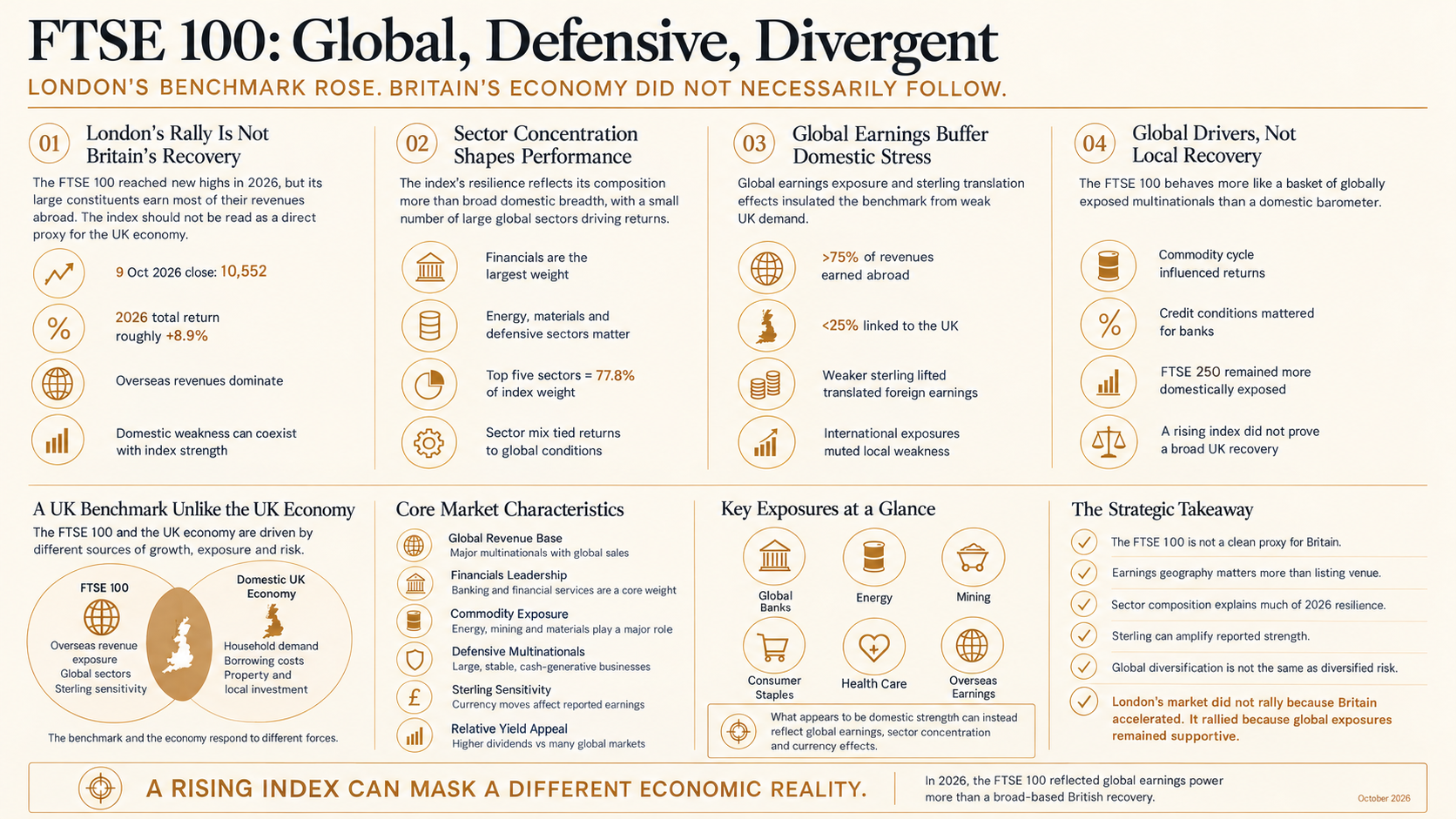

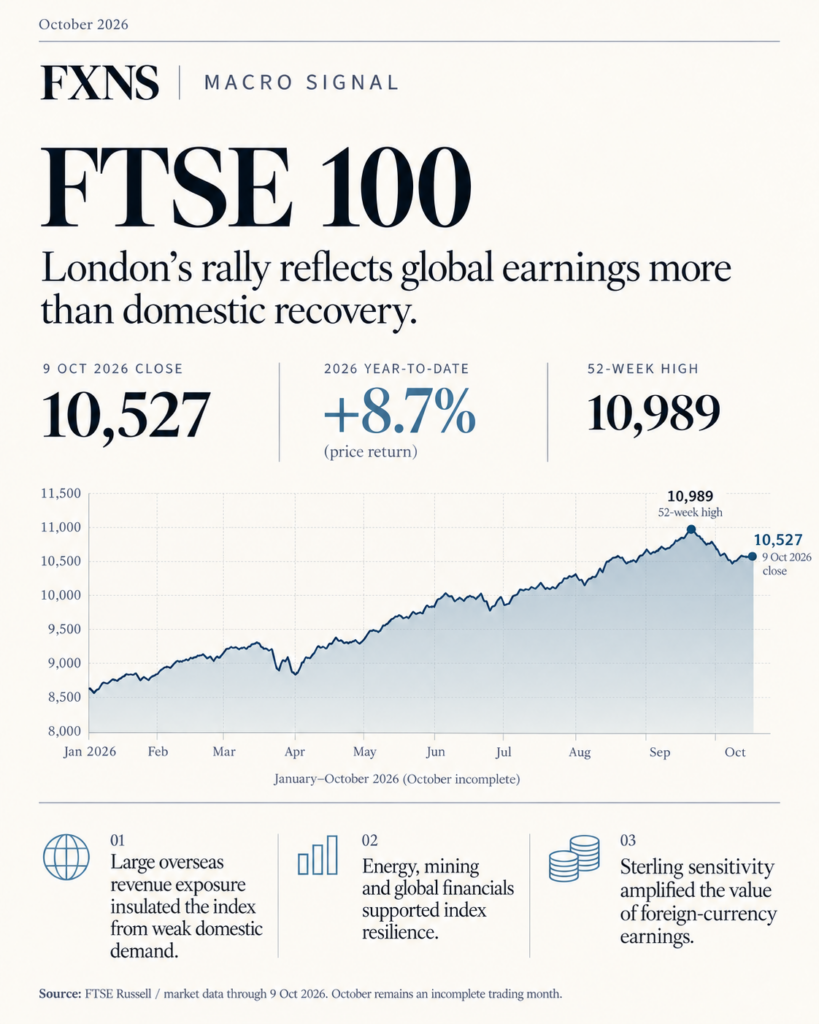
During the first ten months of 2026, the FTSE 100 has reinforced a fundamental distinction between the performance of British equities and the condition of the British economy. Reaching new highs and closing at 10,552 points on October 9, London’s benchmark has demonstrated resilience against persistent inflationary pressures, elevated borrowing costs and renewed geopolitical uncertainty. Yet much of this strength reflects the international earnings exposure, sector composition and capital allocation strategies of its largest constituents rather than a broad acceleration in domestic economic activity. The index increasingly represents a portfolio of globally diversified businesses whose valuations respond to forces extending well beyond the United Kingdom’s borders.
The FTSE 100 is increasingly a measure of global corporate resilience, not domestic economic strength.
This divergence exposes a structural feature of London’s equity market. Energy producers, multinational banks, mining groups and internationally active consumer businesses derive substantial portions of their revenues from overseas markets, creating earnings streams that can remain resilient even as domestic conditions deteriorate. Currency movements further complicate the relationship: sterling depreciation can increase the reported value of foreign-currency profits, while higher commodity prices may benefit major index constituents even as they intensify inflationary pressures on British households and businesses. The result is a market in which rising equity valuations and domestic economic fragility can coexist. Understanding the FTSE 100 in 2026 therefore requires looking beyond its headline performance to examine what is driving returns, where corporate earnings originate and which economic risks remain concealed beneath the index’s apparent strength.
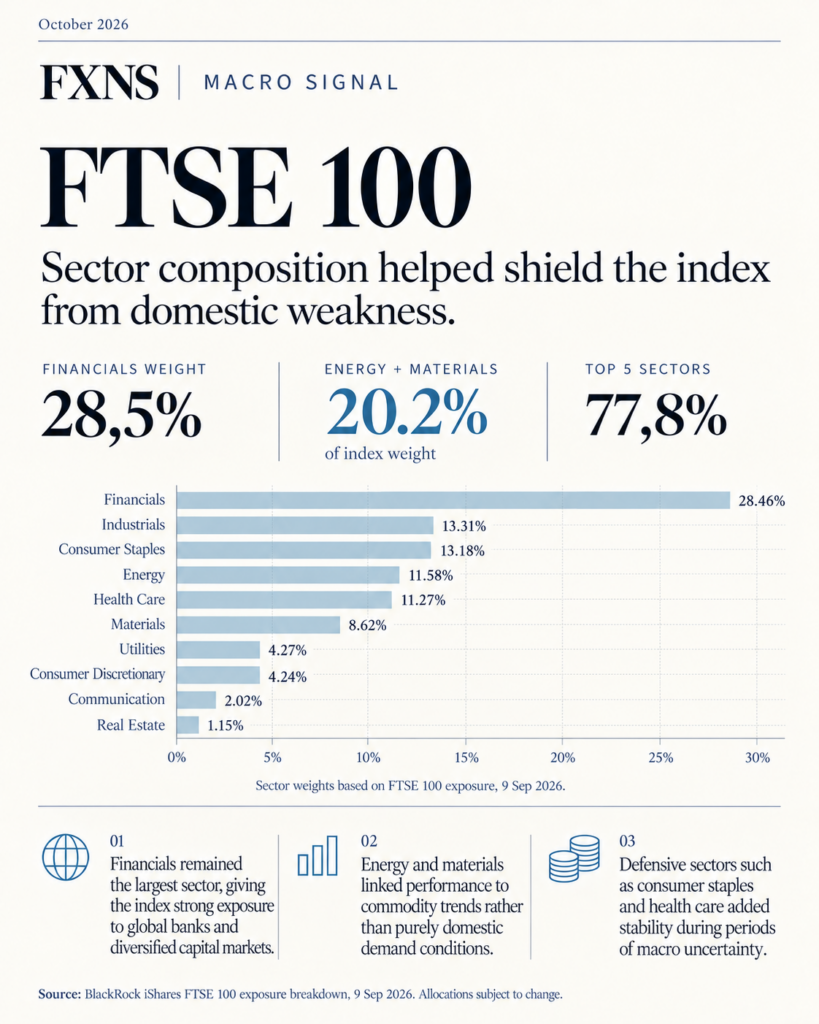
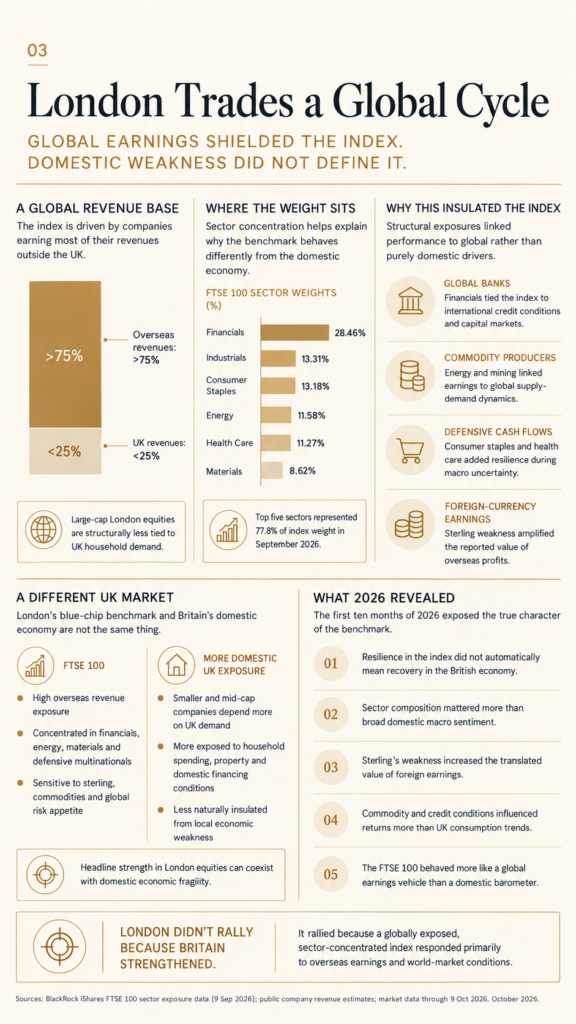
The composition of the FTSE 100 provides the clearest explanation for its ability to outperform the underlying British economy. Financial companies accounted for approximately 28.5% of index exposure in September 2026, while energy and basic materials together represented another 20.2%. This concentration creates a distinctive sensitivity to global credit conditions, commodity markets and international capital flows. Multinational banks can benefit from diversified lending operations and interest income, while energy and mining groups respond primarily to worldwide supply-demand dynamics rather than domestic consumption. Meanwhile, established consumer staples and healthcare companies provide relatively defensive earnings characteristics, supported by geographically diversified operations. Consequently, the index’s performance is shaped less by the economic circumstances of the average British household than by the profitability and valuation of a comparatively small group of globally exposed corporations.
The FTSE 100's resilience is not evidence of economic breadth, but a consequence of where its earnings and exposures are concentrated.
This structural concentration also introduces vulnerabilities that headline index levels can obscure. A benchmark heavily exposed to financials and internationally traded commodities may remain resilient during periods of domestic stagnation, yet become more sensitive to shifts in global risk appetite, credit conditions, energy prices and Chinese industrial demand. Changes in sterling add a further transmission channel: currency depreciation can increase the reported sterling value of overseas earnings, but the eventual effect on equity valuations depends on corporate costs, hedging arrangements and investor expectations. At the same time, domestic-facing businesses—particularly smaller retailers, property companies and firms dependent on British household expenditure—may experience conditions that differ substantially from those reflected in the FTSE 100. The distinction is therefore not simply between a strong stock market and a weak economy. It is between two different sets of economic exposures, operating within the same national financial system but responding to fundamentally different drivers.
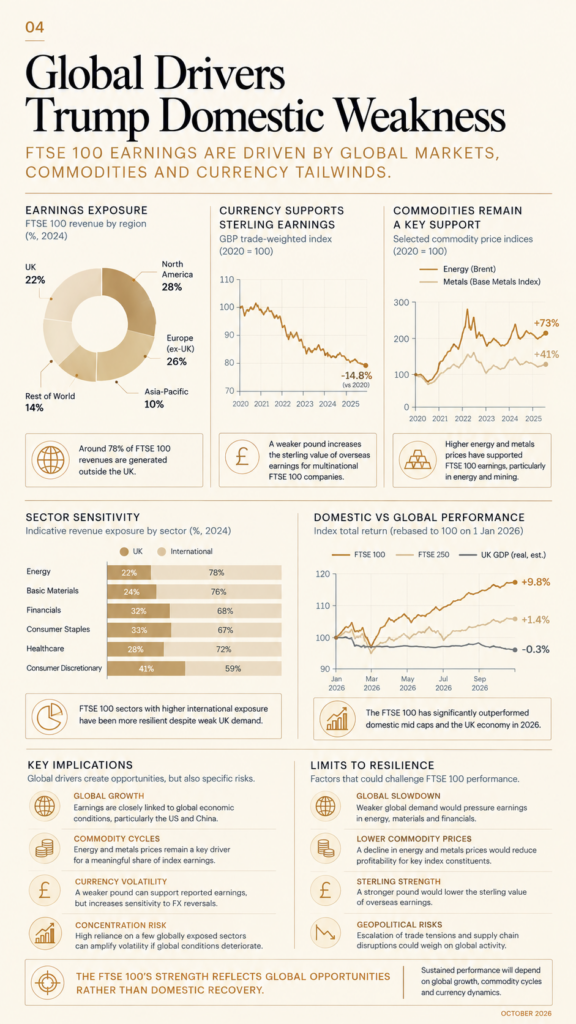
The greater risk is not that London's market has become disconnected from Britain, but that its apparent resilience conceals a different set of global vulnerabilities.
The FTSE 100’s performance through October 9, 2026, reveals a second-order consequence of the growing separation between national equity benchmarks and their domestic economies: the transmission of risk increasingly follows corporate revenue geography and sector exposure rather than the location of a stock exchange. For internationally diversified British-listed companies, changes in global financing conditions, commodity demand and foreign-exchange markets can exert a greater influence on earnings expectations than developments in domestic consumption or investment. This creates an asymmetric relationship between the index and the United Kingdom’s economic outlook. Sterling depreciation may provide a translation benefit to foreign-currency earnings, but a subsequent recovery in the pound could reverse part of that advantage without any deterioration in underlying business activity. Similarly, elevated energy and commodity prices may support the profitability of major producers while simultaneously increasing operating costs, sustaining inflationary pressures and weakening purchasing power elsewhere in the British economy. Financial institutions introduce another layer of complexity: higher interest rates can support certain lending margins, yet rising funding costs, deteriorating credit quality and repricing across sovereign bond markets may eventually offset those benefits. These interactions mean that the same macroeconomic development can strengthen one component of the FTSE 100 while undermining another, making aggregate index performance an increasingly imperfect measure of economic resilience. The implications extend to international capital allocation. Investors seeking diversification away from technology-heavy equity markets may find London’s sector composition attractive, particularly during periods of commodity strength or renewed interest in established dividend-paying businesses. However, this diversification is not equivalent to protection from systemic risk. Concentration in globally sensitive industries exposes the benchmark to shifts in international liquidity, geopolitical disruptions and changes in the profitability of multinational corporations. Nor does a rising index necessarily indicate a broad revival of the United Kingdom’s domestic capital market, where smaller companies remain more directly exposed to household demand, borrowing costs and local investment conditions. The critical distinction, therefore, is between diversification of earnings geography and diversification of economic risk. The FTSE 100 possesses the former, but its concentration in financials, energy, materials and defensive multinationals leaves it exposed to a relatively specific combination of global forces. Its strength during 2026 should consequently be interpreted not as evidence that Britain has escaped its structural economic constraints, but as an illustration of how the internationalisation of corporate earnings can alter the relationship between market valuations, national economic performance and the underlying distribution of financial risk.
“A rising market does not always reflect a strengthening economy. Sometimes, it reveals how far corporate prosperity has moved beyond national borders.”
FXNS RESEARCH